
Best 8-Channel Line Mixers for Small Venues and Studios
Answer: An 8-channel line mixer is ideal for small venues, home studios, and rehearsal spaces that need to blend multiple audio sources into a clean, balanced mix. This guide highlights top 8-channel options, showing who each product is best for and why it stands out. The top picks cover live bars, studio setups, and portable rigs, helping buyers decide based on input types, routing flexibility, and noise performance.
| Product | Best For | Key Benefit |
|---|---|---|
| Moukey 8-Channel Ultra | Small clubs, keyboards, drums | Low-noise, flexible mono/stereo input options |
| Pyle PMAX8 | Content creators, live streams | Ultra-low noise with Bluetooth & USB-C interface |
| LZSIG LMIX3 | Home studios, multi-source routing | Ultra-low noise with wide source compatibility |
| Rockville LINE8 | Multi-mound performances, podcasts | USB-C recording, high headroom |
| BOMGE 8-Channel | Portable gigs, karaoke | DSP effects, USB/Bluetooth inputs |
Moukey Audio Mixer, 8 Channel Ultra-Compact

The Moukey 8-channel mixer is designed for small-stage or sub-mix setups. It divides input paths into stereo and mono modes, using 1/4-inch connectors. This model runs on a DC 5V power supply, enabling flexible placement away from mains noise. It is best for small clubs or practice spaces where multiple keyboards, guitars, or drum triggers must be blended into a single output. Audience or performer concerns include cable management and external power supply stability.
- Best for: Small clubs or bars with multiple instrument inputs
- Better for: Quick setup in compact spaces
- Limitations: Requires external DC 5V supply and suitable TRS/TS cables (not included)
Pyle 8-Channel Bluetooth Mini Line Mixer

The Pyle PMAX8 is a compact 8-channel mixer featuring mono/stereo switching, a built-in USB-C sound card, and Bluetooth connectivity. This makes it suitable for content creators who need wireless streaming and straightforward USB audio output for recording or streaming. It is better for home studios and mobile setups where wireless playback and USB interfaces simplify workflows. Caution: Bluetooth can introduce latency if used for live monitoring.
- Best for: Content creators and streamers needing USB-C audio
- Better for: Wireless playback and plug-and-play recording
- Limitations: Latency considerations with Bluetooth in live monitoring
LZSIG Mini Audio Mixer, 8-Channel

The LZSIG LMIX3 is designed for home studios with eight inputs and a versatile mono/stereo switching option. It supports a wide range of sources including PCs, smartphones, DJ mixers, and gaming consoles, and emphasizes ultra-low noise performance via a dedicated power management chip and ROHM op-amps. It’s best for users needing a compact, reliable mixer for multi-source routing without sacrificing signal integrity. Caution: Ensure compatible 3.5mm or 1/4″ cables for all connections to avoid extra adapters.
- Best for: Home studios needing reliable multi-source routing
- Better for: Clean, distortion-free output with many input sources
- Limitations: Requires exact cable types for full compatibility
Rockville LINE8 USB 8-Channel Mixer
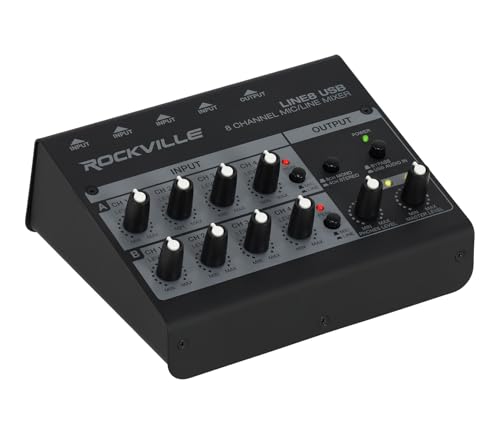
The Rockville LINE8 provides eight input channels with a USB-C recording interface, making it suitable for multi-mic setups and multi-instrument performances. It features a low-noise design with a wide frequency response and low THD+N, suitable for live streams, podcasts, and stage monitoring. It’s best for users who need direct computer recording without extra interfaces. Caution: Higher channel counts can require careful gain staging to avoid distortion on loud sources.
- Best for: Live performances and multi-mic arrangements
- Better for: Direct USB-C recording without extra equipment
- Limitations: Requires mindful gain staging with loud inputs
BOMGE 8 Channel Mini Audio Mixer

The BOMGE 8-channel mixer combines six mono inputs plus a stereo/USB/Bluetooth input, offering 48V phantom power for mics and flexible input/output options. It includes a DSP effects processor with 24 FX presets, allowing short, in-room enhancements for performances or karaoke events. This model suits portable gigs where built-in effects and versatile input routing help simplify setup. Caution: Built-in DSP may not replace dedicated outboard effects for critical productions.
- Best for: Portable gigs needing DSP effects
- Better for: Quick setup with a mix of mics and instruments
- Limitations: DSP effects are preset-based and not a replacement for high-end processors
Buying Guide: 8-Channel Line Mixers for Real-World Use
What should I prioritize in an 8-channel line mixer?
Focus on input type flexibility, noise performance, and routing options. Look for mono/stereo switching, USB or Bluetooth interfaces if recording or streaming is needed, and whether 1/4″ or 3.5mm sources are supported without adapters.
Which features matter most for live venues?
Low-noise preamps, clear gain structure, and reliable phantom power when using condensers are essential. A user-friendly layout with accessible level and pan controls helps quickly balance multiple performers. USB-C recording or direct streaming can simplify setup at a bar or small club.
What are common limitations to expect?
Be aware of potential latency with Bluetooth inputs, the need for external power supplies for some models, and compatibility issues with certain cable configurations. Some compact models may require external mixers or interfaces for full studio-grade workflows.
How to choose between mono vs. stereo configurations?
Mono mode is useful when summing inputs for a single output, such as a simple PA mix. Stereo mode preserves channel separation for more complex stages or DJ setups. For multi-instrument bands, stereo can help maintain spatial balance.
What about compatibility with other gear?
Verify that the mixer supports your common cables: 1/4″ TRS, TS, and 3.5mm plugs. If you rely on USB or Bluetooth, ensure your devices pair reliably and that drivers or USB devices are compatible with your computer or audio interface.
What’s the best pick for a portable, all-in-one setup?
Consider a compact mixer with USB-C recording and Bluetooth, such as the Pyle PMAX8, or BOMGE with USB/Bluetooth input and built-in DSP. These options reduce the number of external devices while maintaining flexible input routing.
Quick comparison: key specs to note
- Number of inputs: All models in this guide offer 8 inputs, with some supporting mono/stereo switching per channel.
- Output options: Master outputs typically include 1/4″ jacks and USB-C for recording; Bluetooth is available on select models.
- Power: Some models use DC 5V adapters; others rely on USB power. Confirm power compatibility with your setup.
FAQ
- Q: Do these mixers require professional installation?
A: No. Most are plug-and-play with basic cables and a power source. - Q: Can I record directly to a computer?
A: Yes, some models include USB-C recording interfaces; others may require an external audio interface. - Q: Is Bluetooth stable for live performance?
A: Bluetooth offers wireless convenience but may introduce latency; use wired inputs for critical monitoring. - Q: What cables do I need?
A: Generally 1/4″ TRS for stereo inputs/outputs and 1/4″ TS for mono paths; some models support 3.5mm plugs. - Q: Which mixer is best for a small band setup?
A: A model with robust preamps, clear EQ, and good headroom, such as Rockville LINE8 or LZSIG LMIX3, handles multiple sources well. - Q: Do these units include built-in effects?
A: Only BOMGE includes a DSP effects processor among the listed options; others rely on external effects or outboard gear.