
Best 8 Channel Mixer Amplifier Options for Clear Live Sound
Looking for an 8-channel mixer amplifier that fits your venue, studio, or home setup? This guide highlights five reliable models that balance power, connectivity, and sound control. Each pick targets a specific use case—from small rooms and podcasts to live performances—so you can choose the best fit for your needs. Below, compare what each product brings to the table and who should consider it. A quick summary table follows to help you scan the key details at a glance.
| Product | Best For | Key Benefit |
|---|---|---|
| Rockville RPM80BT | Home studio to small venues | 8 XLR/TRS inputs, Bluetooth, 500W RMS |
| Mackie Mix8 | Compact studio or stage gigs | High headroom, low noise, phantom power |
| Rockville RPM870 | Live performances with USB/Bluetooth | 6 mic preamps, USB/Bluetooth, up to 3000W peak |
| Kaschun 8-Channel | Broadcast, podcasts, small studios | 8 inputs, Bluetooth/USB, 48V phantom |
| Pyle PMXU83BT.5 | DJ setups and streaming | 8 channels, Bluetooth, USB audio, FX |
Rockville RPM80BT Powered 8-Channel Mixer/Amplifier

The Rockville RPM80BT is a powered 8-channel mixer/amplifier with Bluetooth and a robust 500W RMS output. It offers 8 XLR/8 1/4″ TRS inputs, RCA AUX, USB, plus amplified speaker outputs. A 5-band master EQ and per-channel bass/treble/reverb provide flexible tone shaping for vocal or instrument channels. This model is best for small venues or home studios that need reliable power and wired/wireless connectivity. Limitation: detailed feature specs rely on model-specific menus; users should verify compatibility with their speakers before pairing.
Mackie Mix Series Mix8 8-Channel Mixer

The Mackie Mix8 delivers high-headroom, low-noise performance in a compact 8-channel chassis. It features 2 mic/line inputs with phantom power for studio condensers plus 2 stereo 1/4″ line inputs. This makes it ideal for compact studios, podcast setups, or small stage monitors where clean gain and straightforward controls matter. Caution: limited built-in effects; complex live chains may require external processing for richer sound shaping.
Rockville RPM870 8-Channel 6000W Powered Mixer
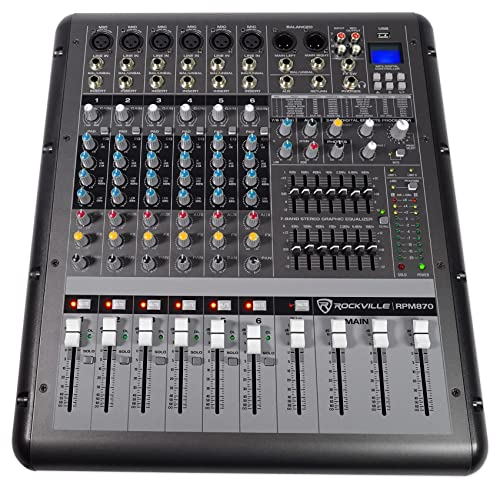
The RPM870 provides a powerful 750W x 2 RMS at 4 ohms and 500W x 2 at 8 ohms, with up to 3000W program/peak. It includes USB, Bluetooth, RCA inputs/outputs, and a PFL monitoring option. Best for small to mid-size live setups requiring robust power and flexible routing. Limitation: higher power can require careful speaker matching to avoid distortion or overheating in smaller rooms.
Kaschun 8-Channel Audio Mixer with Bluetooth

The Kaschun mixer features 8 XLR/1/4″ inputs, Bluetooth 5.0, USB audio, and +48V phantom power across channels. Independent high/mid/low EQ per channel supports precise vocal and instrument shaping, with built-in delay and reverb for added depth. It suits small bands, recording, or podcast studios. Caution: some users may experience a steeper setup curve for new users due to comprehensive channel controls.
Mixers Audio 8 Channel Power Mixer with DSP Reverbs

This MAD OWL model provides 8-channel power with 300W per two channels, plus 16 DSP reverbs. It supports USB/BT compatibility, 8 input channels, and 2-channel power amplification suitable for DJ setups or small venues. Best for users who want built-in DSP effects and straightforward USB/Bluetooth streaming. Limitation: the data suggests versatile DSPs but does not confirm certification or external effect compatibility with certain brands.
Rockville RPM85 8-Channel Powered Mixer

The RPM85 offers 8 channels with Bluetooth and USB/SD playback, delivering powerful performance for small venues. It features 300W x 2 RMS at 4 ohms and supports user-friendly tone control with a 5-band EQ and delay/echo effects to enhance performances. Choose this if you need integrated playback options alongside live mixing. Caution: ensure your venue’s speaker impedance matches the amplifier’s rating to prevent load issues.
Buying Guide
What will you mainly use the mixer for?
Identify whether your needs are for home practice, a podcast setup, a small live venue, or a DJing scenario. This determines the importance of power output, input types, and onboard effects.
Power and speaker compatibility
Check the RMS power rating and the impedance of your speakers. Mismatched power or impedance can cause distortion or damage. For small rooms, 300–500W per channel is often sufficient; for larger venues, look for higher wattage or multiple amplification channels.
Inputs and connectivity
Consider the types of inputs you require: XLR for microphones, 1/4″ TRS, RCA, USB, Bluetooth. If you plan to record or stream, ensure USB audio interfacing is reliable and features are easy to use.
Built-in effects and EQ
Onboard EQ per channel helps shape vocals and instruments. Built-in reverb or delay can add space to performances but may not substitute external processors in complex setups.
Portability vs. flexibility
Compact mixers are easier to transport but may offer fewer features. Larger units deliver more routing options and power, suitable for fixed install setups or frequent gigs.
Reliability and future-proofing
Look for models with solid preamps, stable Bluetooth/USB interfaces, and reputable brands. Plan for future needs, such as additional inputs or better integration with speakers and recording gear.
FAQ
- What is an 8-channel mixer amplifier? A device that mixes up to eight input channels and amplifies audio to drive speakers, often combining both mixer and amplifier functionality in one unit.
- Do I need phantom power? If you plan to use condenser microphones, phantom power (+48V) is necessary. Dynamic mics do not require it.
- Is Bluetooth on mixers reliable for live sound? Bluetooth is convenient for playback or streaming but may introduce latency or interference in busy venues. Use wired sources for critical live input.
- Should I choose a powered or passive mixer? A powered (active) mixer includes built-in amplification, reducing extra equipment. A passive mixer requires a separate amplifier or powered speakers.
- Can I use these for recording? Yes, many models include USB audio interfaces or USB/SD playback, enabling direct recording to a computer or storage device.
- What should I consider when choosing an 8-channel mixer? Power needs, input types, onboard effects, compatibility with your speakers, portability, and future expansion potential.