
Best 8 Mic Input Audio Interface Options for Home Studios
Looking for an 8-mic input audio interface that delivers clear preamps, low latency, and solid I/O for a home or project studio? This guide highlights five strong choices that cover ADAT expandability, USB-C connectivity, and professional-grade mic preamps. Each option is evaluated for who it suits best, from beginners needing simple setups to expanding studios requiring multi-mic configurations. Below is a quick table of the five products to help you compare at a glance.
| Product | Inputs | Outputs | Best For |
|---|---|---|---|
| Behringer ADA8200 | 8 XLR/1/4″ mic/line | 8 ADAT outputs | Budget multi-mic expansion |
| Fender Quantum LT 16 | 16-in | 8-out | Hybrid studios needing many line inputs |
| Focusrite Scarlett Solo 4th Gen | 1 mic + 1 instrument | 2 line | Best for solo singers/guitarists |
| Focusrite Scarlett 18i16 4th Gen | ≥8 mic/line | ≥16 | |
| Tascam US-16×08 | 16 inputs | 8 outputs | Compact multi-input for larger sessions |
| Audient EVO 8 | 1 instrument input | — | Compact 8-channel capability with smart features |
Behringer ADA8200 Audiophile 8 In/8 Out ADAT Interface

The Behringer ADA8200 provides eight front-line microphone preamps and eight ADAT digital outputs, making it a strong expansion option for users with an existing audio interface. This model is best for project studios that need to add more preamps to a compact system while preserving overall signal quality. The ADA8200 uses Midas-designed preamps to deliver clean, dependable gain for multiple vocalists or instrument mics. A key limitation is that it relies on ADAT for expansion, so you’ll need a compatible main interface with ADAT input to harness all eight channels.
Who it’s best for: Producers expanding an existing setup on a budget, or small studios that already own an audio interface with ADAT input.
Why chosen: It’s a cost-effective way to add eight preamps and maintain high headroom, without sacrificing the clarity that Midas preamps can offer in busy sessions.
Limitations to note: No built-in USB-C or standalone monitoring; you must pair it with a compatible interface that supports ADAT.
Fender Quantum LT 16 | Hybrid USB-C Audio Interface

The Fender Quantum LT 16 offers a flexible 16-input, 8-output USB-C configuration designed for hybrid studios. It includes eight MAX-HD mic preamps and a total of fourteen line inputs, enabling easy integration of outboard gear, synths, and multi-mic ensembles. This model is best for musicians who want a single box to handle multiple recording tasks, along with a suite of Fender Amp & FX features via the Fender Studio app. A potential limitation is that the expanded software benefits require account setup and app usage to access full functionality.
Who it’s best for: Musicians and small bands needing numerous inputs and integrated processing options in one interface.
Why chosen: Its broad I/O and low-latency performance make it a versatile hub for tracking drums, ensembles, and layered instruments in one session.
Limitations to note: The software integration requires account setup and may be more than some solo producers need.
Focusrite Scarlett Solo 3rd Gen USB-C Audio Interface

The Scarlett Solo 3rd Gen is a compact, studio-grade interface ideal for solo artists and small setups. It features two instrument-ready inputs, high-headroom mic preamps, and Air mode for brighter vocal and guitar recordings. Although it provides limited 8-channel capability in practice, it remains a go-to for those prioritizing ease of use, portability, and high-quality converters up to 24-bit/192kHz. It’s best for solo vocalists, guitarists, and podcasters who do not need many mic inputs simultaneously.
Who it’s best for: Singer-songwriters and hobbyists seeking a simple, high-fidelity interface for a single mic plus instrument input.
Why chosen: Combines compact form with flagship-quality Focusrite converters and a familiar workflow that reduces setup time.
Limitations to note: Not ideal for multi-mic drum or ensemble tracking due to the limited number of mic inputs.
Tascam US-16×08 Rackmount USB Audio Interface
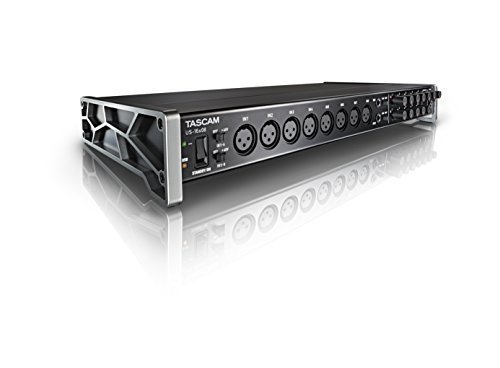
The Tascam US-16×08 combines 16 mic/line inputs with eight outputs in a rackmount design, supporting larger sessions while maintaining straightforward control software. Eight Ultra-HDDA microphone preamps deliver clear gain up to 56dB, with two additional line inputs switchable to instrument level for direct guitar or bass recording. This choice is best for studios that need a robust multi-channel interface with convenient rack-mount form and expandability, without stepping up to PCIe or Firewire. A limitation is that its software ecosystem is less modern than some USB-C-only rivals.
Who it’s best for: Home studios expanding to accommodate drum kits, live tracking, or multi-instrument sessions in a fixed rack layout.
Why chosen: Reliable multi-channel preamps and a versatile I/O matrix support varied recording scenarios efficiently.
Focusrite Scarlett 18i16 4th Gen USB-C

The Scarlett 18i16 4th Gen brings substantial I/O with 18 inputs and 16 outputs, including four mic preamps, Hi-Z inputs, ADAT, S/PDIF, and MIDI I/O. It offers 24-bit/192kHz converters with up to 69dB of gain for flexible recording across a wide range of sources. This is a strong all-around choice for semi-professional studios that require a single, expandable USB-C interface with high-fidelity conversion and robust routing options. The complexity of setup may be more than needed for very small solo projects.
Who it’s best for: Producers and small studios needing many inputs and a scalable, high-quality interface for simultaneous multi-track recording.
Why chosen: Strong preamps, broad I/O, and modern USB-C connectivity make it a versatile hub for evolving recording needs.
Focusrite Scarlett Solo 4th Gen USB-C

The Scarlett Solo 4th Gen remains a staple for solo creators seeking studio-grade sound in a compact package. It offers a single mic preamp and one instrument input with improved Air mode to elevate vocal and guitar tracks. It provides the high-quality 24-bit/192kHz conversion that Focusrite users expect, making it a reliable choice for straightforward recording workflows. Best for: individual singers, podcasters, or musicians who prioritize simplicity and high-quality results over multi-channel capability.
Who it’s best for: Songwriters or solo performers needing dependable, high-fidelity recordings with minimal setup.
Why chosen: The latest generation improves vocal presence and guitar tones with Air mode, while maintaining a familiar, streamlined workflow.
Buying Guide: 8-Channel I/O For Your Setup
- What’s your core need? If you primarily track drums or ensembles, favor interfaces with eight or more mic preamps in a single box or expandability via ADAT.
- Connectivity matters For future-proofing, USB-C and USB-C-equipped interfaces provide broad compatibility and lower latency on modern computers.
- Expandability vs. simplicity Decide between a compact unit with many built-in inputs and a modular approach (like an 8-channel preamp unit paired with a separate main interface).
- Mic preamp quality Look for well-regarded preamps with enough gain and low noise for diverse microphones, especially dynamic and condenser mics of varying impedance.
- Software ecosystem Some brands pair with companion apps or plugin packs; consider whether these add real value to your workflow.
- Dynamics and routing Check for flexible routing options (ADAT, S/PDIF, MIDI) to handle complex sessions or live-to-disk workflows.
Frequently Asked Questions
- What is the advantage of ADAT expansion? It lets you add multi-channel preamps without crowding your main interface’s inputs, ideal for growing drum setups or choir recordings.
- Is USB-C always better than USB-B? USB-C generally offers lower latency and wider compatibility on newer devices; check your computer’s ports and driver support.
- How many mics can I record at once? It depends on the interface. Look for models with eight or more mic preamps for multi-mic sessions, or plan for expansion.
- What should I consider for podcasting? Prioritize quiet mic preamps, stable drivers, and simple routing with direct monitoring to avoid latency during live recording.
- Do I need a high sample rate? 192kHz offers high fidelity for critical recordings, but 96kHz is often sufficient and easier on CPU resources for many projects.
- Are built-in effects important? Some interfaces include software bundles or amp sims; evaluate whether these features align with your workflow.