Best 8 Ohm Mini Speakers for Small Projects and Diy Electronics
Choosing compact, reliable 8 ohm mini speakers is essential for DIY projects, Raspberry Pi projects, Arduino experiments, and small advertising displays. This guide highlights top 5 compact 8 ohm speakers, focusing on practical power, compatibility, and ease of integration. Each option is evaluated for sound quality, durability, and compatibility with common microcontroller and single-board computer platforms. Use the buying guide at the end to compare form factors, voltages, and installation considerations across multiple perspectives.
| Product | Brand | Impedance | Power | Link |
|---|---|---|---|---|
| Dweii 4 PCS 3W 8Ω Mini Speaker | DWEII | 8 Ω | 3 W | Amazon |
| 4PCS 5W 8Ω Double Cavity Mini Speaker | DWEII | 8 Ω | 5 W | Amazon |
| 6Pcs 8Ω 2W Round 28mm Speaker | Shutao | 8 Ω | 2 W | Amazon |
| Dweii 4PCS 3W 8Ω Single Cavity Mini Speaker | DWEII | 8 Ω | 3 W | Amazon |
| Weewooday 6 Pcs 2W 8Ω Small Speakers | Weewooday | 8 Ω | 2 W | Amazon |
DWEII 4 Pcs 3W 8Ω Mini Speaker

The DWEII 4-piece set features an 8-ohm impedance with a 3-watt rated power, designed for compact electronic projects and Arduino interfaces. The rectangle housing and non-paper diaphragm combine to deliver stable performance and clear audio in tight spaces. With options for JST-PH2.0 interfaces, these mini speakers support easy integration into small displays, control panels, and hobby electronics setups. The dual impedance approach (mentioning 4 ohms and 8 ohms in specs) allows flexibility in low- and mid-power configurations, particularly useful in educational kits and DIY advertising machines. The internal magnet design helps sustain consistent output over extended use.
Key considerations include matching the voltage to your board’s output (often 3.3V or 5V systems) and ensuring a suitable enclosure to maximize bass response in a small form factor. The compact size aids installation in desktop displays, handheld devices, and compact automotive dashboards. For hobbyists, these are a practical option for quick prototypes and school projects where space is at a premium.
DWEII 4PCS 5W 8Ω Mini Speaker
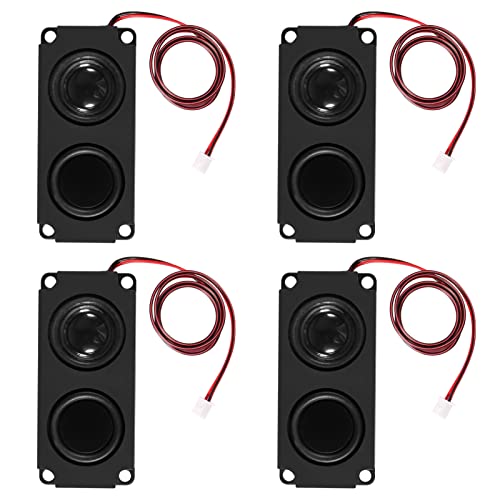
This 4-pack from DWEII expands to 5W per speaker with an 8-ohm impedance, offering greater output for modules like advertising machines, LCD monitors, and project kiosks. The product supports 3.3V or 5V operation via JST-PH2.5mm-2 pin terminals, making it a flexible option for Arduino, Raspberry Pi, or microcontroller projects that demand more audible presence. The full-frequency cavity design aims to deliver a broad range of audio signals, and the larger 100 mm by 45 mm footprint provides a stable mount in mid-sized enclosures. It is described as suitable for various digital devices and display panels.
When planning usage, consider heat dissipation in longer sessions and the potential need for a small amplifier for higher volumes. The provided interface and dimensions suit compact advertising players and DIY audio projects that require a stronger audio signal without demanding a larger speaker footprint.
Shutao 6Pcs 8Ω 2W Round 28mm Speakers

Shutao offers a set of six 8-ohm, 2-watt round speakers with a 28mm diameter, designed for quick DIY repairs, toy projects, and portable devices. The compact size and internal magnet structure facilitate simple mounting in small enclosures or replacement in existing audio modules. At 2W, output is modest but adequate for toys, MP3 players, and compact multimedia devices. The 8-ohm impedance aligns with common microcontroller audio shields and simple amplifier circuits, enabling straightforward integration. These are best suited for low-volume, space-constrained applications where multiple units may be deployed for stereo or array configurations.
Practical considerations include ensuring a stable power supply and proper mechanical mounting to avoid audible vibration. The 28mm footprint makes these ideal for embedded projects where space is constrained but multi-speaker configurations are desired for wider sound coverage in kiosks or educational devices.
Dweii 4PCS 3W 8Ω Single Cavity Mini Speaker

This single-cavity variant by DWEII provides 3W of output with 8-ohm impedance in a compact package, ideal for portable advertising machines and small control panels. The 3.3V or 5V compatibility via JST-PH2.0 or similar terminals makes it adaptable for Arduino and Raspberry Pi projects. It emphasizes a stable internal magnetic design and a tight seal to protect the diaphragm, ensuring reliable performance across various environmental conditions. The 31x28x15 mm footprint suits thin enclosures and compact panels, enabling easy integration into devices where space is at a premium.
When selecting this speaker, assess enclosure volume and the desired sound level. Pairing with a small amplifier or DAC can improve perceived loudness for advertising displays, while keeping power consumption reasonable for battery-powered devices. This model offers a balance of size and output suitable for micro-projects requiring a discrete audio module.
Weewooday 6 Pcs 2W 8Ω Small Speakers

This set from Weewooday provides six 8-ohm, 2W micro speakers with a metal shell and an internal magnet design. The 1.1-inch diameter keeps size minimal while delivering adequate audio for toys, mini displays, and multimedia devices. The metal shell offers durability in educational kits or field demos and helps reduce unwanted resonance when mounted with proper isolation. These are particularly suitable for projects that require multiple identical speakers, enabling synchronized audio output or multi-channel configurations without excessive footprint.
Key considerations include mechanical mounting options, voltage compatibility with microcontrollers, and the potential need for damping material inside enclosures to minimize vibration. For small projects or starter kits, these speakers provide a practical balance of size, quantity, and performance.
DWEII 4 Pcs 1W 8Ω Mini Speaker

These 1W mini speakers from DWEII deliver compact 8-ohm performance suitable for small electronics projects and Arduino-based experiments. The JST-PH1.25mm-2 pin interface supports straightforward wiring to microcontrollers. The design emphasizes durability, lightweight form, and compatibility with general-purpose communication modules and advertising machines. The compact dimensions and sealed construction enable consistent sound output in tight enclosures and portable devices. They’re well-suited for educational kits, DIY sounders, and small interactive displays where a modest audio presence is required without crowding the space.
When integrating these speakers, verify voltage supply limits and ensure proper thermal management in longer sessions. A small audio amplifier or DAC can significantly improve audio clarity and volume without increasing the overall system size. These speakers are a practical option for compact projects and demonstrations that demand reliable, repeatable performance.
Buying Guide: Key Purchase Considerations For 8 Ohm Mini Speakers
- Impedance and power: An 8 ohm speaker is common for microcontroller projects. Match the impedance with your amplifier or audio driver and consider watts to determine usable loudness in your enclosure.
- Voltage compatibility: Many microcontrollers operate at 3.3V or 5V. Look for speakers with JST-PH terminals or similar interfaces that align with your board’s voltage and pinout.
- Size and enclosure: Mini speakers vary from around 20–40 mm in diameter. Choose a size that fits your project’s housing while allowing adequate air volume for sound.
- Sound quality vs. durability: Metal shells and internal magnets improve durability and resonance control. If your device experiences vibration, consider mounting hardware and damping materials to minimize distortion.
- Application context: For DIY toys and educational kits, prioritize small size and multiple units for stereo or multi-channel effects. For advertising machines, prioritize higher wattage and broader frequency response.
- Compatibility and wiring: Check terminal types (JST-PH variants, 2-pin) and ensure you have compatible cables or connectors. Plan for simple solder-free connections when possible.
- Power management: Higher wattage can require more robust power sources and, in portable devices, efficient amplification. Balance output needs with battery life and heat dissipation.
- Availability and sourcing: A mix of brands (DWEII, Shutao, Weewooday, Adafruit) offers options across price ranges. Consider bundled sets for projects requiring multiple identical speakers.
- Replacement and repairs: Standard sizes and impedances ease the process of replacing failed units in vintage or patched devices.
Across these options, the best choice depends on the project scope—whether you need a compact, lightweight component for prototypes, or a more robust module for display kiosks and interactive installations. For learners and hobbyists, starting with small sets helps test compatibility with microcontrollers and amplifiers before scaling up to larger arrangements or multi-speaker systems. Proper enclosure design and testing remain essential to achieving clear, consistent audio output in any compact application.