
Best AC Adapters for Guitar Pedals
Answer: Choose a dedicated 9V DC power supply with adequate current, low noise, and compatible plug polarity for your guitar pedals. This guide profiles top options and explains who each adapter fits best, helping you power a pedalboard reliably on stage or in the studio. The selections below target common pedalboard setups—from compact boards to larger rigs requiring multiple pedals.
The following table highlights the five best-suited adapters for guitar pedals, based on current needs and compatibility. Use this quick reference to compare key specs at a glance.
| Product | Current (A) | Voltage | Polarity | Notes |
|---|---|---|---|---|
| JOYO DC 9V 1.2A Power Supply | 1.2 | 9V | Negative center | 5-way daisy chain; higher current for multiple pedals |
| D’Addario PW-CT-9V DC Power Adapter | 0.8 | 9V | Center negative | Trusted brand; reliable for standard boards |
| WUKUR 9V Power Supply | Not specified | 9V | Center negative | Long cable, compatible with Boss PSAs |
| Donner DPA-1 9V DC 1A | 1 | 9V | Center negative | 5-way daisy chain; stable, versatile for keyboards or pedals |
| Pigtone 9V 1A Power Supply | 1 | 9V | Center negative | Supports up to 8 pedals with daisy chain |
JOYO DC 9V 1.2A Power Supply
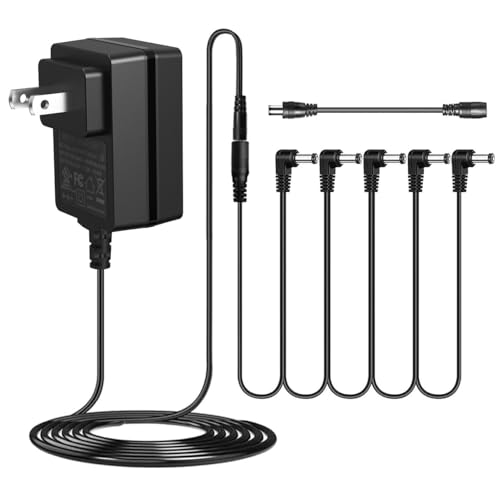
The JOYO 9V 1.2A power supply delivers 9V DC at up to 1.2A with a negative-center polarity. It includes a 5-way daisy chain and a dedicated reverse polarity cable, enabling multiple pedals from a single source. Best for mid-sized pedalboards needing extra current headroom and simpler cable routing. This adapter suits players who run several compact effects and want reliable power without batteries.
Who it’s best for: guitarists with moderate pedal loads that require more current per chain and straightforward daisy chaining. Why selected: higher current rating supports more pedals concurrently, reducing voltage drops. Caution: ensure your pedals’ total draw stays within 1.2A to avoid overheating or instability.
D’Addario PW-CT-9V DC Power Adapter
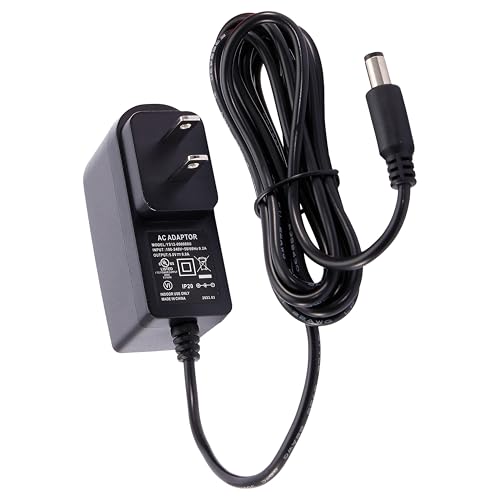
The D’Addario PW-CT-9V DC Power Adapter provides a dependable 9V supply designed to keep pedals powered without changing batteries. It is versatile for typical pedalboards and can power devices requiring 9V DC. This option is well-suited for players prioritizing brand reliability and a straightforward setup that minimizes battery changes on stage.
Who it’s best for: players who want a stable, battery-free power source using a trusted guitar-brand adapter. Why selected: reduces the risk of battery failures mid-performance. Caution: capacity is oriented toward standard pedal loads; check total draw to avoid shortfalls on larger boards.
WUKUR 9V Power Supply

The WUKUR 9V pedal power supply emphasizes a quiet, stable 9V output compatible with many Boss PSA-style inputs. It ships with a long 5.9-foot cable for easier wiring around larger pedalboards. This option is ideal for players who want a dedicated pedalboard supply that helps maintain consistent tone across multiple effects.
Who it’s best for: board setups that require neat routing and compatibility with Boss-style 9V inputs. Why selected: long power cord enhances cable management. Caution: verify compatibility with every pedal’s input jack since some older units use different power formats.
Replacement for 9V Guitar Pedal Power Supply

This WUKUR unit offers 9V DC at 1A with center-negative polarity and a long dual-length cable setup suitable for powering two or more pedals in tandem. It includes multiple protection features to guard against short circuits and over voltages. It’s a strong choice for compact to mid-sized pedalboards needing reliable multi-pedal power with noise-conscious design.
Who it’s best for: players powering multiple effects with one supply. Why selected: the 1A current and long daisy-chain compatibility suit compact to medium boards. Caution: ensure the total current draw stays within the rated supply to avoid voltage sag.
Donner DPA-1 9V DC 1A Power Supply
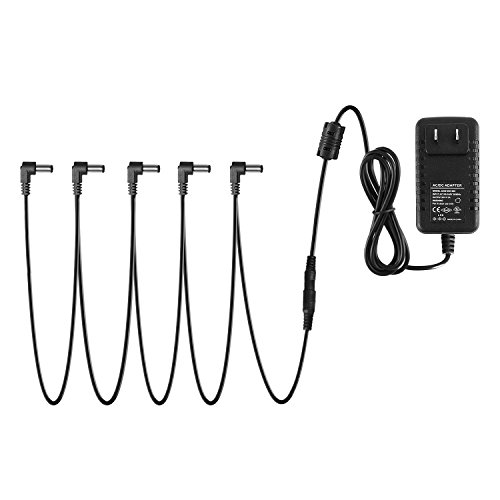
The Donner DPA-1 provides 9V DC at 1A with a 5-way daisy chain, plus a compact design suitable for boards that require multiple pedals. It emphasizes stable power and a simple setup for diverse rigs, including keyboards and guitar pedals. It’s a practical choice when you need one adapter to drive several pedals without battery changes.
Who it’s best for: users needing a reliable multi-pedal supply with straightforward cabling. Why selected: balanced current and chain capability, aiding clean transitions between effects. Caution: check that the included daisy chain matches the number of pedals you intend to power.
Pigtone 9V 1A Power Supply

The Pigtone 9V 1A supply offers 9V DC at 1A with center-negative polarity and a 5.5×2.1mm plug. It supports up to eight pedals when paired with a daisy chain, making it a strong option for larger boards or future expansion. It’s designed to deliver solid power with a practical daisy-chain approach.
Who it’s best for: players growing into larger pedalboards or needing a scalable solution. Why selected: high daisy-chain capacity for multiple pedals. Caution: ensure chain compatibility with your specific pedal models to avoid underpowered units.
Buying Guide: Key Considerations For Guitar Pedal Power
- Current capacity: Match the total current draw of your pedals to the adapter’s maximum output. Overloading can cause sag or noise.
- Polarity and plug size: Most pedals use center-negative 5.5×2.1mm jacks. Verify polarity and connector dimensions before purchasing.
- Daisy-chain vs. isolated outputs: Daisy chains save cables but can introduce noise or hum on sensitive pedals. Isolated outputs reduce noise by separating pedal grounds.
- Noise reduction: Look for power supplies with noise suppression and filtering to maintain signal integrity, especially on noise-sensitive delays and modulation pedals.
- Build quality and safety: Ensure over-current, over-voltage, short-circuit, and thermal protections are present for safe, long-term operation.
- Cable length and routing: Longer cords aid stage setup but can create clutter. Plan cable management to prevent tangling and interference.
- Compatibility: If you own Boss, DOD, or Casio gear, verify compatibility with your device’s power input and required current.
Frequently Asked Questions
- What is the difference between daisy-chain and isolated outputs?
– Daisy-chain power provides multiple outputs from a single supply but can introduce noise if pedals share grounds. Isolated outputs reduce noise by separating grounds, at the cost of more cables. - Do I need more than 9V for my pedals?
– Most guitar pedals run on 9V DC. Some require different voltages or higher current; check each pedal’s power specification before purchase. - Can I power keyboards or MIDI controllers with guitar pedal adapters?
– Some adapters are compatible with keyboards or MIDI devices, but verify voltage, current, and connector standards to avoid damage. - Is a higher current rating always better?
– Not necessarily. A supply must meet or exceed the combined pedal draw. Excess current does not harm pedals but can be unnecessary expense. - What should I consider for on-stage use?
– Choose adapters with stable regulation, noise filtering, and robust cables. Long cables improve routing, but manage them to prevent interference. - Are there any safety certifications to look for?
– Certifications like CE, FCC, and RoHS indicate compliance with safety and environmental standards, which is advantageous for reliability.