
Best Acoustic Guitar Effects Box: Top Picks for Studio and Stage
Looking for the right acoustic guitar effects box to shape tone on stage or in the studio? This guide highlights five standout options that balance analog warmth with digital versatility. Each pick targets a different player profile—from live performers needing reliable DI and feedback control to home studio users seeking deep customization. The list below helps identify who benefits most from each pedal, with clear pros, limitations, and a practical buying approach.
Buyer’s quick reference:
| Product | Best For | Why It Stands Out |
|---|---|---|
| SONICAKE Acoustic Guitar Effects Pedal with Analog Preamp | Live performers needing XLR output | Analog preamp, digital reverb, notch filter, mute, and high-impedance input |
| SONICAKE Acoustic Pedal Guitar Effect | All-in-one gig-ready solution | Main effects, warm acoustic amp emulation, XLR output |
| MOOER GE100 | Custom sound designers with large preset libraries | 80 presets, 66 effects, 8 pedal controls |
| Caline CP-40 DI-Box | High clarity DI with anti-feedback | True bypass, anti-feedback |
| LEKATO Multi Effects | IR loading and versatile tones on the go | 9 amp models, 8 IRs, Bluetooth, recording features |
SONICAKE Acoustic Guitar Effects Pedal with Analog Preamp

This pedal targets players who want a compact, stage-ready solution with strong signal integrity. The analog preamp drives a digital reverb, offering a classic warmth paired with modern space. A built-in notch filter helps eliminate feedback or whistling, while a mute with gain and frequency range adjustment allows precise vocal and guitar balance. The high impedance input and XLR balanced output make it ideal for direct-to-PA setups or recording. Best for solo performers or small ensembles needing reliable DI and robust tone shaping in one box.
Who it’s best for: Acoustic players performing live who rely on clear DI output and quick feedback control. The integrated notch filter and mute feature are practical for on-stage scenarios with varying venues.
Limitations: Balance between analog warmth and digital reverb may not satisfy players seeking deep modulation or a large pedalboard alternative in purely studio contexts.
SONICAKE Acoustic Pedal Guitar Effect

This all-in-one acoustic pedal is designed as a one-stop gig solution. It features an analog preamp with a built-in two-band EQ to recreate a warm, natural acoustic guitar amplifier feel. The pedal includes high-quality chorus, delay, and reverb, making it versatile for various performance styles—from intimate coffeehouse sets to small venues. Best for players who want a compact, complete effects suite without carrying multiple pedals.
Who it’s best for: Guitarists who need a straightforward, all-in-one effect pedal with credible acoustic tone, simple controls, and dependable XLR output for live sound.
Limitations: Might lack advanced routing options or expansive EQ beyond the two-band model for players who require deep studio-grade tone sculpting.
MOOER GE100 Multi-Effects Pedal

The GE100 is a compact workhorse for players who value extensive tone libraries. It offers 80 preset patches plus 80 user patches, with eight effect modules including 66 effect types, providing a broad Mooer sound library. The device supports six assignable expression pedal parameters for flexible live control and features a unique output mode to preserve tone in a direct line-out setup without an amplifier. Best for players building a diverse sonic palette onstage or in rehearsal rooms.
Who it’s best for: Musicians who want a wide array of effects with easy navigation and robust live-editing capabilities. If you need a large library and quick access, this is a solid choice.
Limitations: The array of options can be overwhelming; setting up patches may require time to program for specific gigs.
Caline CP-40 DI-Box for Acoustic Guitar
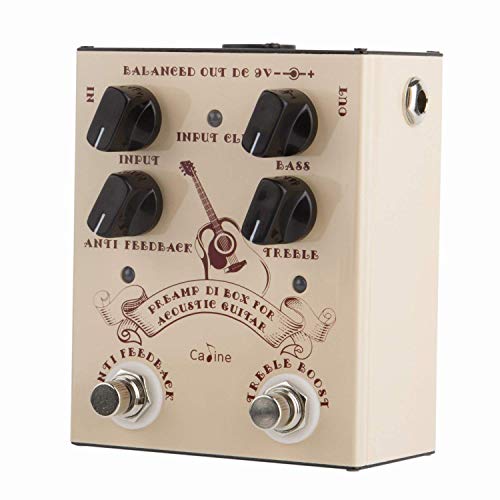
The CP-40 focuses on transparent DI performance for acoustic guitars. New product highlights include true bypass and an anti-feedback foot switch, which helps keep stage noise low and tone intact when your signal runs through the sound system. This DI box is well-suited for players who need clean signal separation and minimal coloration when connecting directly to PA systems or recording interfaces. Best for gigging players who require reliable DI with practical anti-feedback tooling.
Who it’s best for: Players prioritizing clean, stage-friendly DI performance and ease of use in different live environments.
Limitations: Lacks built-in effects beyond DI capabilities, so users needing comprehensive tone-shaping may pair it with other pedals.
LEKATO Multi Effects Pedal for Acoustic Guitar

LEKATO offers a versatile multi-effects pedal with 9 amp models and 8 IR cabinet simulations. It supports IR loading or deletion and includes Bluetooth 5.0 for quick presets and recording. The unit also supports USB-based software updates via Cube-Suite, enabling deeper customization. This pedal is best for players who want recording-ready tones, flexible IR loading, and on-the-go editing with wireless connectivity.
Who it’s best for: Acoustic players who value amp simulation variety, IR-loaded tones, and convenient software control for studio and stage use.
Limitations: Software setup and third-party IR management may require a computer or manual to maximize the device’s potential.
Buying Guide
Key considerations to help you pick the right acoustic guitar effects box:
- Output and connectivity: Do you need XLR balanced output for direct-to-PA or a standard 1/4 inch guitar line? DI boxes and pedals with XLR output simplify on-stage connections.
- Tone shaping vs. convenience: Are you seeking deep EQ and amp/cab models, or a compact, all-in-one pedal for quick setups? Consider whether you need IR loading and third-party IR compatibility.
- Presets and memory: How important is it to store and recall tones during gigs? Pedals with user patches offer rapid switching between sounds.
- Feedback control: For acoustic guitars, how critical is notch filtering and anti-feedback features? These tools can save a performance in challenging rooms.
- Power and portability: Do you prefer battery power for on-the-go recording, or a mains-powered unit for stable rehearsal setups?
- Software integration: If you record, would you benefit from USB or Bluetooth connectivity to import/export presets or third-party IR files?
- Live vs. studio use: Are you prioritizing stage reliability with minimal tone coloration, or studio-friendly tones with more room to sculpt?
FAQ
- What is an acoustic guitar effects box best for? It provides tone shaping, amp emulation, and DI outputs suitable for live performance or recording.
- Should I choose an all-in-one pedal or individual pedals? All-in-one pedals are convenient for simpler setups; individual pedals offer deeper tone control and expandability.
- What does IR loading mean? It refers to impulse responses that simulate speaker cabinets; loading allows you to recreate classic mic’ed cab tones.
- Is XLR output important for acoustic players? Yes, it simplifies direct connection to mixers, ensuring a balanced, low-noise signal.
- Do these devices require software for full control? Some do; software can enable deeper editing, preset management, and IR file handling.
- Can these units replace a full pedalboard? Many can cover essential needs, but advanced multi-effects users may still opt for dedicated pedals in certain cases.