
Find compact, powerful bass solutions for home theater, music production, and whole-house audio with in-wall active and passive subwoofers. Below is a quick comparison table of the most relevant models reviewed in this guide to help you scan core specs and features at a glance.
| Product | Driver | Power / Type | Notable Feature |
|---|---|---|---|
| OSD Trimless SL800D | Dual 8″ + 10″ passive radiator | 300W (requires amp) | Trimless magnetic grille, sealed enclosure |
| Monoprice Fiber In-Wall (Caliber) | 10″ Aramid fiber | 300W peak (requires amp) | Shallow install, paintable grill |
| Monoprice Carbon Fiber (Alpha) | 10″ Carbon fiber | 300W (requires amp) | Carbon fiber driver for low distortion |
| OSD Nero IWSDUAL8 | Dual 8″ graphite cones | 300W (requires amp) | Trimless magnetic grille, compact depth |
| PreSonus Eris Sub 8BT | 8″ woven-composite woofer | 100W active, Bluetooth | Powered sub with wireless input |
OSD Trimless In Wall Subwoofer Dual 8″ Woofers SL800

The SL800D Is Built For In-Wall Installation And Uses A Combination Of An 8″ Polypropylene Woofer And A 10″ Passive Radiator To Extend Low Frequency Output. The Sealed Enclosure Design Focuses On Controlled Bass And Reduced Vibration, While The Trimless Magnetic Grille Creates A Low-Profile, Paintable Finish.
- Power Handling: 300W (requires external amplifier)
- Design: Sealed in-wall enclosure with passive radiator for enhanced LF
- Use Case: Home theater systems that need hidden, tight bass without bulky cabinets
Monoprice Fiber In-Wall 10 Inch Subwoofer Caliber
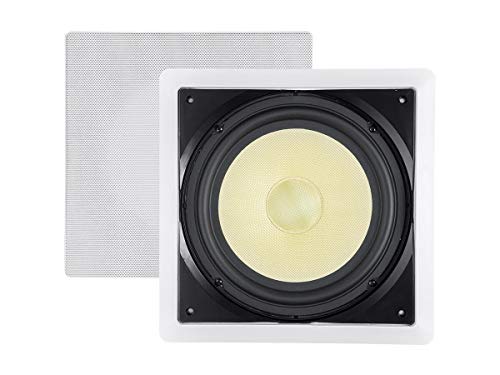
The Caliber Series Uses An Aramid Fiber Driver To Maintain Cone Integrity Under High Power And Reduce Distortion. The Unit Is Designed For Typical Wall Cavity Depths And Ships With Installation Guidance, And A Paintable Grill For A Seamless Look.
- Installation: Requires ~3.6″ of wall space behind the mounting surface
- Driver Material: Aramid fiber for stiffness and low distortion
- Power: 300W peak handling (matches with subwoofer amp)
Monoprice Carbon Fiber 10 Inch In-Wall Subwoofer Alpha
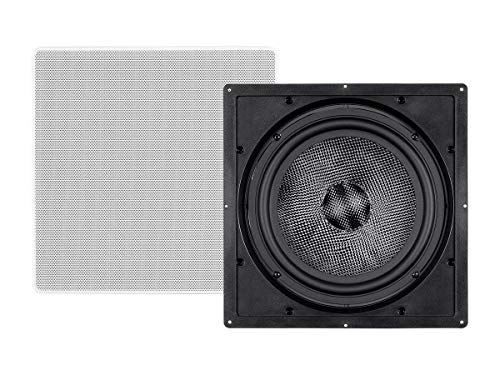
The Alpha Series Incorporates Carbon Fiber Drivers For Lower Distortion And Greater Stiffness Compared To Conventional Cones. These Subs Are Intended For Integration Into Home Theater Or Whole-House Audio, With Driver Construction Focused On Punch And Accuracy.
- Driver: Carbon fiber for tight, accurate bass
- Application: Main home theater sub or part of distributed audio
- Design Note: Best paired with a compatible amplifier or subwoofer output
OSD Nero IWSDUAL8 In-Wall 300W Dual 8″ Subwoofer

The Nero IWSDUAL8 Features Dual 8″ Graphite Cones And A Trimless Magnetic Grille That Sits Nearly Flush To The Wall. The Dual-Woofer Layout Aims To Increase Output In A Compact Mounting Depth, Making It Useful Where Wall Cavity Space Is Moderate.
- Configuration: Dual 8″ woofers for room-filling low frequencies
- Aesthetics: Paintable trimless magnetic grille
- Power: Up To 300W Handling (external amp required)
PreSonus Eris Sub 8BT — 8″ Powered Subwoofer

The PreSonus Eris Sub 8BT Is A Compact, Active Subwoofer With A Built-In 100W Amplifier And Bluetooth Wireless Input. Designed For Close-Proximity Use In Production Rooms Or Small Theaters, It Offers Front-Firing Output And A Low Extension To Around 30 Hz.
- Type: Active (powered) sub with Bluetooth input
- Power: 100W built-in amplification
- Use Case: Desktop studios, small rooms, or where a powered in-room sub is preferred over in-wall passive units
Buying Guide: Choosing The Right In-Wall Subwoofer
Selecting an in-wall subwoofer requires balancing installation constraints, desired bass character, and whether you need an active (powered) or passive unit. Below are the key considerations to evaluate.
Active Versus Passive
- Active (Powered): Includes built-in amp—simpler hookup and matched amp-sub characteristics. Good when wall depth or cabling access is limited for external amps.
- Passive: Requires an external subwoofer amplifier or powered sub output from an AVR. Offers flexibility in amplifier selection and upgrade path for larger systems.
Driver Size And Configuration
- Larger Drivers (10″ or dual 8″): Typically provide deeper extension and higher output for the same excursion, beneficial for larger rooms or home theaters.
- Dual-Woofer Designs: Can increase output while retaining shallow mounting depth, useful for limited wall cavities.
Enclosure Type And Mounting Depth
- Sealed Enclosures: Provide tight, accurate bass with less group delay—advantages for music and mixed use.
- Passive Radiators / Shallow Designs: Help extend bass in shallower cavities without increasing cone excursion or distortion.
- Measure Wall Cavity Depth: Confirm minimum behind-the-wall clearance before purchase.
Material And Cone Construction
- Aramid Or Carbon Fiber Cones: Offer stiffness and reduced distortion at high output levels.
- Polypropylene And Composite Cones: Often used where controlled, cost-effective performance is acceptable.
Power Handling And Amplification
- Match Amp To Driver Rating: Use an amplifier that complements the subwoofer’s power handling to avoid clipping and distortion.
- Headroom: Choose an amp with some headroom above the sub’s nominal rating for cleaner dynamic peaks.
Integration And Aesthetics
- Trimless / Magnetic Grilles: Create a nearly invisible install and allow painting to match decor.
- Grille Access: Removable magnetic grilles simplify cleaning and maintenance.
Room Size And Placement
- Small Rooms: A powered 8″ sub like the PreSonus Eris Sub 8BT may suffice and simplifies setup.
- Medium To Large Rooms: 10″ in-wall drivers or dual 8″ configurations provide more output and lower extension when paired with the right amplifier.
Comparison Perspectives
- Performance vs. Space: Dual 8″ or passive-radiator designs yield stronger LF in limited depth compared to single large drivers.
- Passive Flexibility vs. Active Convenience: Passive models require external amplification but allow customized system tuning; active models offer plug-and-play simplicity.
- Material Tradeoffs: Carbon and aramid fiber cones excel in low distortion and higher SPL, while polypropylene/composite cones may be more forgiving and cost-effective.
Use the above factors to match your room dimensions, installation constraints, and audio goals. Measure wall depth, decide between powered and passive subwoofers, and pair components for optimal bass integration.