
Best ADAT to USB Interface Solutions for Audio Enablement
Common buyers search for practical USB-based audio interfaces that adapt digital or analog sources for computer playback or recording. This guide picks five reliable USB-based options that suit different needs—from simple plug-and-play sound cards to more capable interfaces for home studios. Ideal buyers include casual listeners upgrading laptop audio, podcasters seeking quick setup, and hobbyists testing lightweight recording workflows.
| Product | Best For | Why It Stands Out |
|---|---|---|
| SABRENT USB External Stereo Sound Card Adapter | Basic, driverless use | Plug-and-play, no drivers, compatible across major OSes, two jacks for input/output. |
| Cubilux USB A to TOSLINK Optical Audio Adapter | Digital audio with SPDIF | Lossless digital output from USB-A devices to SPDIF systems, no external power. |
| XTUGA USB Audio Interface for PC | Home studio, quick-start recording | Dual inputs, phantom power option, low-latency, plug-and-play. |
| UGREEN USB Sound Card Adapter | Upgrade laptop sound quality | High-resolution DAC with noise reduction, driver-free. |
| Bojer AMI MDI Adapter Cable to USB Flash Drive | In-car audio/AMi integration | Lossless sound transmission for AMI/MDI systems, wide car compatibility. |
Notes: The table summarizes practical use-cases. Your actual choice depends on whether you need basic output, digital SPDIF, or in-device recording capabilities.
SABRENT USB External Stereo Sound Card Adapter

This adapter provides a straightforward, driverless solution with separate 3.5mm jacks for stereo output and mono microphone input. Best for users who want immediate sound playback and simple mic input without software fuss. It is ideal for basic listening setups, video calls, or quick experiments with audio on a laptop or desktop.
Best for: Windows, Mac, and Linux users who prefer a plug-and-play device and minimal configuration.
Caution: It does not power passive speakers or support 4-pole headsets on a single plug, and it does not create surround sound.
Cubilux USB A to TOSLINK Optical Audio Adapter

This unidirectional USB A to S/PDIF optical converter delivers high-resolution digital audio to SPDIF-equipped systems. It’s best for users with a USB-A source who want to connect to a soundbar, DAC, or home audio system without installing drivers. It supports common sampling rates up to 192kHz/24-bit for clear digital output.
Best for: Users seeking lossless digital connection from USB devices to external DACs or receivers.
Caution: Not suitable for TVs or devices that require internal digital audio processing beyond SPDIF out.
XTUGA USB Audio Interface for PC

This interface offers dual inputs with 16-Bit/48kHz resolution and switchable 48V phantom power. It’s best for budding studios or home-recording setups where condenser mics require phantom power and latency needs are a priority. The plug-and-play design minimizes setup time for PC users, enabling quick vocal or instrument capture without external power adapters.
Best for: Musicians and podcasters who need reliable low-latency recording with phantom-powered mics.
Caution: Some users may require driver checks for specific software environments; ensure compatibility with your DAW before purchase.
UGREEN USB Sound Card Adapter
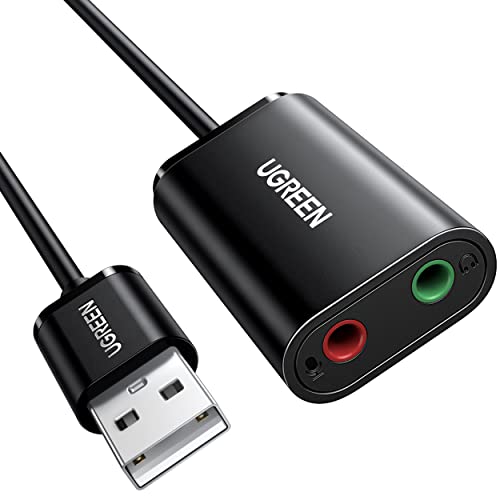
This USB sound card features a built-in high-resolution DAC and a 16-bit/48kHz output capability with improved noise reduction. It is an excellent upgrade for laptops or desktops needing better audio for gaming, media playback, or light recording. The device is driver-free, offering quick setup with a simple plug-and-play experience.
Best for: Those seeking clearer audio and reduced noise in everyday computer use without installing drivers.
Limitation: While suitable for many scenarios, it may not match the capabilities of dedicated external audio interfaces for professional studio recording.
Bojer AMI MDI Adapter Cable to USB Flash Drive

This AMI-to-USB interface is designed for in-car audio systems that use AMI/MDI or MMI sockets. It supports lossless sound for music playback via a USB flash drive. Best for car audio enthusiasts who want seamless integration with supported Audi and VW models. Do not assume compatibility with vehicles lacking an AMI/MDI socket.
Best for: Car owners with AMI or MMI-compatible interfaces seeking simplified music playback from USB storage.
Caution: Not compatible with all in-car infotainment configurations. Verify socket type before purchase.
Buying Guide
What to consider when choosing a USB audio interface
- Purpose: Do you need simple playback, a digital SPDIF connection, or a basic recording interface?
- Inputs and outputs: Number and type of jacks (stereo, mic, line, SPDIF) determine compatibility with your gear.
- Power and drivers: Driver-free devices are easiest, but some setups benefit from powered interfaces or specific drivers.
- Latency: For recording, low latency is important; confirm if the device supports zero-latency or has buffering suitable for your DAW.
- Compatibility: Ensure operating system support (Windows, macOS, Linux) and any platform-specific requirements.
- Audio quality: Look for DAC resolution (44.1kHz/48kHz common; higher rates available) and noise reduction features.
- Form factor and portability: Desktop dongle vs. compact in-car adapters; consider where you’ll use the device.
Comparison snapshot
- Best for quick setup: SABRENT USB External Stereo Sound Card Adapter — driverless, simple two-jack design.
- Best for digital systems: Cubilux USB A to TOSLINK Optical Audio Adapter — SPDIF output for digital audio chains.
- Best for home studio: XTUGA USB Audio Interface — dual inputs, phantom power, low latency.
- Best for laptop upgrade: UGREEN USB Sound Card Adapter — high-resolution DAC, driver-free.
- Best for car audio: Bojer AMI MDI Adapter Cable — AMI/MDI/MI compatibility for in-car systems.
Practical checklists
- Do you need microphone input, line output, or both? Choose accordingly from the jacks provided.
- Is external power needed or desirable for your setup? If you want maximum portability, prefer bus-powered devices.
- Will you be using a phantom-powered mic? If yes, ensure your interface supports 48V phantom power.
- Are you connecting to a digital sound system via SPDIF? Choose a USB-to-TOSLINK option like Cubilux.
FAQ
- What is ADAT, and how does it relate to USB interfaces? ADAT is a fiber-optic or electrical protocol for multi-channel digital audio. USB interfaces normally convert digital or analog audio to USB for computer use, while ADAT can be an external digital multitrack format; many consumer USB adapters do not support ADAT channels directly.
- Do these devices require drivers? Most listed items are driver-free and plug-and-play on common operating systems, but some professional setups may benefit from specific drivers.
- Can I use a USB sound card with a headset? Yes, many two-jack adapters provide stereo output and mic input suitable for headsets, though some may not support 4-pole headsets.
- Is latency a concern for casual listening? Latency is mainly a concern for recording; for listening, it’s usually negligible with modern USB interfaces.
- Will these work with gaming consoles? Some adapters are designed for PC/macOS; SPDIF adapters may work with certain consoles if compatible with the digital input.
- Can I use these for professional music production? For high-end studios, consider dedicated audio interfaces with low-latency drivers and multi-channel support.