
Best Analog Stereo Delay Pedals for Rich, Spacious Tones in 2026
The best analog stereo delay pedals deliver warm, tape-like repeats with true stereo imaging, ideal for guitars, synths, and hybrid rigs. This guide highlights five top picks that excel in warmth, headroom, and intuitive control. It’s geared toward players seeking spacious echoes, lush modulation, and reliable performance on stage or in the studio. Below you’ll find who each pedal is best for, why it stands out, and practical considerations to help you choose.
Walrus Audio Meraki Analog Stereo Delay

The Walrus Meraki uses eight MN3005 bucket brigade chips to deliver independent left and right channel delays with up to 1200ms. It offers true stereo I/O, precise control over delay time, left/right modulation, tap tempo, and extensive MIDI integration for time and modulation settings. Best for players who need deep, studio-grade stereo imaging and advanced control. Choose this if you want dual-channel precision with flexible tempo and external control, and avoid if you require compact size or simple setups.
Donner White Tape Stereo Delay Pedal

This pedal emulates classic tape echo with two independent stereo delay channels. It provides independent Time, Feedback, and Level controls per channel, delivering a spacious, natural echo with a vintage vibe. Best for players seeking classic tape-like repeats in stereo, suitable for guitar, bass, or synth setups. Better for those who want straightforward, hands-on control without digital artifacts. Caution: noise floor can be higher than modern digital delays in some settings.
Klowra Everlast Delay

The Klowra Everlast Delay offers nine stereo delay engines with up to 1200ms delay, plus analog-dry-through for a clean wet/dry mix. It emphasizes zero-latency analog signal preservation and expressive motion through presets or external controllers. Best for players who want evolving textures and reliable analog response with modern control features. Choose this if you value pure tone preservation and dynamic, evolving delay textures; avoid if you need a compact, ultra-simple unit.
FLAMMA FS22 Stereo Delay & Reverb
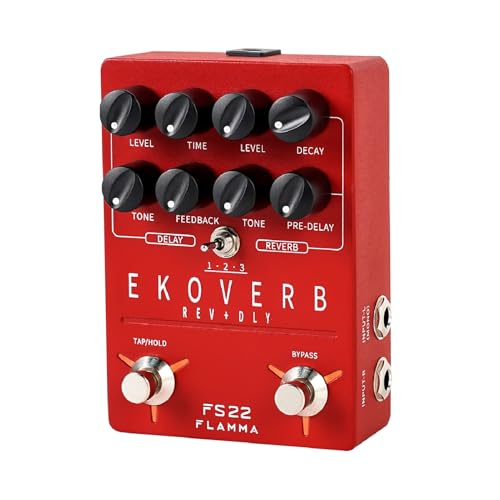
The FLAMMA FS22 combines stereo delay with reverb, offering a range of modes including Reverse Delay, Swell Reverb, and Shimmer. It features a dedicated Tap Tempo, Freeze function, and three dual-effect pairings. Best for players who want an all-in-one ambient tool with quick tempo control. Choose this if you desire integrated reverb plus delay in a compact pedal; avoid if you require separate, higher-fidelity delay and reverb controls.
MOOER D7 X2 Delay Pedal
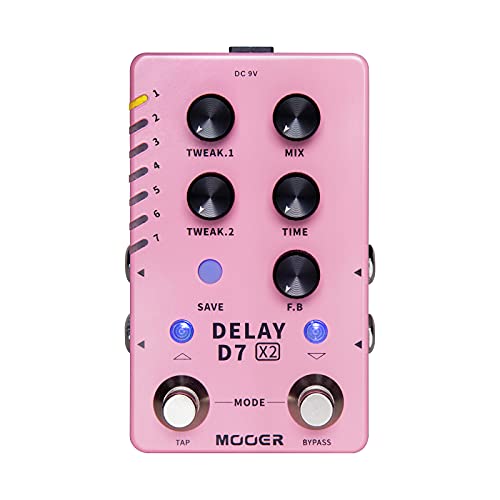
The D7 X2 provides 14 built-in stereo delay effects with a broad range from classic to experimental. It includes separate MIX, TIME, and FEEDBACK controls, plus tap-tempo, and two tweak knobs for depth of customization. Best for players who want a versatile set of stereo textures in a compact box. Choose this if you want a budget-friendly, feature-rich option; avoid if you specifically need premium analog dry-through or boutique BBD tone.
Pogolab Delay Pedal

The Pogolab Delay Pedal emphasizes analog warmth with a focused Time control and a Mix knob to blend wet and dry signals. It uses a compact, sturdy aluminum chassis and targets players who want a straightforward, musical analog delay with a clear wet-dry balance. Best for beginners or players seeking an affordable, reliable analog delay; avoid if you require extensive presets or complex routing.
Buying Guide: Key Considerations For Analog Stereo Delays
- What defines analog stereo delay? Analog delay uses bucket-brigade or analog signal paths to create warm repeats. Stereo support enables separate left and right channels for width and spatial effects.
- Delay time range: Look for pedals offering a broad range (roughly 20ms to 1200ms or more). A wider span provides short slapbacks and long echo trails for ambient textures.
- Two-channel or multi-channel control: Independent left/right controls, plus tap tempo and modulation, allow deep stereo imaging and dynamic performance.
- Dry-through and tone integrity: Analog dry-through preserves the direct signal’s warmth while mixing in wet repeats. Value this for a more transparent tone.
- Controls and usability: Simple three-knob interfaces are quick to dial in; more knobs offer deeper editing but may require more learning time.
- Power and footprint: Some pedals require isolated power to avoid noise; consider size, power supply needs, and pedalboard compatibility.
- Additional features: Tap tempo, modulation, shimmer, freeze, MIDI or expression pedal compatibility can expand your sonic palette.
Frequently Asked Questions
- What is the difference between analog and digital delay?
Analog delays use analog circuitry to create repeats, often delivering warmer, darker repeats. Digital delays use digital processing, typically offering pristine repeat quality and longer memory. - Is stereo delay worth it for guitarists?
Yes, stereo delays create a wider, more immersive soundscape, especially with stereo rigs or amp+panning setups. - Should I choose a tape-style delay or a classic analog delay?
Tape-style emulations mimic tape echo with wow and flutter, while classic analog delays provide smoother repeats; choice depends on desired texture. - Do I need MIDI or expression compatibility?
If you perform with complex timing or want hands-free control, MIDI/expressions add precision and versatility. - Can I use these pedals with bass or synths?
Many analog delay pedals support bass and synth; check input/output impedance and clean headroom to avoid tone loss. - What maintenance is required for analog delays?
Routine power checks, battery if applicable, and occasional capsule or switch cleaning help maintain reliability.