
Choosing the Right Speaker Cable affects sound quality, reliability, and installation ease. Below is a concise comparison of top speaker cable and aux options suitable for home theater, car audio, and portable speaker setups.
| Product | Type | Key Feature |
|---|---|---|
| Kinter 16-Gauge Speaker Wire (100ft) | Speaker Wire (CCA) | Flexible PVC, polarity marked |
| Amazon Basics 14-Gauge 100ft (OFC) | Speaker Wire (OFC) | 99.9% Oxygen-Free Copper |
| Install Link 14-Gauge 100ft (CCA) | Speaker Wire (CCA) | 14-gauge, double conductor, easy strip |
| GEARit 14-Gauge 100ft (CCA) | Speaker Wire (CCA) | Compatible with banana/spade connectors |
| Syncwire 3.5mm Nylon Braided Aux (3.3ft) | Aux Cable (3.5mm) | Gold-plated connectors, braided |
Kinter Cable 100ft 16-Gauge Audio Stereo Speaker Wire
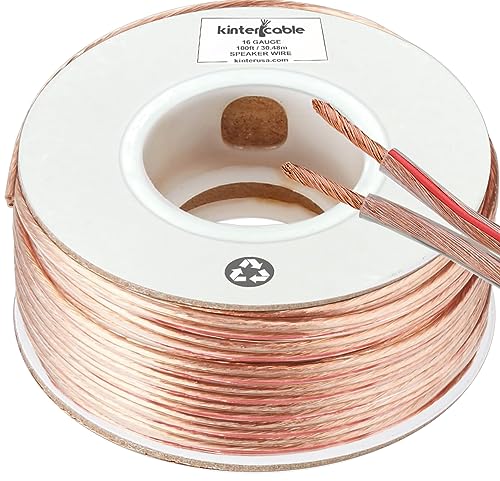
Brand: Kinter. This 100-foot 16-gauge speaker wire is built from CCA (Copper Clad Aluminum) with a soft, flexible PVC jacket. The cable features a red polarity stripe for quick identification and a high strand count for added flexibility. It is intended for home theater, HiFi, surround sound, or auto amp connections.
- Strengths: Long run length, flexible jacket, polarity marking simplifies installation.
- Considerations: CCA conductors have higher resistance than pure copper; best for standard installs where runs are moderate.
Amazon Basics 14-Gauge Audio Speaker Wire Cable – 100-foot

Brand: Amazon Basics. This 100-foot 14-gauge speaker cable is constructed from 99.9% oxygen-free copper (OFC), intended to reduce signal loss and preserve clarity. It’s suitable for connecting speakers to A/V receivers or amplifiers, especially where lower resistance and longer runs are desired.
- Strengths: OFC construction for improved conductivity and lower signal loss compared to CCA.
- Considerations: Thicker 14-gauge is beneficial for longer runs and higher power systems but is less flexible than 16-gauge.
Install Link 14 Gauge Speaker Wire (100ft)

Brand: Install Link. This 14-gauge, 100-foot cable uses a copper-clad aluminum (CCA) design with a frosted red/black jacket for polarity identification. It emphasizes flexibility, easy stripping, and suitability for home theater, car, or RV installations.
- Strengths: Good flexibility and clear polarity marking for DIY installs, better mechanical handling for routing in vehicles or tight spaces.
- Considerations: CCA trade-offs: lighter weight and lower cost but higher resistance than pure copper—consider gauge and run length carefully.
GEARit Speaker Wire 14 Gauge, 100ft

Brand: GEARit. A premium-grade 14-gauge speaker cable with CCA stranded conductors designed for custom setups. The cable is noted for compatibility with banana plugs, spade tips, and bent pin connectors, making it suitable for professional or hobbyist speaker connections.
- Strengths: Connector compatibility simplifies terminal terminations; 14-gauge supports higher power and longer runs than 16-gauge.
- Considerations: CCA remains a factor for electrical resistance—match to system power and distance for optimal performance.
Syncwire 3.5mm Nylon Braided Aux Cable (3.3ft)
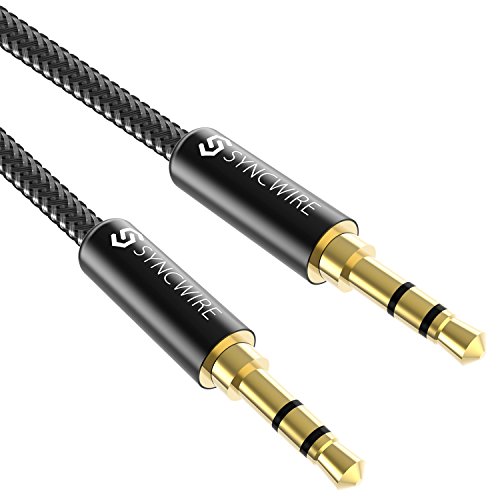
Brand: SYNCWIRE. This 3.3-foot 3.5mm male-to-male aux cable uses 24K gold-plated connectors and a nylon-braided jacket. It’s designed for portable speakers, car stereos, headphones, and devices with an aux input. The cable promotes durability and tangle resistance with a long bend lifespan.
- Strengths: Compact, durable, and minimizes connector corrosion; ideal for short-line analog connections where RCA or Bluetooth isn’t used.
- Considerations: Not a substitute for speaker-level wiring used between amps and passive speakers; intended for line-level aux connections only.
Buying Guide: How To Choose The Best Audio Cable For Speakers
Selecting the right cable depends on intended use, distance, connector type, and budget. Below are key considerations and comparison perspectives to guide purchase decisions.
Conductor Material
Oxygen-Free Copper (OFC) provides lower resistance and better conductivity, beneficial for longer runs and high-power systems. Copper-Clad Aluminum (CCA) offers cost and weight savings but increases resistance; suitable for shorter runs and budget builds.
Gauge (Thickness)
- 14-Gauge: Better for longer runs (>25 ft) or higher-power speakers. Lower resistance preserves bass response over distance.
- 16-Gauge: Common for shorter runs and smaller systems; more flexible and easier to route in tight spaces.
Run Length And System Power
Calculate total cable length from amplifier to speaker. For runs under 25 feet, 16-gauge often suffices; over 25-50 feet, prefer 14-gauge. For multi-room or high-power home theater, step up to thicker cables or OFC for minimal loss.
Connector Compatibility And Terminations
Decide if you need bare-wire, banana plugs, spade lugs, or pin connectors. Some 14-gauge cables are easier to terminate with banana or spade connectors—verify strand count and insulation for secure attachment.
Cable Jacket And Flexibility
PVC jackets are common and durable. Braided jackets add abrasion resistance for portable or in-vehicle use. Flexibility matters for routing through walls, conduits, or car panels.
Use Case: Speaker-Level vs Line-Level
Speaker wire (14–16 gauge) connects amplifiers to passive speakers. Aux cables (3.5mm) are line-level and connect source devices to powered speakers or stereo inputs—do not use a 3.5mm aux in place of speaker wire for passive speakers.
Noise, Shielding, And Connector Quality
For long analog lines or in high-EMI environments, consider shielded cables for line-level connections. For speaker wire, focus on quality terminations and minimizing exposed conductor to avoid short circuits.
Budget Versus Performance
Match cable choice to system demands. OFC and thicker gauges yield measurable improvements in resistance and power delivery, but CCA options provide acceptable performance for many consumer applications at lower cost.
Practical Tips
- Measure run lengths and add slack for routing and terminations.
- Label polarity at both ends; use marked conductors or tape for clarity.
- When transitioning to connectors, tin or use quality mechanical terminations to avoid stray strands.
- For in-wall installations, verify local building codes and use CL2/CL3-rated cable if required.