
Best Audio Interface Keyboard Controllers for Creators
If you want a compact, versatile setup that blends MIDI control with audio I/O, these five products deliver strong value for musicians, producers, and podcasters. The list covers portable USB-C and USB-A devices, premium master keyboards with built‑in audio interfaces, and easy plug‑and‑play options for mobile and desktop workflows. Best for: bedroom studios, live performers, Podcasters, and on‑the‑go producers seeking integrated input/output and tactile control.
| Product | Best For | Why It Stands Out |
|---|---|---|
| IK Multimedia iRig Keys I/O 25-keys | Mobile producers | All‑in‑one MIDI keyboard with 24-bit/96 kHz I/O |
| Focusrite Scarlett Solo 3rd Gen | Home studios | Pro preamps, low latency, 24/192 |
| Akai MPK Mini IV 25‑Key | Beat makers | 8 assignable knobs, MPC pads, compact and portable |
| PIYONE Audio Interface Q28 | Mac/PC hobbyists and students | 2×2 24‑bit/192 kHz, USB‑C, plug‑and‑play |
| Studiologic SL88 GT MK2 | Expressive players | 73 weighted keys, audio interface, DAW control |
IK Multimedia iRig Keys I/O 25-keys MIDI Controller

This compact, fully portable MIDI keyboard doubles as an audio interface, offering 24-bit/96 kHz I/O. It is ideal for musicians who need an all‑in‑one solution that works with iPhone, iPad, Mac, and PC. The 25 velocity‑sensitive keys support expressive playing, while the two user‑programmable slider strips handle pitch and modulation for live control.
Best for: traveling producers and mobile composers who want an integrated solution without carrying extra gear. The device’s compact form makes it a strong choice for small studios or on‑the‑go recording. Cautions: built‑in audio is convenient, but for high‑end studios you may want a dedicated external interface with more I/O flexibility.
Focusrite Scarlett Solo 3rd Gen USB-C Audio Interface

The Focusrite Scarlett Solo 3rd Gen delivers studio‑quality sound with high‑headroom mic preamps and an Air mode for added clarity on acoustic instruments. It includes two instrument inputs and exceptional converters that support up to 24-bit/192 kHz. This model is well suited for singers, podcast hosts, and solo producers seeking reliable, clean recordings with minimal setup.
Best for: home studios and podcasters who want professional preamps and pristine conversion. Limitation: it has a simpler two‑input setup, which may not suffice for multi‑instrument recording sessions without an additional preamp or interface.
Akai MPK Mini IV 25-Key USB-C Controller

Akai MPK Mini IV combines 25 mini keys with eight assignable knobs and RGB MPC pads, all in a compact form. It’s optimized for studio or beat production with hands‑on access to DAW functions via an intuitive LED display and encoder. This makes it an excellent choice for beat makers, producers, and touring musicians who need portable control without a bulky setup.
Best for: beat makers and programmers who want tactile control on the go. Limitation: smaller keys may be less comfortable for long studio sessions compared to full‑size keyboards.
PIYONE Audio Interface Q28 (2×2, USB‑C)

PIYONE offers a 2×2 24‑bit/192 kHz USB‑C audio interface with XLR/TRS combo inputs, ideal for Mac/PC and iOS recording. Its plug‑and‑play USB‑C port makes it a practical choice for mobile studios, podcasters, and students who need reliable bus‑powered performance without extra drivers. It combines solid audio fidelity with a compact footprint.
Best for: users seeking an affordable, driver‑free USB‑C interface for two channels. Caution: like many entry‑level interfaces, users should monitor input gain to prevent clipping in loud environments.
STUDIOLGIC SL73 MK2 Master Keyboard 73 Keys
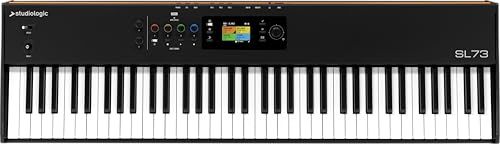
The SL73 MK2 combines a 73‑key weighted hammer action with an integrated audio interface and MIDI 2.0 capabilities. Its UX Logic color display and intuitive controls simplify parameter management, while the built‑in audio interface supports direct sound routing without extra gear. This model is best for players who value a realistic piano feel and streamlined studio workflow.
Best for: serious players and producers who need a weighted keyboard with built‑in audio I/O. Limitation: the 73 keys may be less portable than smaller controllers for traveling musicians.
Buying Guide: Key Considerations for Audio Interface Keyboard Controllers
- What are your primary use cases? If portability matters, a compact 25‑key model with built‑in audio can simplify travel. For piano feel, weighted keyboards with higher key counts are preferred.
- How many inputs do you need? Solo vocal/guitar setups may suffice with two inputs, while multi‑instrument sessions may require additional I/O or a separate interface.
- What type of connection do you use? USB‑C offers modern compatibility with newer laptops; USB‑A is widely supported. Consider power needs—bus power is convenient, but some setups benefit from external power for stability.
- Do you need DAW control? Controllers with assignable knobs, faders, and transport controls can speed up production, track grouping, and performance tasks.
- What is your budget and upgrade path? Entry‑level interfaces are great for beginners, while premium units deliver higher dynamic range and more robust preamps for long‑term growth.
FAQ
- Q: Is a built‑in audio interface on a keyboard worth it? A: For mobile setups or compact studios, an integrated I/O reduces gear, cables, and setup time.
- Q: Can I use these with iOS devices? A: Several models support iPhone/iPad via USB‑C or compatible adapters; verify compatibility on product pages.
- Q: Do these require drivers? A: Many are class‑compliant and driver‑less, especially USB‑C models, but check current driver requirements for each device.
- Q: Which is best for learning piano but still recording? A: A weighted keyboard option like the SL73 MK2 provides authentic feel for practice and robust I/O for recordings.
- Q: Can I connect external MIDI devices alongside these interfaces? A: Yes, most units offer MIDI I/O or USB MIDI to link external synths or controllers as needed.
- Q: What should I consider for future expansion? A: Look for additional USB ports, potential for multi‑channel audio interfaces, and MIDI 2.0 compatibility for future software.