
Best Audio Interface Zero Latency: Top Picks for Clear, Real-Time Recording
Zero-latency monitoring and clean, noise-free audio are essential for singers, podcasters, and music producers. This guide highlights five USB-C audio interfaces that deliver low or zero-latency monitoring and strong preamps, making them ideal for home studios and portable setups. Each pick targets a specific workflow—from solo vocal-recording to multi-input guitar rigs—so you can match the best device to your needs without overpaying. The products below are organized to help you compare input options, conversion quality, and ease of use at a glance.
Summary table of chosen products:
| Product | Best For | Key Benefit |
|---|---|---|
| Focusrite Scarlett Solo 3rd Gen | Solo vocalists and guitarists | High-quality preamps and Air mode for clarity |
| Focusrite Scarlett 2i2 4th Gen | Two-instrument setups | Auto Gain and Clip Safe for easy progress |
| Focusrite Scarlett Solo 4th Gen | Compact studio setups | Air mode and 120 dB dynamic range |
| Universal Audio Volt 1 | Studio-grade tone with UA workflow | Vintage preamp character and LUNA integration |
| M-AUDIO M-Track Solo | Budget-friendly one-mic + one-instrument | Practical monitoring and straightforward USB interface |
Focusrite Scarlett Solo 3rd Gen USB-C Audio Interface

The Focusrite Scarlett Solo 3rd Gen centers on a single high-headroom mic preamp and a dedicated instrument input. Air mode adds extra clarity to vocals and acoustic guitar, while high-performance converters support up to 24-bit/192 kHz for clean recordings. This makes the Solo 3rd Gen ideal for solo vocalists and guitarist-songwriters who want pro-sounding results in a compact package. A potential limitation is that it only offers one mic input, so larger multi-mic setups require an additional interface or a different model.
Focusrite Scarlett 2i2 4th Gen USB-C Audio Interface
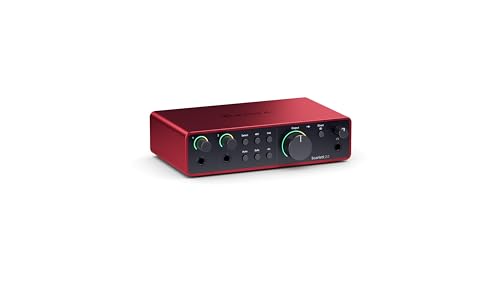
This 4th Gen model adds two mic/line/instrument inputs, making it better for small recording setups that require two sources simultaneously. It features Auto Gain and Clip Safe to help maintain optimal levels without manual tweaking. The 120 dB dynamic range and Focusrite-grade converters ensure studio-like quality for vocals or guitar. However, users should note that portability is slightly less than ultra-compact solo models due to the extra input capability.
Focusrite Scarlett Solo 4th Gen USB-C Audio Interface

The Solo 4th Gen brings a refreshed Air mode and a broader dynamic range for studio-grade results on the go. It is designed for single-mic and single-instrument setups, delivering clear vocal and guitar tones with the signature Focusrite preamps. Choose this if you want a compact, versatile unit with modern features and a familiar, reliable workflow. A limitation is the single-in, single-out configuration, which may restrict multi-source sessions without a secondary device.
PIYONE Audio Interface, 2X2 24-bit/192kHz

The PIYONE 2×2 offers USB-C connectivity with class-compliant operation, high-resolution 24-bit/192 kHz capture, and a stylish illuminated control design. It supports XLR/TRS inputs and features a one-cable setup for simplified usage. This interface is best for users who want a balance of portability and solid conversion at a reasonable price. A potential caveat is that it may lack some advanced features found on premium brands, which could matter for professional studios requiring extensive routing options.
MAONO PS22 Lite USB Audio Interface

The MAONO PS22 Lite focuses on streaming and podcasters, delivering 24-bit/192 kHz recording with up to 106 dB dynamic range. It includes a dedicated instrument input and phantom-power-enabled XLR, making it a versatile starter option for creators who need straightforward setup and reliable monitoring. Limitations include feature depth compared with more refinded interfaces from premium brands, which might matter for growing studios seeking advanced routing or modeling features.
Buying Guide: Key Considerations for Zero-Latency Interfaces
What makes an interface truly zero-latency? Look for direct monitoring options, stable driver-less operation, and well-designed preamps that minimize latency and noise. When choosing, consider input needs, portability, and software ecosystem compatibility.
How many inputs do you need?
Single-input models are ideal for solo voices or guitars. If you record two sources at once, pick a 2-in interface with Auto Gain or Clip Safe features to prevent clipping.
Do you need USB-C and bus power?
USB-C connections simplify power delivery and compatibility with modern laptops. Bus-powered devices work well for mobile setups, but ensure your computer can provide adequate power for stable operation.
Which preamp and conversion quality matter most?
High-quality preamps preserve signal integrity at the source, while 24-bit/192 kHz converters ensure accurate capture and playback. Interfaces from Focusrite and Universal Audio are commonly favored for their clean, transparent sound.
What about software and workflow?
Some interfaces pair with a DAW and offer bundled software, Auto Gain, or advanced monitoring options. If you use a specific DAW (like Ableton, Logic, or Pro Tools), check compatibility and any included components that speed up your setup.
Portability and setup
Compact, lightweight units suit traveling musicians and podcasters. Look for a simple connection flow, intuitive gain controls, and clear labeling to minimize setup time.
Potential pitfalls to avoid
Avoid models with limited output routing or insufficient headroom for loud sources. If you need multiple mics, ensure the interface has enough mic pres and reliable phantom power handling.
FAQ: Quick Answers for Zero-Latency Recording
- What does zero-latency mean in audio interfaces? – It refers to direct monitoring without the round-trip delay introduced by software processing, giving real-time monitoring during recording.
- Do all USB-C interfaces support bus power? – Many do, especially newer models, but always verify power requirements to ensure your computer can supply enough power.
- Is Air mode only for microphones? – Air mode enhances certain frequency balance on vocal and guitar recordings, adding presence and brightness in the mix.
- Can I use these interfaces with mobile devices? – Some interfaces support iOS or Android through USB-C or adapters; check device compatibility before purchasing.
- How important is Dynamic Range? – A higher dynamic range helps capture quiet details in loud passages, reducing distortion when recording louder sources.
- Should I buy a two-input interface if I only record one source? – If you foresee adding another source soon, a 2-input model can be a cost-effective future-proof choice.