
Best Audio Matrix Switcher With Volume Control for Flexible Home Theaters and Workstations
Answering the demand for versatile audio routing with volume control, this guide highlights five top matrix and switcher devices. Each product is suited to different setups—from multi-room audio to desktop headphones rigs. The Daytons Matrix88 targets whole-home or large-system users needing app-based control. The Cubilux and PROZOR units fit compact desks or portable rigs. Pyle and TENEALAY offer practical, independent volume control for multiple zones or sources. Read on to compare features, intended uses, and key tradeoffs.
Buying quick reference: the table below summarizes core capabilities, ideal environments, and notable limitations for the five selected products.
| Product | Best For | Key Benefit | Limitation |
|---|---|---|---|
| Dayton Audio Matrix88 | Large systems, app-controlled layouts | 8 zones, RS232, 12V trigger, full matrix routing | Requires app and setup |
| Cubilux 3.5mm 6-in-1 | Desktop or portable setups | 6 inputs to 1 output, passive design | No digital inputs |
| Pyle PSLSW6 | Home theaters with multi-zone needs | 6 speaker pairs, independent volume per zone | Limited to 100 W per channel |
| PROZOR 3.5mm & RCA Bi-Directional | Budget, flexible inputs/outputs | Bi-directional 3.5mm and RCA, mute feature | Passive design, no amplification |
| TENEALAY 3.5mm 3-in-1-Out | Simple desktop switching | Three inputs, one output with volume control | 3-in-1, limited routing |
Dayton Audio Matrix88 APP Controlled Matrix

The Dayton Matrix88 offers eight input/output zones with app control and RS232 support. It is designed for users who want central, software-driven routing across multiple rooms or devices. Best for buyers who operate a home theater or distributed audio system and need per-zone volume and tone adjustments from a mobile interface. It is especially suitable for setups that can integrate with existing amplifiers and a compatible control environment.
Key features include: total input-to-output assignment, per-zone volume, bass, and treble adjustments, and power control by zone. The matrix is described as upgrade-friendly, enabling expansion with new amplification. A potential limitation is the need to configure and manage the app and interfaces to achieve optimal routing, which may require technical familiarity.
Best for: homeowners with a central AV rack or distributed audio plan who value centralized, per-zone control via an app. Choose this if you need scalable routing with external control signals like RS232.
2×5 Matrix Speaker Selector Switch

This 2×5 matrix lets you route two amplifier inputs to up to five speaker pairs with independent volume controls for each zone. It supports 4–16 ohm impedances and uses push terminals that accept up to 14 AWG wire, with 4mm banana plug compatibility. It’s well-suited for compact multi-room or dorm rooms where separate speaker groups share a single amplifier source. A limitation to consider is that it does not provide digital inputs or master digital processing; it’s a traditional analog solution.
Best for: users who need flexible wiring between two amplifiers and multiple speaker pairs, with per-pair volume control and simple, screw-terminal wiring. Ideal for retrofit projects or budget-conscious multi-room setups.
Cubilux 3.5mm 6-in-1 Switcher
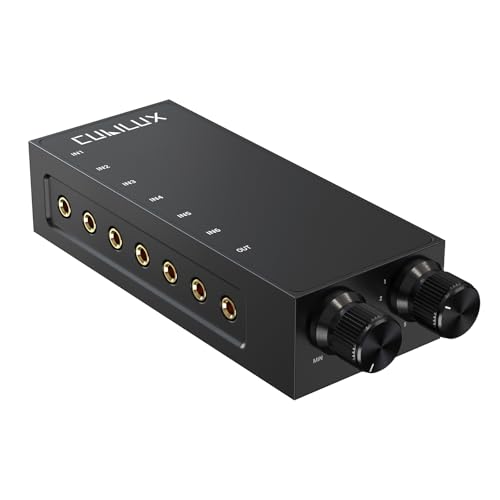
The Cubilux unit provides six inputs to a single output with a passive, driver-free design. It features two independent volume controls: one for switching between inputs and another for adjusting the shared output level, including full mute. The aluminum housing shields against interference, preserving audio clarity. This is a strong choice for desks or portable setups requiring a compact, plug-and-play switcher without power or drivers.
Best for: users who want a compact, passive switcher for a single output with simple volume control and mute—great for computer desks, headphones, or compact workstations. Choose this if you prefer a silent, interference-free path and straightforward operation.
TENEALAY HiFi RCA Passive Preamp

The TENEALAY FV2 is a passive stereo RCA switch with a volume control for 2 input sources feeding a single output. It uses a high-precision A10K potentiometer for fine volume adjustment and matches well with power amplifiers or active speakers that require clean, lossless sound. Since it’s a passive design, there is no gain, which preserves the original signal but limits maximum output in systems with low-powered amplifiers.
Best for: users who want clean, lossless switching between two audio sources without added amplification. Choose this if you need precise volume control in a simple two-source setup and plan to pair with a capable amplifier.
Pyle 6 Channel Speaker Switch

The Pyle PSLSW6 handles six speaker pairs with independent zone control and a 100-watt max per channel rating. It’s designed for home theater setups where multiple speakers need to be managed through a single distribution unit. Terminals accept up to 14 AWG wire, allowing for thicker speaker cables. A limitation is the fixed 100 W per channel, which may constrain larger, power-hungry speakers or demanding listening rooms.
Best for: home theater enthusiasts building a multi-zone speaker layout with independent zone control, where amplifier power aligns with 8-ohm speakers. Opt for this if you want a rugged, wall-to-wall speaker distribution with straightforward wiring.
PROZOR 3.5mm & RCA Bi-Directional Switch

The PROZOR unit provides flexible bi-directional switching between 1-in-2-out or 2-in-1-out with both 3.5mm and RCA interfaces. It is widely compatible with PCs, smartphones, turntables, amplifiers, and speakers, and supports passive operation with no external power. A one-touch mute adds convenience, but the device does not provide amplification, so it relies on external power for louder playback.
Best for: budget-conscious buyers who need flexible input/output routing across popular interfaces without external power. Choose this if you want a compact, all-purpose switch with immediate mute capability and broad compatibility.
TENEALAY 3.5mm 3-in-1-Out Mini Switch
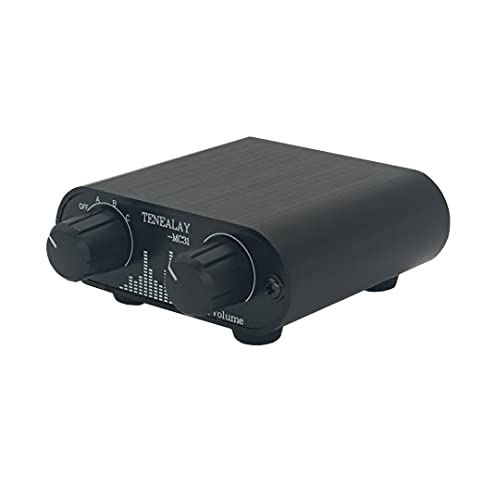
This 3-in-1-out 3.5mm switcher uses a simple interface to switch among three inputs to a single output, with an inline volume control for the shared output. It’s ideal for lightweight desktop setups where a compact, straightforward solution is required. Note that it does not provide amplification or complex routing, which keeps integration simple but limits use in larger systems.
Buying Guide: How To Choose The Right Audio Matrix With Volume Control
- What size of system are you supporting? Larger homes or venues may benefit from an 8-channel matrix (like Matrix88) with app or RS232 control, while smaller desks can use 2–6 input units with independent zone controls.
- Do you need external amplification? If yes, choose devices that include preamp or matrix routing with sufficient power handling per channel; otherwise, passive switches are ideal for clean signal paths.
- What interfaces do you use? If you work with analog speakers, look for 4–16 ohm impedance support and solid terminal connections. If you lean on digital sources, ensure the device can accommodate digital inputs or streaming sources where needed.
- How important is independent volume per zone? For multi-room or multi-speaker setups, a unit with per-zone volume controls and mute features provides the most flexibility.
- Is remote or software control a must? App-based or RS232-enabled units deliver centralized routing, saving time in complex installations.
Frequently Asked Questions
- What is an audio matrix switcher?
An audio matrix switcher routes multiple inputs to multiple outputs with flexible control, allowing per-output routing and volume management.
- Do these devices require a lot of setup?
Some require app or software configuration, while passive models offer plug-and-play use with minimal setup.
- Can I mix analog and digital sources with these devices?
Compatibility depends on the model; many support analog switches, while some offer digital inputs or streaming integration.
- Is independent volume control per zone common?
Yes, several models provide per-zone volume or independent output controls for multi-room configurations.
- Are passive switches better than powered ones?
Passive switches preserve the original signal without gain but rely on an existing amplifier; powered units can add amplification and routing flexibility.
- What should I consider for installation?
Consider impedance compatibility, wire gauge, terminal types, and whether you need external control capabilities like RS232 or a dedicated app.