
Best Audio Signal Splitter Box for Multi-Device Setups
If you need a reliable audio signal splitter box to share sound across multiple devices, this guide highlights five solid options. Each product is suited to different use cases—from home studios and classroom AV setups to live performances and home entertainment systems. The top picks emphasize durability, signal integrity, and compatibility across common connectors like RCA and 3.5mm. Use the buying guide to compare features and decide which splitter best matches your setup and workflow.
| Product | Brand | Best For | Key Benefit |
|---|---|---|---|
| Cubilux AS-R1 4 Way RCA Audio Splitter Box | Cubilux | Home studios and multi-sink dubbing | Lossless sound with rugged aluminum housing |
| FlyroadUp 3.5mm Aux RCA L/R Audio Splitter | FlyroadUp | Multi-output sharing on mixed connections | Supports 3.5mm and RCA outputs |
| Cubilux 5-Way 1/4” Signal Splitter | Cubilux | Live performance and studio monitoring | Five outputs with durable metal build |
| BolAAzuL 4-Way RCA L/R & 3.5mm Splitter | BolAAzuL | Entertainment systems and conferences | Versatile input/output combos |
| TENEALAY 4-Way 3.5mm Stereo Switch | TENEALAY | Multi-source switching for headphones or amps | No power supply required |
Cubilux AS-R1 4 Way RCA Audio Splitter Box

Best for multi-sink dubbing projects in home studios or small classrooms. This 1 in, 4 out RCA splitter preserves signal quality with a design aimed at lossless sound distribution. The aluminum alloy enclosure enhances durability and helps with EMI/RFI shielding. It is suitable for users who need stable, clean audio routing to several sinks from a single analog source.
- Best for: small studio setups requiring multiple outputs from one source
- Why selected: robust build and true lossless propagation help maintain clarity in multi-sink configurations
- Caution: as a passive splitter, ensure proper impedance matching to avoid minor tone shifts with long cable runs
FlyroadUp 3.5mm Aux RCA L/R Audio Splitter 1 in 4 Out
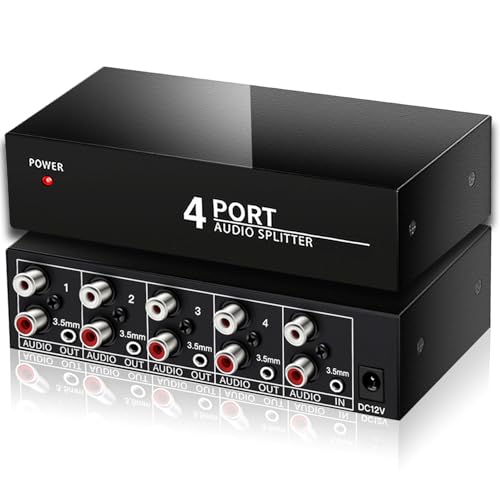
Best for mixed-connector environments where a single source must feed both 3.5mm and RCA devices. The splitter supports various configurations, including 3.5mm and RCA L/R outputs, making it versatile for TVs, computers, CD players, and powered speakers. It is ideal when compatibility across multiple device types matters most.
- Better for: setups with both 3.5mm and RCA devices
- Why selected: flexible connections reduce the need for adapters
- Caution: ensure all devices are powered off during connection to minimize noise when initially wiring
Cubilux 5-Way Quarter Inch Signal Splitter
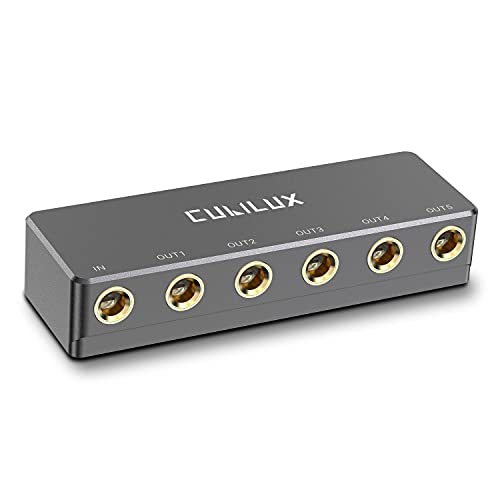
Best for live performances and studio monitoring where five independent outputs are required from a single source. The 6.35 mm jacks use gold-plated contacts to help maintain high audio quality and reduce distortion. The all-metal housing improves durability and ensures stable operation on irregular surfaces.
- Best for: gigs or studio setups needing multiple mono/stereo outputs
- Why selected: high-quality connectors and robust construction
- Caution: as a passive device, volume management is important when feeding several outputs simultaneously
BolAAzuL 4-Way RCA L/R & 3.5mm Splitter
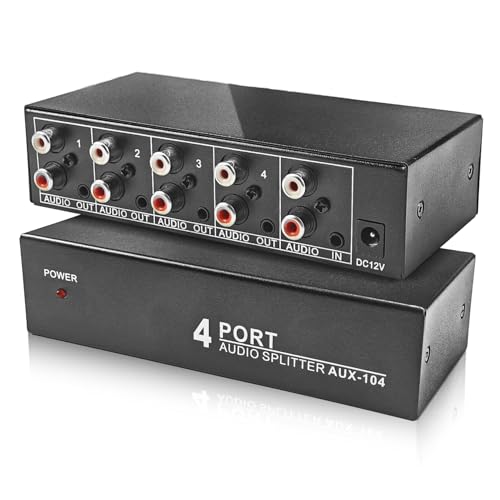
Best for flexible entertainment setups and conference rooms where both RCA and 3.5mm paths are needed. This splitter supports 1 in to 4 outs with multiple output formats. The metal housing provides reliable heat dissipation for longer sessions and heavy use.
- Choose this if: you need versatile input/output options
- Why selected: strong build and broad compatibility improve reliability
- Caution: ensure wiring accuracy to avoid cross-talk between outputs
TENEALAY 3 in 2 Out RCA Stereo Switcher

Best for compact setups needing independent ground switching and multiple source options. It supports three inputs and two outputs, with an isolated ground design to minimize interference. It is suitable for small studios or classroom AV configurations where signal integrity and interference reduction are priorities.
- Best for: independent ground switching in mixed-source environments
- Why selected: reduces ground loop noise in sensitive audio chains
- Caution: may require careful setup to balance levels when using multiple sources
TENEALAY 4-Way 3.5mm Switcher MC41
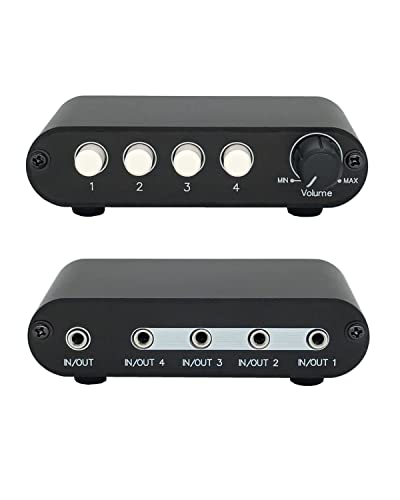
Best for users with multiple audio sources who need to route one source to four different outputs. This no-power design is simple to use and supports a variety of configurations, including multiple 3.5mm outputs to amps, active speakers, or headphones. Choose this when you want a compact, plug-and-play solution.
- Best for: simple, plug-and-play multi-output routing
- Why selected: no external power needed keeps setup minimal
- Caution:_locking multiple outputs may require moderate hand‑eye coordination to select simultaneous channels
DTECH Powered 8 Way 3 RCA Splitter Box

Best for larger AV setups requiring eight outputs from a single source in a durable metal enclosure. This unit distributes video and audio to multiple monitors or speakers, with a built-in amplifier to maintain signal strength. Suitable for classrooms, event spaces, and home theater rigs with many endpoints.
- Best for: larger installations needing multiple outputs
- Why selected: built-in amplification supports longer cable runs
- Caution: heavier unit; ensure stable mounting and ventilation
Buying Guide
What to consider when choosing an audio signal splitter box:
- Number of outputs: Match the required number of destinations to avoid overloading a single source.
- Connector types: Ensure compatibility with RCA, 3.5mm, or 1/4″ outputs; mixed systems may require adapters.
- Passive vs powered: Passive splitters preserve signal without power, but may lose volume with many outputs; powered options maintain level across many devices.
- Build quality: Aluminum or metal housings improve durability and EMI/RFI shielding, especially in live settings.
- Grounding and interference: Some units offer isolated ground or anti-interference designs—useful in multi-device environments.
- Channel configuration: Decide between one-in-multiple-out or multiple inputs/outputs to fit your routing needs.
- Ease of use: Plug-and-play designs simplify quick setups; complex switching boxes suit seasoned users with frequent changes.
FAQ
- What is an audio signal splitter box used for?
It distributes a single audio source to multiple outputs, enabling simultaneous listening on several devices or feeds for recording and monitoring.
- Should I buy a powered or passive splitter?
Powered splitters maintain consistent volume across many outputs; passive splitters are simple and low-cost but may lose level with multiple connections.
- Can I mix RCA and 3.5mm connections in one setup?
Some splitters support both, but ensure compatibility for all connected devices to avoid impedance or tone issues.
- Is grounding important for multi-output audio?
Yes. Ground isolation helps prevent hum and noise; certain switchers are designed to minimize ground loop issues.
- What should I consider for live stage use?
Durability, shielding, and heat dissipation matter; choose metal enclosures and units with reliable connectors for continuous use.
- Do these devices impact audio quality?
Quality splitters maintain signal integrity when properly matched to the system; poor cables or excessive length can introduce loss or noise.