
Best Audio Splitter Solutions for Speakers and Headphones
If you need to share audio from a single device with two outputs, these adapters and splitters are the right choice. This guide highlights five reliable options and explains who each is best for, plus practical buying tips. Ideal buyers include students sharing videos, homes with multi-speaker setups, and professionals setting up simple audio shares without complex gear.
| Product | Best For | Key Benefit |
|---|---|---|
| Belkin 3.5mm Audio Splitter | Casual listening with two listeners | Simple dual-output for headphones or speakers |
| SYNCWIRE 3.5mm Extension Splitter | Reliable Hi-Fi sharing on the go | Gold-plated connectors for low signal loss |
| Quelong 3.5mm Dual Y Splitter | Two headphones; clear stereo | Durable nylon-braided design |
| FlyroadUp RCA 2 In 4 Out Splitter | Home theater or DJ setups | Independent volume control per channel |
| DUKABEL Headphone Splitter | Two headphones or small speakers | Durable construction with 3.5mm compatibility |
Belkin 3.5mm Audio Splitter – Dual Output

This device provides dual audio outputs from a single 3.5mm jack. It supports two headphones or speakers, making it good for sharing music, videos, or podcasts between two listeners. It is a compact option that works with iPhones, iPads, laptops, tablets, and other devices with AUX ports. Best for: casual sharing at home or on the move.
Limitation: It uses a simple splitter design without active amplification, so very low-output devices might require careful volume management to avoid imbalance between outputs.
DteeDck RCA Splitter 1 Male 2 Female

This RCA splitter is designed for 2-channel outputs, connecting a single RCA male input to two RCA female outputs. It’s a fit for subwoofers, home theaters, HDTVs, gaming consoles, and Hi‑Fi systems. Best for: expanding a single source to two separate RCA receivers without digital conversion. Caution: RCA splitters may introduce some phase differences between outputs depending on the source and wiring.
Syncwire Nylon-Braided 3.5mm Extension Splitter
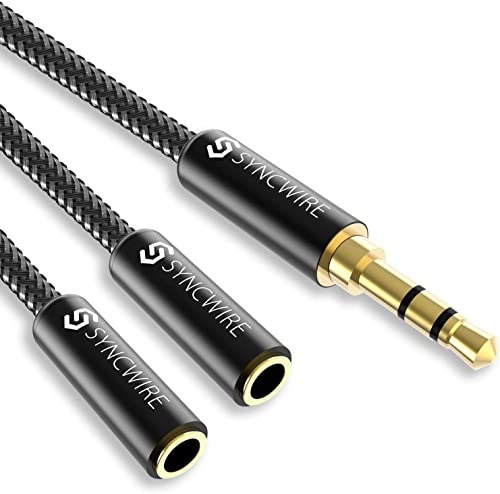
This 3.5mm splitter extension includes two female outputs from a single male jack and is designed for Hi-Fi sound. Gold-plated connectors and double shielding reduce interference and ensure clear stereo playback. Best for: users needing reliable, high-quality stereo sharing for iPhones, Android devices, laptops, and tablets. Limitation: Does not include a built-in microphone pass-through on most setups.
Quelong Headphone Splitter Nylon Braided

The Quelong Y splitter converts one 3.5mm stereo jack into two outputs and emphasizes stereo channel integrity. It uses 24K gold-plated connectors and a copper core to minimize signal loss and noise. Best for: sharing music or games with a friend while maintaining high-fidelity sound. Note: Microphone functionality is not supported with this model.
FlyroadUp 2 In 4 Out RCA Splitter

This RCA-powered splitter distributes 1 or 2 inputs to four outputs with a built-in amplifier offering up to +15 dB gain. It includes separate volume controls per channel and supports real-time audio mixing. Best for: DJs, podcasters, or small studios needing adjustable balance across multiple speakers. Caution: The device may introduce noise if inputs are left unbalanced or overly amplified.
Buying Guide
What’s the difference between passive and powered splitters?
Passive splitters simply divide the signal, which can reduce volume and introduce impedance mismatches. Powered (or amplifying) splitters add gain to maintain level across outputs, which is helpful for multiple speakers or distant runs.
How many outputs do you actually need?
Two outputs are enough for most households. If you plan to feed multiple speakers or a small mixer, consider a 2-in/4-out model with individual level controls to avoid clipping or echo.
Do you need a mic or headset passthrough?
Some setups require both audio and microphone signals. If you need mic support, look for splitter designs that explicitly mention microphone compatibility or use separate adapters for mic lines.
What connection types matter?
3.5mm mini-jack splitters are common for phones and laptops. For larger home theater systems, RCA splitters are popular. Gold-plated connectors and robust shielding help preserve signal quality in noisy environments.
Durability and portability considerations
Nylon-braided cables and metal housings tend to be more durable for travel. If you’ll carry the splitter in a bag or case, select compact, lightweight designs with protective coatings.
How to choose based on use case
- Casual listening with friends: choose a simple 3.5mm splitter like Belkin or SYNCWIRE for quick sharing.
- Home theater or DJ setups: prefer a splitter with independent volume controls, such as FlyroadUp.
- Travel or mobile use: prioritize compact, durable, and shielded options like Quelong or DUKABEL.
FAQ
- Q: Will a splitter reduce my audio quality? A: Most splitters preserve the signal if used within their design limits; poor cables or long runs can introduce noise.
- Q: Can I use a splitter with a smartphone? A: Yes, many 3.5mm splitters are compatible with phones that have an AUX jack.
- Q: Do all splitters support microphones? A: Not all do; check the product features for mic support or use separate mic adapters if needed.
- Q: Is active amplification necessary for two outputs? A: Amplification helps maintain level across outputs; choose a model with built-in gain if you have low-volume devices.
- Q: Can I connect two subwoofers with an RCA splitter? A: An RCA splitter can distribute a single source to two RCA inputs, but verify impedance and compatibility with your subs.
- Q: Which connector lasts longest? A: Gold-plated connectors and braided or metal housings tend to resist corrosion and wear better over time.