
Best Audio Stream Sound Mixers for Clear, Confident Live Streaming
The best audio stream sound mixers combine ease of use with strong mic support, noise reduction, and real-time monitoring—ideal for gamers, podcasters, and creators who want professional-sounding broadcasts. This guide highlights five standout options suited for different setups, from compact USB interfaces to multi-channel controllers. Each product is chosen for clear mic performance, useful monitoring, and practical features that keep streaming smooth. Buyers should consider mic type, platform compatibility, and how many inputs you need for guests or multiple devices.
Summary table of selected products
| Product | Best For | Key Benefit |
|---|---|---|
| FIFINE Ampligame SC3 Gaming Audio Mixer | Gamers and streamers with XLR mics | Indi-Fader, four channels, phantom power |
| Facmogu F998 Live Sound Card | Podcasters needing portable USB solution | 7 knobs, 2 faders, Bluetooth, built-in battery |
| PUPGSIS Streaming Sound Card | All-in-one streaming hub | 4 sound pads, voice changer, noise cancellation |
| FIFINE Ampligame SC3W | Multi-device gaming and streaming | 4-channel control, XLR with phantom power |
| MAONO G1 NEO | Compact, pro-grade sound for creators | Pro preamp, 48V phantom, RGB, noise reduction |
FIFINE Ampligame SC3 Gaming Audio Mixer with Indi-Fader

This four-channel mixer is designed for gamers and streamers using XLR mics. It includes one XLR mic input with 48V phantom power, enabling condenser mics, and a smooth, individual channel fader for precise control of MICROPHONE, LINE IN, HEADPHONE, and LINE OUT. Best for solo streamers who want direct mic control without relying entirely on software, or for setups that emphasize clean live mic output. A potential limitation is that USB mics aren’t supported directly, so external mics or audio interfaces are needed.
Who it’s best for: Streamers who want hardware-based mic control with phantom power and a simple, direct workflow. Why selected: It offers four distinct channels, real-time monitoring, mute features, and sturdy physical controls that minimize on-air mistakes.
Caution: Not suitable for USB-only microphones; requires an XLR mic or an external USB interface for USB mics.
Facmogu F998 Live Sound Card Audio Mixer
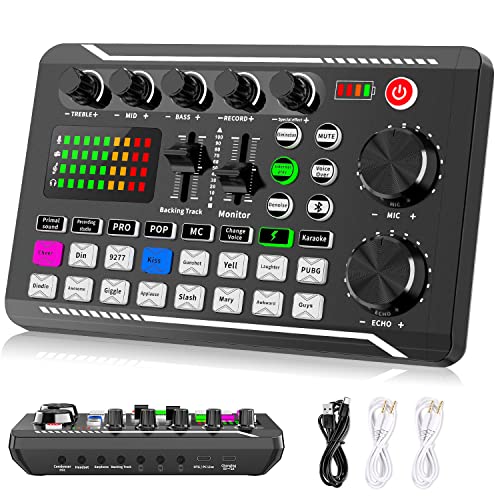
This USB audio mixer is a versatile, entry-level choice for beginners and portable setups. It features 7 independent volume knobs, 2 fader buttons, built-in noise reduction, and Bluetooth connectivity for wireless accompaniment. Best for podcasters and creators who need a compact all-in-one device with multiple sound options and wireless capability. Caution: The device supports USB interfaces; ensure your computer or tablet is compatible with USB audio devices.
Who it’s best for: Beginners to intermediate users who want an all-in-one live sound solution with easy USB connectivity. Why selected: It combines substantial control (7 knobs, 2 faders) with package-friendly portability, and it includes noise reduction for clearer recordings.
PUPGSIS Gaming Audio Mixer For Streaming

This all-in-one audio interface is tailored for streaming, podcasting, and gaming. It includes a 1/4″ TRS dynamic microphone input, built-in reverb, four sound effect pads, and a voice changer. Best for creators who want immediate audio customization and interactive features to engage audiences. Limitation: It does not support 48V phantom power for certain mics, and USB mics are not supported, so an XLR setup may be needed.
Who it’s best for: Creators who want vocal effects, live sound shaping, and quick on-air adjustments. Why selected: The combination of live effects, pads, and a voice changer offers versatility for dynamic streams and entertainment value.
FIFINE Ampligame SC3W Gaming Audio Mixer

This 4-channel gaming mixer offers individual control channels and XLR microphone input with 48V phantom power for condenser mics. It’s well-suited for multi-device streams where you need separate control for mic, game audio, and chat. Best for streamers who value per-channel adjustment and phantom power. Caution: Similar to other XLR-focused gear, USB-only microphones aren’t supported without an external interface.
Who it’s best for: Gamers and streamers running separate audio sources who want precise, channel-by-channel management. Why selected: Its four independent channels with phantom power provide flexible routing and reliable mic performance in live sessions.
FIFINE SC8 Gaming Audio Mixer for Live Streaming

The SC8 focuses on high-fidelity, surround-like audio control for multi-channel streams. It supports XLR mics with phantom power, offering a balance of mic clarity and game/chat separation. Best for creators who require a robust multi-channel setup and realistic 7.1-style immersion. Caution: Virtual surround features rely on software processing; results may vary by platform and headset quality.
Who it’s best for: Streamers seeking improved mic clarity and sophisticated game/chat balance. Why selected: The unit emphasizes mic performance with phantom power and an emphasis on balance and immersion for streamed sessions.
MAONO G1 Neo Gaming Audio Mixer

The MAONO G1 Neo focuses on essential streaming needs with a built-in Pro-preamp and 48V phantom power to unlock mic potential. It includes voice-changing features, customizable sound pads, and reverb/sidechain effects for creative streams. Best for creators who want personality and professional voice capture in a compact package. Caution: Its feature set emphasizes effects; users who only need basic mixing may find some options underutilized.
Who it’s best for: Creators who want a compact, feature-rich mixer with voice effects and RGB lighting for engaging streams. Why selected: It combines high-quality mic support, user-friendly effects, and intuitive controls in one small unit.
Buying Guide
- Determine your input needs: Are you streaming solo or with guests? Multi-channel mixers are ideal for multiple mics and devices, while compact USB interfaces suit single-m mic needs.
- Mic compatibility: Check phantom power (48V) if you use condenser mics. Some devices support only dynamic mics or require adapters for USB mics.
- Monitoring and mute controls: Real-time monitoring helps you hear yourself clearly. Independent mute or solo controls reduce on-air noise.
- Software vs. hardware: Hardware mixers provide reliable on-air control without software latency, while some devices integrate DSP effects or voice changing tools that can reduce post-production time.
- Portability and power: Consider whether a battery-powered unit or a compact USB-C powered device fits your travel or desk space needs.
- Platform compatibility: Ensure the unit works with your computer, console, or mobile device. USB-audio interfaces are broadly compatible; some devices also offer Bluetooth or optical inputs for broader setups.
FAQ
- What is the main advantage of a dedicated audio mixer for streaming?
Answer: It provides hardware-level control over mic levels, monitoring, and effects, reducing reliance on software and minimizing latency during live streams. - Do I need phantom power for my microphone?
Answer: If you use a condenser mic, phantom power is typically required. If you use a dynamic mic, phantom power may not be necessary. - Can USB mics be used with these mixers?
Answer: Some mixers do not support USB mics directly and require an analog mic with an interface. Always verify mic type compatibility in the product features. - Is built-in noise reduction useful for streaming?
Answer: Yes, it helps reduce background hum and fan noise, producing clearer on-air voice without post-processing. - Should I choose a 4-channel or 7-channel mixer?
Answer: Choose based on how many input devices you need. A 4-channel mixer works for solo streams with one mic and a couple of audio sources; 7-channel or more are better for multi-person or more complex setups. - What performance factors should I prioritize?
Answer: Mic clarity (SNR and distortion), monitoring options, ease of use, and compatibility with your devices and software are key considerations.