
Best Aux to Speaker Amplifier Setups for Clear Sound
Discover the best aux to speaker amplifier options to optimize sound quality, reduce noise, and simplify connections. This guide highlights five carefully chosen products suited for different use cases—home studios, living rooms, or portable setups. If you’re wiring a guitar, keyboard, or portable device to an amplifier or speaker, you’ll find practical, direct answers here. The quick comparison table below helps you pick by compatibility, bidirectional use, and durability.
| Product | Best For | Key Benefit | Limitations |
|---|---|---|---|
| Tiierzon 3.5mm to 6.35mm Cable | Guitarists and Keyboardists | Bidirectional, gold-plated for clean signal | 6 ft length may be short for large stages |
| JSAUX RCA to 3.5mm Cable | Home stereo and receivers | Dual RCA with easy grip connectors | RCA to 3.5mm is limited by source quality |
| UGREEN 3.5mm to RCA Cable | Studio and hobbyists | Low loss, high durability, tangle-free | Most effective with well-matched devices |
| WOOPKER AK45Pro Amplifier | Small apartments and desktops | 400W peak, multiple inputs, remote | Size may be overkill for tiny rooms |
| ARRAROWN ZK-1002T Bluetooth Amp Board | DIY setups and subwoofers | Bluetooth 5.0, dual-channel | Requires integration work for some users |
Tiierzon 3.5mm To 6.35mm Cable
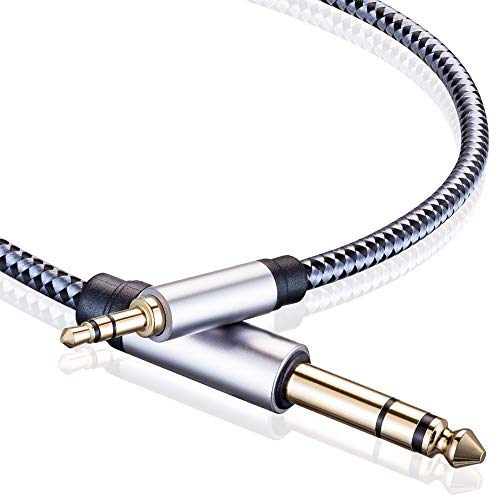
Best for guitarists and keyboard players needing a reliable, bidirectional connection between a 3.5mm source and 6.35mm gear. The gold-plated connectors reduce static and ensure lossless audio through a braided, double-nylon jacket that resists tangling and wear. Use it to connect a phone or laptop to an amplifier, or a guitar pedal to a speaker. A practical choice for setups where space is limited and cable longevity matters.
Who this is for: players seeking a sturdy, low-noise auxiliary link between common pro-audio ports. Why selected: its bidirectional capability covers both 3.5mm-to-1/4″ and 1/4″ to 3.5″ paths, simplifying cable inventories. Caution: long-term bending can still wear braided jackets; handle with care to maximize life.
JSAUX RCA To 3.5mm Cable

This RCA to 3.5mm adaptor is ideal for linking mobile devices or MP3 players to stereo receivers or amplifiers that use RCA inputs. The dual-shielded design and gold-plated connectors reduce interference, helping preserve stereo imaging and clarity. The labeled red/white connectors aid quick left-right identification, which is helpful in home theaters or living rooms.
Who this is for: listeners who need a straightforward, reliable bridge between a mobile device and an RCA input. Why selected: strong interference rejection and easy-grip connectors simplify everyday use. Caution: quality can vary with older receiver inputs; verify backward compatibility before purchasing.
UGREEN 3.5mm To RCA Cable

Designed for versatile audio setups, this cable connects from a 3.5mm source to RCA inputs with minimal signal loss. It emphasizes durability with a flexible PVC jacket and a high bend lifespan. The combination of gold plating and copper wire core enhances conductivity and reduces noise, making it suitable for both amateur and semi-professional environments.
Who this is for: users needing robust, long-lasting performance in mixed home or studio contexts. Why selected: balance of durability and audio fidelity. Caution: ensure your devices’ inputs match RCA compatibility for best results.
6.35mm To 3.5mm Braided Cable

This bidirectional 6.35mm to 3.5mm cable is useful when linking gear with different jack sizes, including keyboards, mixing consoles, and electric guitars to systems with 3.5mm outputs. The braided construction provides additional durability for frequent setup changes, and the clear labeling supports quick, reliable connections.
Who this is for: professionals and hobbyists seeking a flexible, tangle-free option for mixed-port environments. Why selected: physical durability and bidirectional design reduce the need for multiple adapters. Caution: longer runs may introduce minor signal loss; keep runs as short as practical to maintain signal integrity.
3.5mm To 1/4″ TRS Cable

This bidirectional 3.5mm to 1/4″ TRS cable suits setups that require reliable 1/8″ to 1/4″ connections across various audio ports. Its 6.6ft length is a practical middle ground for desktop or mid-room layouts. The connector geometry supports quick plug-and-play connections with minimal resistance.
Who this is for: users needing a solid all-rounder for home studios or small venues. Why selected: clear, repeatable connections with a flexible length. Caution: ensure device inputs are truly compatible with TRS configurations to avoid mis-wiring.
Buying Guide: How to Choose The Right Aux To Speaker Amplifier Cable
Key questions to guide your decision:
- What ports do my devices have? Match 3.5mm, 1/4″ (6.35mm), and RCA connections accurately to avoid adapters with extra impedance.
- Is bidirectional use important to me? Cables that work both directions simplify inventory and set-up.
- What level of durability do I need? Braided jackets and gold-plated connectors help in high-traffic setups or travel.
- Do I need interference resistance? Copper cores and shielding reduce hum, noise, and radio frequency interference.
- What length is practical? Balance flexibility with signal loss; longer runs may require higher-quality shielding.
Practical Tips for Connecting Aux Cables to Speakers and Amps
- Always power off equipment before connecting or disconnecting cables to avoid pops and damage.
- Test one cable at a time to identify any noise sources early.
- Label cables by port type and direction to speed up future setups.
Common Scenarios and Recommendations
- Home studio: Choose cables with robust shielding and a comfortable length for desk setups (UGREEN, JSAUX).
- Live room or small venue: Opt for higher-grade, longer runs with braided jackets to withstand movement (Tiierzon, 6.6 ft options).
- DIY audio projects: A Bluetooth-enabled amplifier board like ARRAROWN can expand wireless capabilities while maintaining wired options.
FAQ
- What is the difference between RCA and 3.5mm cables for amplifiers?
– RCA is common on home audio gear, while 3.5mm is typical for portable devices. Using the correct connector minimizes impedance and noise. - Are bidirectional cables worth it?
– Yes, they reduce the need for separate adapters and simplify setups where devices can act as sources or destinations. - Can these cables improve sound quality?
– They reduce interference and maintain signal integrity when properly matched to device inputs and outputs. - Do I need shielding?
– Shielding helps in environments with electrical noise or long cable runs. It is especially beneficial in multi-device setups. - How long should an aux-to-amp cable be?
– Choose the shortest length that comfortably reaches your gear to minimize signal loss and clutter.