
Best Balanced to Unbalanced Adapters for Audio Systems in 2026
When building or upgrading an audio setup, choosing the right balanced to unbalanced adapter can reduce noise, preserve signal integrity, and simplify connections. This guide highlights five top products suited for different user needs—home studios, live rigs, DJs, and casual listeners. Each option is explained with who it’s best for, key benefits, and a practical limitation to consider.
| Product | Best For | Key Benefit |
|---|---|---|
| HUALEU 2Pack 1FT RCA Female to 3Pin XLR Female | Small studios and compact rigs | Two-pack convenience with color-differentiated cables |
| SinLoon 4.4mm to 3.5mm Adapter | HiFi portable listening and on-the-go setups | Gold-plated, OFC for low loss in compact size |
| PYLE-PRO Premium DI Box | Live sound and stage rigs | Impedance transformer with hum cancellation |
| Cable Matters XLR to 1/4 TS Cable | Microphone to unbalanced line | Flexible, durable unbalanced connection |
| Cable Matters Dual RCA to XLR Cable | Home theater and DJ setups | Dual channel conversion for stereo signals |
HUALEU 2Pack 1FT RCA Female to 3Pin XLR Female

The HUALEU RCA to XLR cable converts XLR outputs from mixers or players to RCA female connectors. It’s ideal for compact studios and small venues where quick, reliable connections are needed. Best for users who need a ready-made solution in a 1-foot length and value color-coded cables for left-right channel identification. The included double-shielded, OFC construction helps minimize signal loss and interference in short runs. A practical limitation is that it does not perform active conversion; it passes a balanced signal into an unbalanced RCA path.
HUALEU 2Pack 3Pin XLR Female to RCA Male

This balanced XLR to unbalanced RCA adapter handles balanced XLR outputs and converts them to RCA inputs. Constructed with a premium zinc alloy shell and nickel-plated connectors, it prioritizes durability and stable signal transfer. It’s best for systems where you need rugged, plug-and-play adapters in fixed installations or on stage. A potential limitation is that the adapter relies on the originating device delivering a balanced signal; it does not balance an inherently unbalanced source.
PYLE-PRO Premium Direct Injection (DI) Box
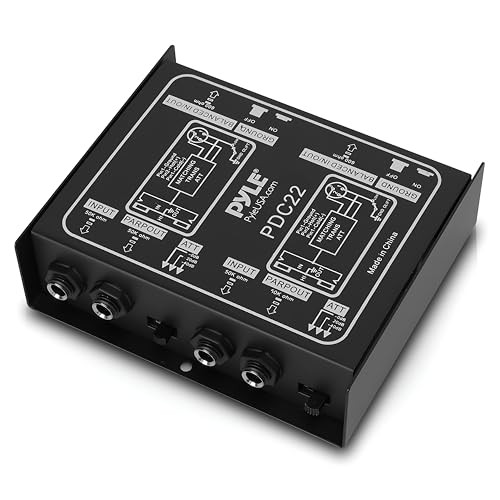
The PYLE-PRO DI box is a passive solution designed for live sound and recording. It provides a ¼ inch device connector and a detachable AC power option, supporting connection of keyboards, guitars, and processors to a PA or mixer. It includes impedance transformation and hum cancellation features, making it a solid choice for reducing noise in live environments. The device is best for users who need a robust dedicated DI tool for unbalanced to balanced transitions. A limitation is that it emphasizes instrument-level signals and may not be necessary for all line-level balanced-to-unbalanced needs.
Cable Matters XLR to 1/4 TS Cable

This 1/4 inch TS unbalanced cable connects a dynamic microphone to an amplifier or karaoke machine, delivering a straightforward unbalanced signal path. It features OFC conductors and copper shielding for reduced hum and noise. The braided shielding provides durability, making it suitable for mobile setups and quick, temporary connections. Best avoided if higher noise rejection is required or if your system relies on true balanced lines to minimize interference in long cable runs.
Cable Matters Dual RCA to XLR Cable

The Cable Matters dual RCA to XLR cable carries stereo signals from AV receivers or mixers to XLR inputs on a powered speaker or amplifier. It provides separate left and right channels in unbalanced form, making it a practical choice for home theaters and DJ setups. The shielded construction helps reduce external interference, but users should note that this cable does not convert a true unbalanced signal into a balanced one; it simply adapts RCA to XLR connectors.
Buying Guide: How To Choose The Right Balanced To Unbalanced Adapter
- Signal type: Identify whether you need to pass a balanced or unbalanced signal and whether you require a passive adapter or an active DI box.
- Application: Consider studio, live, or portable use. Short runs benefit from simple adapters, while longer runs may require DI boxes or shielded cables to minimize interference.
- Connectors: Ensure compatibility with your equipment’s outputs and inputs (XLR, RCA, ¼ inch TS/TRS, 4.4 mm balanced, etc.).
- Durability: For stage or road use, prioritize rugged housings (like zinc alloy) and reinforced cables with shielding.
- Length and routing: Short cables reduce signal loss and noise pickup; plan cable management for your space to minimize tangling and wear.
- Audio quality: Look for OFC conductors, gold or nickel-plated connectors, and multi-layer shielding to preserve clarity and reduce corrosion.
Frequently Asked Questions
- What is a balanced to unbalanced adapter used for?
It converts balanced outputs to unbalanced inputs, allowing equipment with different signal formats to connect and transmit audio with less noise in short to moderate runs. - Do I need a DI box for every balanced to unbalanced connection?
Not necessarily. DI boxes are ideal for live instruments and long cable runs or when ground loop issues are present. Simple adapters work for short, controlled studio or home setups. - Will using an adapter degrade audio quality?
Any passive adapter can introduce minor signal loss or noise if shielding is inadequate or cable length is long. High-quality connectors and shielding mitigate most issues. - When should I choose an RCA to XLR adapter over XLR to RCA?
Choose based on the direction of signal flow and the inputs/outputs you’re connecting. Both are common in studios and PA systems for converting between line-level and mic-level paths. - Are there risks in using mismatched connections?
Mismatched impedance or unbalanced long runs can introduce hum or reach stability issues. Use appropriate adapters and DI tools when in doubt. - Can these adapters connect professional audio gear to consumer devices?
Yes, they’re designed to bridge professional interfaces (XLR, balanced lines) with consumer-oriented inputs (RCA, 3.5 mm), expanding compatibility across gear.