
Best Bass Cab Sim Pedal Options for Studio and Stage
For bassists seeking authentic cabinet tones without a full live mic setup, a bass cab sim pedal can be a practical game changer. This guide highlights five top-rated options that offer reliable IR loading, built-in cab simulations, and direct DI or playback versatility. Each pick targets a different use case—from studio recording to live performance and silent practice—helping you choose the right tool for your needs. Buyers should consider how you record, perform, and how much tone shaping you require in one compact pedal.
| Product | Best For | Key Benefit |
|---|---|---|
| SONICAKE IR Pedal Speaker Cabinet Simulator | Pro-studio players and bassists needing multiple classic IRs | 11 onboard cabinet simulations with USB-like drag-and-drop IR management |
| JOYO MONOMYTH Bass Preamp & DI | Live rigs and direct-to-PA setups | XLR DI with Ground Lift and flexible 6-band EQ |
| JOYO American Tube Amp Simulator & Preamp | Direct recording and silent practice | Built-in analog cabinet simulation for direct interfaces |
| JOYO Double Thruster Bass Overdrive | Venues needing blend-preserved low end | Dedicated Blend with mid and gain boosts for flexible overdrive |
| FLAMMA FS07 Stereo Simulation Pedal | IR loading enthusiasts with multiple preset slots | 7 user presets and stereo cabinet simulation |
Below are five carefully chosen products that align with the keyword “bass cab sim pedal.” Each entry includes a concise rationale, best-use scenarios, and practical considerations to help you compare at a glance.
SONICAKE IR Pedal Cabinet Simulator

The SONICAKE IR Pedal is an impulse response loader designed to simulate a wide range of speaker cabinets. It features 11 onboard classic cabinet simulations and a drag-and-drop workflow for managing IR files, recognized as a USB disk. Best for players who want immediate, varied cabinet tones without external software or complex setup.
Who this is best for: studio players needing multiple cabinet options and quick IR management, and live players seeking a compact pedal with versatile tone shaping. The main limitation is the IR library’s onboard scope; expanding tones would rely on external IR files you import.
JOYO MONOMYTH Bass Preamp & DI

The MONOMYTH combines a bass preamp, a 6-band graphic EQ, and a blend/voice/gain framework with a dedicated overdrive channel. The balanced XLR DI output with Ground Lift enables direct connection to PA systems or interfaces without an amp. It supports a wide range of styles from jazz to metal, giving you studio-grade tonal flexibility in a compact pedal.
Who this is best for: players seeking direct-to-PA capability and strong tonal control in one pedal. Better for musicians who want a blend of clean and distorted tones while maintaining bass clarity. A potential limitation is that the device relies on electronic circuits for drive shaping, which may sound different from a mic’d cabinet in some situations.
JOYO American Tube Amp Simulator & Preamp
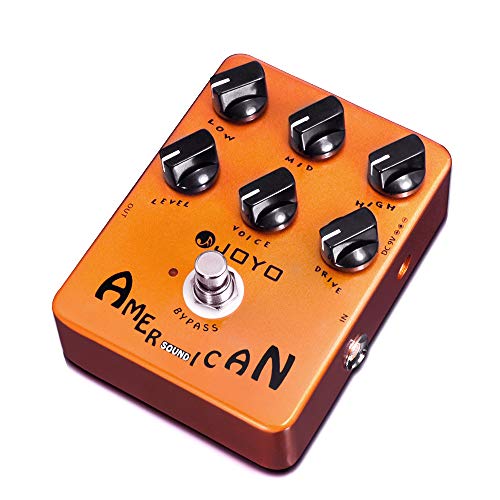
This pedal provides classic American tube-amp tones with six-knob control including Level, Drive, Low, Mid, High, and Voice. It features built-in cabinet simulation for direct recording or silent practice, enabling straightforward DI use without a separate amp or mic. It suits players who want authentic American tone without the need for mic’ing a cabinet.
Who this is best for: players needing reliable direct-recording or silent-practice tones with built-in cab sim. The limitation is that the integrated cab sim might not perfectly replicate every room or audience environment, so some players may still prefer mic’d cabinets in certain settings.
JOYO Bass Overdrive Double Thruster

The Double Thruster offers a blend control to retain low-end while adding grit. Two independent boosts—Mid Boost and Gain Boost—provide additional tonal versatility. Four-knob control covers Tone, Blend, Volume, and Gain. This pedal is suitable for players who need a flexible overdrive that preserves bass fundamentals while adding character.
Who this is best for: players who want a versatile overdrive solution that keeps bass punch intact. A caution is that overdrive can muddy the very low end if pushed too hard without careful blending, so use the blend control to maintain clarity.
FLAMMA FS07 Stereo Simulation Pedal

The FLAMMA FS07 provides stereo cabinet simulation with IR loading and seven user preset slots for storing dual-cab settings. It supports loading third-party impulse responses, expanding its tonal repertoire for both guitar and bass use. This is an attractive option for players who want studio-level IR flexibility in a compact pedal.
Who this is best for: players who value stereo cabinet simulation and the ability to load third-party IRs. A limitation is that the preset slots and IR loading can be overwhelming for beginners, so some time may be needed to dial in preferred tones.
Buying Guide: Key Considerations For Choosing A Bass Cab Sim Pedal
- Direct recording vs live use: If you primarily record, prioritize built-in cab simulations and DI outputs for easy integration with audio interfaces. For live performance, ensure the unit can drive a PA or stage system cleanly.
- IR management: Consider whether you want onboard cabinet simulations only or the ability to import external IR files. More IR options mean broader tonal possibilities but a steeper learning curve.
- Output options: Check for XLR DI outputs, ground lift, stereo outputs, and compatibility with your amp or interface. DI capability is essential for clean stage and studio work.
- Tone shaping controls: Look for multi-band EQs, blend controls, and dedicated boost switches. These features help tailor the tone to different genres and playing styles.
- Walkabout practicality: Size, battery vs. power supply, and ease of use impact live gig readiness. Pedals with simple, reliable cab sims are generally more dependable on stage.
- Presets and IR loading workflow: A pedal with user presets and intuitive IR management saves time during setup and performance.
Frequently Asked Questions
- What is a bass cab sim pedal used for?
It provides cabinet tonality and speaker characteristics, enabling direct recording, DI from live gigs, or silent practice without mic’ing a real cabinet. - Do I need to import IR files to get good tones?
Not always. Many pedals include a set of onboard cabinet simulations; importing IRs expands tone options but may require extra setup. - Can I use these pedals with a bass amp?
Yes. Most bass cab sims are designed to be used direct into DI, a mixer, or an amp’s effect loop, depending on the unit. - Is stereo cabinet simulation worth it for bass?
It can be advantageous for certain genres or recording setups, but mono cab sim often suffices for many live situations. - Are DI outputs mandatory for portability?
For direct-to-PA or interface work, DI outputs are highly beneficial; they reduce the need for a separate amp on stage or in the studio. - Do these pedals work with guitar tones as well?
Many models support guitar and bass signals; some are optimized for bass with optimized low-end response. Check the product’s specs for confirmation.