Best Beam Antennas for Ham Radio: Top Picks for Every Operator
Whether you’re building a compact home station, heading to a field day, or operating portable from a vehicle or tent, a beam antenna can boost your signal in the right direction. This guide highlights five well-rounded beam and multi-band options that suit common ham radio needs, from VHF/UHF base setups to multi-band HF and portable configurations. The selections emphasize reliability, ease of use, and practical coverage for operators of all levels. The top picks are best for daily operators, field-day enthusiasts, DX chasers, and mobile hams seeking steady performance.
Buyer focus summary table
| Product | Best For | Key Strength | Best Use Case |
|---|---|---|---|
| VHF UHF 2m 70cm Ham Radio Antenna for Base Station | Base station owners needing dual-band 2m/70cm | High gain on both bands, wide horizontal coverage | Fixed location, GA/region-wide reach |
| GOOZEEZOO JPC-12 HF Antenna | HF operators seeking multi-band, field-friendly setup | Low SWR across 7–50 MHz bands | POTA/SOTA Field Day, lightweight outdoor use |
| JYR8010 End Fed 8-Band Antenna | HF enthusiasts who want multi-band without tuning | End-fed with balun, broad coverage 80–10m | DX work, portable or fixed setups |
| Bingfu Vehicle Magnetic Base Dual-Band Antenna | Mobile/vehicle ops needing VHF/UHF reach | Magnetic base, dual-band coverage | Mobile field operations, marine or road use |
| TWAYRDIO Yagi Antenna UHF 400–470 MHz | Directional UHF work with repeaters | 7 dBi gain, compact Yagi, strong front-to-back | Base or portable repeater links |
Below are five product profiles with practical insights. Each section notes who should consider the product, why it’s a good pick for that use, and one limitation to watch for during setup or operation.
VHF UHF 2m 70cm Ham Radio Antenna for Base Station

The SIGNALPLUS dual-band base station antenna covers 136–174 MHz and 400–470 MHz with a vertical polarization and a full 360º horizontal beam. It offers a 3.5 dBi gain at 144 MHz and 5.5 dBi at 433 MHz, with a VSWR under 1.5, and a robust 1.1 m length. It is designed for up to 100 W input power and uses a UHF Female (SO-239) connector. Best for: Station hams who need a compact, sturdy dual-band antenna for fixed location operation, particularly where a broad azimuth is important. Limitation: Coax length and mounting must be planned to avoid nearby metal surfaces that could affect radiation patterns.
GOOZEEZOO JPC-12 HF Antenna 7–50 MHz All-Band

The JPC-12 is designed as a low-SWR multiband HF vertical for 7–50 MHz, covering 40/30/20/17/15/12/10/6 meters with a 50 Ω impedance and up to 100 W SSB power. It promises a low SWR of ≤1.1 across all bands and includes a reinforced coil design for field reliability. Best for: Operators participating in POTA, SOTA, or Field Day who want a single, easy-to-tune solution with strong reception and simple deployment. Limitation: It may require available ground plane or adequate mounting to achieve optimal performance in some environments.
JYR8010 End Fed 8-Band HF Antenna

The JYR8010 is an 8-band end-fed antenna covering 80–10 meters with a 1:64 impedance transformer, delivering low SWR and reduced need for external tuners in many setups. It supports SSB up to 150 W and CW/FT8 up to 100 W. Best for: HF enthusiasts who value quick multi-band operation without extensive tuning, especially in portable or space-constrained environments. Limitation: End-fed length and mounting require attention to avoid nearby metal surfaces that may detune the antenna.
Bingfu Vehicle Mobile Dual-Band Antenna

This magnetic-base mobile antenna spans 136–174 MHz and 400–470 MHz, featuring a 42 cm length and a 5 m RG58/U cable. It uses a UHF PL259 male connector and is designed for versatile vehicle or marine use. Best for: Mobile operators seeking straightforward dual-band performance with simple mounting. Limitation: Power handling is not specified beyond “general use,” so high-power operations might require verification of compatibility and mounting stability.
TWAYRDIO Yagi Antenna UHF 400–470 MHz
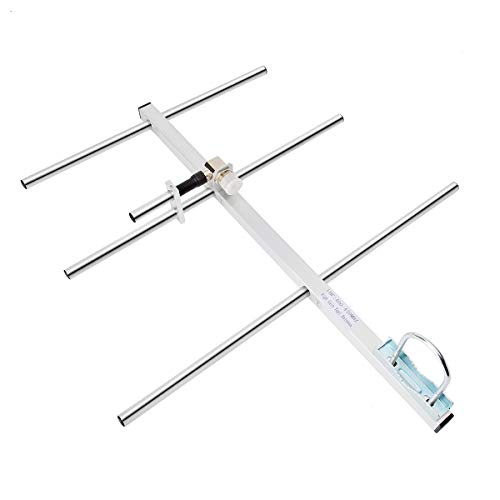
The Yagi from UAYESOK is a directional 7 dBi gain antenna for 400–470 MHz, with a 50 Ω impedance and VSWR under 1.5. It is a compact 3-element design with a 430 mm by 380 mm footprint, built in aluminum alloy for weather resistance. Best for: Operators needing a high-gain, directional UHF link for repeater work or point-to-point sits. Limitation: Directionality means you must rotate or adjust to track targets, unlike omnidirectional antennas.
Sirio SY 27-4 4 Elements 26.5–30 MHz Yagi

The Sirio SY 27-4 is a 4-element Yagi designed for 26.5–30 MHz (10 meters HAM band). It is a high-power, base-station directional antenna made from aluminum alloy with waterproof jointing sleeves. Best for: 10-meter DX and contest-focused operators who want a robust, tunable beam. Limitation: Meant for mid-band operation; not ideal for broad-band multi-band use without additional elements or configurations.
ABBREE Dual-Band VHF/UHF 144/430 MHz Antenna Pair

The ABBREE AR-805S dual-band antenna pair is designed for 144/430 MHz with a 2.15–3.0 dBi gain depending on band, 50 Ω impedance, and a compact 1.96 inch form factor. It uses SMA-Female connectors and is suitable for Baofeng and similar handhelds. Best for: Stealthy, portable handheld upgrades and quick field deployments when space is limited. Limitation: Lower gain compared to larger base antennas; intended for handheld rigs rather than fixed base stations.
Buying Guide
- Frequency coverage: Match the antenna’s bands to your most-used bands (VHF, UHF, HF multi-band, etc.).
- Radiation pattern: Omnidirectional antennas are easier for general use; directional beams like Yagi offer higher gain but require aiming.
- Impedance and connectors: Ensure 50 Ω impedance and matching connectors (SO-239, PL-259, SMA) to your radio setup.
- Mounting and environment: Ground planes, mounting height, and nearby metal affect performance. Field use may benefit from versatile mounting options and weather resistance.
- Power handling: Check the maximum input power to avoid overloading the antenna during transmissions.
- Portability vs. fixed use: End-fed and foldable designs excel for portable use; large base-station beams suit fixed locations.
Practical considerations: For field operations, multi-band options like the JPC-12 and JYR8010 reduce the need for tuner installations in many setups. For mobile or vehicle use, magnetic base antennas provide quick deployment, though they can couple with metal surfaces on vehicles and may require secure mounting for high-speed driving. If you need broad coverage on HF without tuning, the end-fed designs offer compelling simplicity, but check local regulations and mounting constraints in outdoor environments.
Frequently Asked Questions
- What is the advantage of a multi-band beam versus a single-band antenna?
Answer: A multi-band beam covers several bands with a single antenna, reducing antenna clutter and the need for multiple installations, though performance can vary by band and mounting. - Do I need a ground plane for these antennas?
Answer: Some HF end-fed designs rely less on ground planes, while VHF/UHF verticals may benefit from an adequate ground plane or mounting structure. - Can I use a beam antenna for portable operations?
Answer: Yes, but ensure the design is lightweight and easy to transport. Foldable or compact beams are ideal for portable use. - How do I choose between omnidirectional and directional beams?
Answer: Choose omnidirectional for simple, flexible use without pointing; choose directional beams for higher gain and longer-range links, at the cost of requiring aiming accuracy. - Is higher gain always better?
Answer: Higher gain helps in weaker signal conditions but may narrow the beamwidth, making aiming more critical and potentially increasing pattern distortion near obstructions. - Are there any safety considerations for mounting beams outdoors?
Answer: Yes. Follow local codes, ensure secure mounting, use guy wires if required, and protect cables from weather and lightning where appropriate.