
Best Bluetooth 4.0 Audio Receiver Boards for DIY Projects
The top Bluetooth 4.0 audio receiver boards offer reliable wireless audio for car, home, and DIY speaker builds. This guide highlights five practical options, clarifying who each is best for and why. Ideal buyers include hobbyists building car audio interfaces, small DIY sound systems, or simple wireless adapters for existing outputs. The table below compares key attributes to help you decide quickly.
| Product | Best For | Key Benefit | Note |
|---|---|---|---|
| Comimark LN-BT02 | Car audio and phone hands-free | Stable 4.0 wireless, good stereo output | Great for car setups |
| DROK 4.x Bluetooth Board | DIY home audio and headsets | Wide voltage range, AUX inputs | Versatile power options |
| Comimark KRC-86B | Basic DIY receivers | Simple 4.0 stereo reception | Compact module |
| ARRAROWN ZK-1002T | 2.0 channel amps with BT | Bluetooth 5.0, powerful output | Not 4.0, but compatible as a Bluetooth board option |
| MakerHawk BT 5.0 Modules | DIY audio projects with 5.0 | Lossless formats, decent range | BT 5.0, modern alternative |
Comimark LN-BT02 Bluetooth 4.0 Receiver Board

Features include Bluetooth 4.0 connectivity for wireless pairing, stereo sound quality, and compatibility with car phones. This board centers on in-vehicle or compact audio projects where reliable hands-free use is important. Best for: car audio adapters and simple DIY wireless receivers for phones. Limitation: 4.0 technology may offer slower pairing and shorter range than newer standards.
DROK Blue~Tooth Board (BT 4.x)
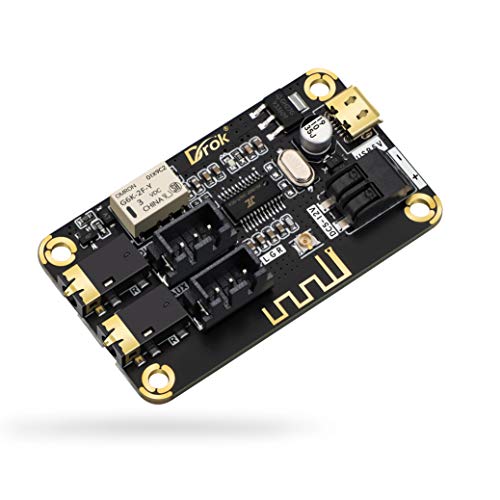
Best for DIY home audio and simple speaker projects. It supports a wide input voltage range (DC 5–12V) and micro USB power, with 3.5mm AUX and 2.54mm AUX inputs. Choose this if you need flexible power options and straightforward decoding for headphones or small speakers. Caution: Data sheet notes 4.2 compatibility; verify your project power supply to avoid miswiring.
Comimark KRC-86B Bluetooth 4.0 Receiver Module

Best for straightforward DIY projects needing a compact 4.0 stereo receiver module. It focuses on reliable stereo sound reception in a small form factor. Best for hobbyists building compact wireless modules or adding Bluetooth input to a dedicated amplifier. Limitation: 4.0 technology may limit compatibility with some newer devices, compared to BT 5.0 modules.
ARRAROWN ZK-1002T 2.0 Channel Bluetooth 5.0 Amplifier

Best for projects needing higher power and a broader feature set with BT 5.0. It provides 100W+100W output, USB/AUX inputs, and treble/bass adjustment. Use this if you require more robust amplification and greater control over sound shaping. Caution: Not a pure 4.0 receiver; consider if BT 5.0 compatibility is acceptable for your setup.
MakerHawk BT 5.0 2-Piece Receiver Board Kit

Best for multi-device DIY setups that demand 5.0 features and flexibility. This kit supports WAV/APE/FLAC/MP3 lossless decoding and a 15m typical transmission distance. Choose this if you want modern Bluetooth performance and the ability to split or pair multiple boards in a project. Limitation: Not a pure 4.0 board, so consider compatibility with older devices.
Romicta 4 Channel Bluetooth 5.0 Amplifier

Best for home theater or karaoke setups needing 4x channel output with 5.0 connectivity. It offers up to 50W per channel, plus USB/SD/FM inputs. Use this when you want multi-speaker output with Bluetooth streaming. Caution: Higher power output can require careful heat management in enclosed spaces.
X W EI UNION Home Audio 5.0 Receiver

Best for integrated home theater and multi-speaker setups needing stable BT 5.0 streaming and subwoofer support. It provides 2.1 channel output with a dedicated sub output and multiple inputs. Choose this if you want a complete, ready-to-use home audio solution rather than a bare module. Limitation: BT 5.0, not a 4.0 board, which may affect compatibility with older devices or strict 4.0 project goals.
Buying Guide: Key Considerations for Bluetooth Audio Receiver Boards
- Bluetooth version and range: 4.0 boards are generally reliable for everyday use, while 5.0 offers longer range and better efficiency. Decide whether compatibility with older devices or future-proofing matters more for your project.
- Power supply compatibility: Check voltage requirements (3.3V, 5V, 12V). Many DIY boards require a dedicated power source; ensure your project supplies match the board’s needs.
- Input and output options: Look for AUX, USB, SD, or FM inputs, and the number of channels and speaker impedance compatibility. Consider whether you need stereo only or multi-channel output.
- Audio decoding formats: If you plan to play lossless files (WAV, FLAC, APE) or MP3, verify supported formats. This affects audio fidelity and playback compatibility with your media sources.
- Integration and mounting: Assess whether the board’s size and mounting options fit your enclosure, car dash, or DIY enclosure. Some modules are compact; others include power adapters or remote controls.
- Sound control features: Treble, bass, and volume controls can simplify sound tuning. Some boards include digital or analog tone controls; others require separate amplifiers or receivers.
- Connectivity ecosystem: For multi-room or multi-device setups, consider boards that support easy pairing, stable BT connections, and compatibility with your existing speakers or amps.
Frequently Asked Questions
- What is the main difference between Bluetooth 4.0 and 5.0 boards?
Bluetooth 5.0 typically offers longer range, faster pairing, and improved efficiency compared to 4.0, which can matter for multi-room or power-sensitive applications. - Can a Bluetooth receiver board drive multiple speakers?
Some boards support multi-channel output or multiple amplifier channels, but many are designed for stereo (2-channel) use. Check the product specs for the number of channels and impedance compatibility. - Do these boards require special drivers?
Most Bluetooth receiver boards are plug-and-play with standard audio outputs and do not require special drivers for basic streaming. Some DIY kits may include software or microcontroller interfaces for advanced control. - Is it safe to power a Bluetooth board from a car’s 12V system?
It is possible with a proper voltage regulator or board designed for 12V input. Always confirm voltage requirements from the product documentation to avoid damage. - Which boards are best for car use versus home use?
For cars, boards with compact size and reliable hands-free calling features are ideal. For home systems, boards with multiple input options and 5.0/2.1 outputs offer more flexibility and performance. - What should I avoid when choosing a Bluetooth board?
Avoid boards that use outdated BT versions if your device ecosystem relies on newer devices; also avoid boards with limited inputs or insufficient power handling for your speakers.