
Best Bluetooth Amplifier Board Kits for DIY Audio Projects
Answering the question “which Bluetooth amplifier board kit is best for my project,” this guide highlights five top-value options that balance power, input options, and build quality. These kits are suitable for hobbyists building home theaters, car audio upgrades, or DIY speaker systems. The top picks vary from compact 2.0/2.1 channel boards to higher-powered dual-chip setups. The table below offers a quick reference to help you compare at a glance.
| Product | Output Type | Best For |
|---|---|---|
| ARRAROWN ZK-1002T RPO 2.0 | 100W+100W Bluetooth 5.0, 2.0 channel | Compact stereo upgrades and small DIY projects |
| Sigllr Bluetooth 5.1 Amplifier Board | 160W×2 + 220W subwoofer, 2.1 channel | HiFi home audio and compact car upgrades |
| S600X-W Power Amplifier Board | 300W×2 + 600W, 2.1 channel | High-power DIY subwoofer systems |
| X400HS 2.1 Channel | 200W+200W+400W, 12-42V | Multi-channel home theater or large DIY speakers |
| ZK-1002T PRO | 100W+100W Bluetooth 5.0, 2.1 channel | Balanced subwoofer and stereo projects |
Note: This guide uses product features as described by sellers. compatibility, warranties, and certifications are not assumed. Each board includes tone controls for treble and bass, and many offer multiple input methods such as Bluetooth, AUX, and USB. Consider the power needs of your speakers and the available installation space when selecting a kit.
ARRAROWN ZK-1002T RPO 2.0 Bluetooth Amplifier Board

The ARRAROWN ZK-1002T RPO 2.0 is a two-channel Bluetooth 5.0 amplifier board offering 100W+100W output with USB and AUX inputs. It includes independent treble and bass adjustments for direct tone control without external components, and it emphasizes low-noise performance and AM interference suppression for clearer sound. Best for compact stereo upgrades and small projects where space is a constraint. Limitation: AUX usage requires disconnecting the Bluetooth input.
Sigllr Bluetooth 5.1 Amplifier Board
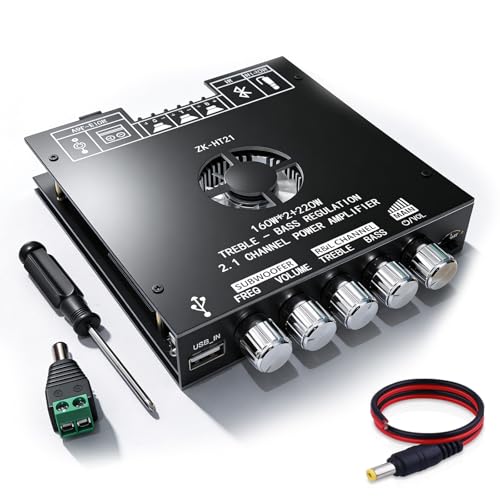
This 2.1 channel board delivers 160W×2 plus 220W subwoofer output with 12-24V DC input and Bluetooth 5.1. It uses independent tone controls for treble, bass, and sub, paired with a high-performance audio chip to reduce distortion. Best for HiFi home systems and car audio upgrades where extra sub-bass is desired. Caution: Ensure proper heat management for sustained operation, as higher output generates more heat.
S600X-W Power Amplifier Board

The S600X-W uses dual TPA3255 chips to reach up to 300W×2 plus a 600W subwoofer channel, with a wide 19-51V input range. It supports multiple inputs and includes a DIY panel for straightforward enclosure integration. Best for high-power DIY subwoofer projects and compact multi-room setups. Limitation: Requires careful heat dissipation planning due to higher power output.
ZK-1002T PRO Bluetooth 5.0 Amplifier Board

The ZK-1002T PRO mirrors the 100W+100W Bluetooth 5.0 design with a 2.1 channel output and features treble and bass adjustment, AM interference suppression, and a low-noise front end. Best for balanced subwoofer and stereo projects needing reliable Bluetooth connectivity. Caution: Confirm Bluetooth disconnection when using AUX mode to avoid mixed inputs.
T220HS-W Power Amplifier Board (DAJUNGUO)
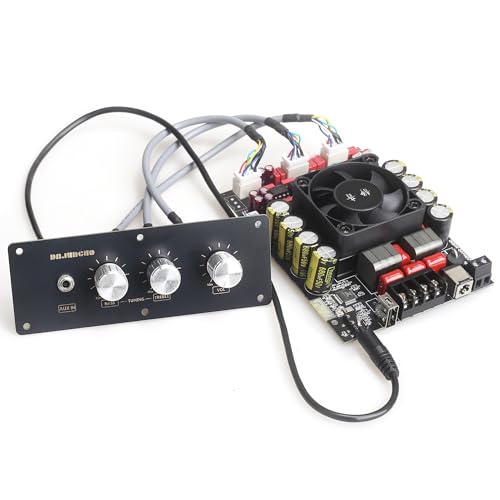
Featuring the TPA3251D2 HiFi chip, 12-36V input, and a DIY panel, the T220HS-W provides a clean 2.0 channel output with optional USB/BT/Aux inputs. Best for users seeking high-fidelity sound with a compact panel setup. Limitation: Lower power compared with some 2.1 channel boards, which may affect very large rooms or demanding sub systems.
X400HS 2.1 Channel Amplifier Board

The X400HS uses dual TI TPA3223 chips to output 200W+200W+400W across Left, Right, and Sub with 12-42V input. It features six knobs for precise control of sub frequency, sub volume, treble, bass, and master volume, plus multiple inputs (Bluetooth, AUX, USB). Best for theater-like home systems or large DIY speaker builds. Caution: The six-knob interface can be complex for first-time builders; plan your enclosure layout carefully.
Buying Guide
Key considerations to help you choose the right Bluetooth amplifier board kit:
- Power and headroom: Match amplifier output to speaker rating and room size. Higher wattage is not always better if subwoofers and room acoustics are limited.
- Input options: Bluetooth version and supported codecs (AAC, SBC, etc.), plus wired inputs (AUX, USB). More inputs offer flexibility for future upgrades.
- Channel configuration: 2.0, 2.1, or multichannel. 2.1 adds subwoofer support for deeper bass but may require a larger enclosure.
- Control and sound shaping: Independent treble, bass, and sub controls help dial in the tone without external DSP gear.
- Size and heat management: Consider the physical footprint and whether a heatsink, fan, or airflow is necessary for continuous operation.
- Chip architecture: Chips from TI (TPA3xxx) or similar families influence fidelity, distortion, and efficiency. Higher-end chips generally provide cleaner output with lower THD.
Frequently Asked Questions
- What is the difference between 2.0 and 2.1 channel boards?
2.0 provides stereo output for two channels, while 2.1 adds a dedicated subwoofer channel for deeper bass and more immersive sound.
- Do these boards require external amplification?
Most boards integrate amplification, but some setups may perform better with additional external components in certain configurations.
- Can I use Bluetooth with wired speakers?
Yes, many boards support Bluetooth input alongside AUX or USB, enabling wireless streaming to wired speakers.
- Is heat dissipation important?
Yes. Higher power outputs generate more heat; ensure adequate ventilation or cooling for stable long-term operation.
- What should I consider about power supply voltage?
Check the board’s recommended voltage range (e.g., 12-24V or 19-51V). Choose a supply that fits your speaker system and enclosure design.
- Which board is best for a car audio upgrade?
Boards with 2.1 channel output and robust subwoofer control, such as those offering 160W×2 + 220W, are strong candidates, but ensure the power supply and enclosure are compatible with the vehicle’s electrical system.