
Best Bluetooth Speaker Components Kit for DIY Builders
Looking for a complete Bluetooth speaker components kit that suits DIY projects, STEM learning, or hobbyist experimentation? This guide highlights five top Amazon picks, outlining who each kit is best for, what you can build, and where to focus your attention when choosing. Whether you want a soldering-practice project, a compact desktop speaker, or a more advanced 2.0 to 2.1 channel board, these options cover a range of skill levels and end uses.
| Product | Brand | Best For |
|---|---|---|
| ARRAROWN ZK-1002T RPO 2.0 Channel Bluetooth 5.0 Amplifier Board 200W AMP | ARRAROWN | Advanced builders needing strong power and tone control |
| MiOYOOW DIY Bluetooth Speaker Kit | MiOYOOW | STEM learning and beginner-friendly soldering practice |
| ZK-1002T PRO Bluetooth 5.0 Amplifier Board 2.0 Ch 200W | ARRAROWN | High-power, feature-rich projects requiring 2.0 channels |
| DIY Bluetooth Speaker Kit Wood Case (CYOEST) | CYOEST | Wood-case builds and hands-on assembly with easy setup |
| DIY Bluetooth Speaker Kit with LED Light Show (ScienSta) | ScienSta | Acrylic-case dual-speaker kits with LED effects |
ARRAROWN ZK-1002T RPO 2.0 Channel Bluetooth Amplifier Board

Features include 100W+100W output via Bluetooth 5.0, USB and AUX inputs, and independent treble and bass adjustment. Aims for low-noise performance with AM interference suppression and shielding power inductance for cleaner sound. Best for: dedicated audio projects where you need strong output and tone control without external preamps.
Best for: Builders who want direct control over treble and bass and who plan to drive a subwoofer or larger speakers. Limitation: AUX mode requires disconnecting the Bluetooth connection to avoid signal overlap.
MiOYOOW DIY Bluetooth Speaker Kit

This kit provides a dual 3W speaker setup, LED lights, and a clear acrylic enclosure. It is a strong choice for desks, dorm rooms, and beginner-friendly projects. Best for: students and hobbyists seeking a hands-on STEM experience with a functional, ready-to-use Bluetooth speaker after assembly.
Best for: Learners new to electronics who want to explore amplifier circuits. Caution: Requires basic soldering skills; not ideal for absolute beginners without any soldering experience.
ZK-1002T PRO Bluetooth 5.0 Amplifier Board

Same core spec as the standard ZK-1002T but labeled as PRO, featuring 100W+100W Bluetooth 5.0, USB/AUX, and 2.1 channel output. Independent treble and bass adjustment supports precise tuning. Best for: projects needing a slight uptick in channel configuration and robust sound with low-noise characteristics.
Best for: Builders who want a step-up version with 2.1 output. Caution: Ensure proper Bluetooth disconnection when using AUX mode to prevent interference.
DIY Bluetooth Speaker Kit Wood Case (CYOEST)

Wood-case kit with laser-cut components, two 2-inch, 4-ohm 3W full-range speakers, and a dual-channel amplifier board. Simple assembly guide and a4 power options. Best for: new builders who want a complete wood-case project with straightforward wiring and a tangible finished product.
Best for: Classroom or hobby projects emphasizing hands-on building. Caution: Batteries are required (not included) to power the unit during operation.
DIY Bluetooth Speaker Kit With LED Light Show
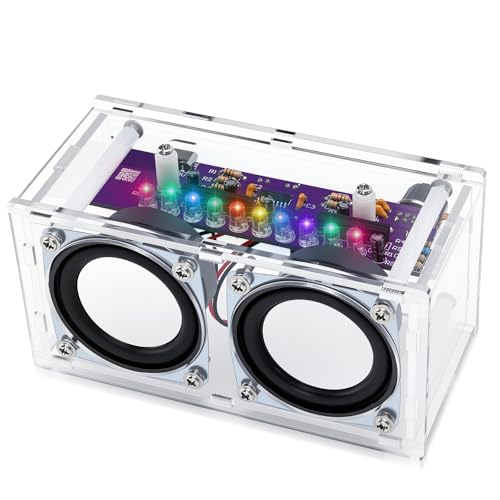
Includes a purple PCB, dual 2-inch speakers, transparent acrylic enclosure, and a colorful LED light show. Beginner-friendly with a detailed color-illustrated manual. Best for: projects where aesthetics and visual effects complement audio, suitable for STEM demonstrations or creative gifts.
Best for: Learners who want a visually engaging, step-by-step soldering exercise. Caution: Requires foundational soldering skills; not for absolute beginners with zero experience.
Buying Guide
What type of buyer should choose a Bluetooth speaker components kit?
Such kits suit DIY enthusiasts, students in STEM programs, hobbyists, and educators who want hands-on electronics education. The right kit balances build simplicity with learning outcomes and final sound goals.
What should you look for in a kit’s power and sound features?
Key factors include amplifier power (watts per channel), available channels (2.0 vs 2.1), Bluetooth version (5.0 or higher is common), and tone control (separate treble and bass). A kit with low-noise front-end and AM interference suppression tends to deliver clearer audio.
How important are inputs and expandability?
Consider input options (Bluetooth, USB, AUX, TF/SD) and whether the board supports expansion (subwoofer output, additional channels). If you plan a larger speaker system, a 2.1 setup can provide more depth with a dedicated subwoofer.
What about assembly complexity and learning value?
Some kits emphasize STEM learning with soldering practice and component-level assembly, while others focus on producing a ready-to-use speaker with fewer steps. Match the kit’s complexity to your experience and goals.
Which finishing options matter for a display project?
Wood cases, acrylic enclosures, and LED lighting add aesthetic appeal. If you want a classroom-friendly look or a stylish desk setup, choose a kit that includes the enclosure material you prefer and any visual effects you want.
Safety and preparation considerations
Safety basics include using proper soldering techniques, handling batteries correctly, and ensuring proper insulation of connections. Review included instructions for any required tools and safety warnings before starting.
FAQ
Q: Are these kits suitable for absolute beginners?
A: Some kits include beginner-friendly components and clear manuals, but several require basic soldering skills. Check the product description for assembly prerequisites.
Q: Can I add more speakers or a subwoofer later?
A: Many boards support additional channels or subwoofer connections, especially 2.1-channel configurations. Verify compatibility in the product features.
Q: Do these kits come with enclosures?
A: Several include wooden or acrylic enclosures, while others require you to assemble your own housing or reuse existing cases.
Q: What wiring skills will I learn?
A: You’ll typically practice basic soldering, wiring polarity, and connecting inputs to outputs, alongside basic circuit concepts in audio amplification.