
Best Wireless Guitar Systems for Clean Stage Performance and Practice
Answering the common query for reliable, low-latency wireless guitar systems, this guide highlights five top options that balance stability, sound quality, and ease of use. These picks are best for players who need dependable freedom on stage, in rehearsal spaces, or during home practice. Each product section explains who it’s best for, why it was chosen, and a practical caveat to consider before buying. A quick summary table is included to compare core specs at a glance.
Quick Product Overview
| Product | Best For | Key Benefit | Approx. Latency |
|---|---|---|---|
| JOYO JW-06 | Small venues and practice | High stability with 5.8GHz transmission | Under 6 ms |
| Xvive A58 (5.8GHz) | Live performers requiring long range | Long range, low latency, multi-system use | < 5 ms |
| LEKATO WS-100 | Bands and tours | 4-channel, long battery life | < 6 ms |
| LEKATO 5.8GHz System | Studio and stage | True 5.8GHz diversity, 24-bit/48kHz | ~6 ms |
| Positive Grid Spark Link | Hybrid wireless for electric, acoustic, bass | Wide range, very low latency | < 3 ms |
JOYO JW-06 5.8GHz Wireless Guitar System

Best for practicing at home or small gigs where a simple plug-and-play setup is preferred. The JW-06 uses 5.8GHz digital transmission with 48K/24Bit audio and low noise. Latency stays under 6ms, ensuring the guitar’s dynamic feel is preserved during playing. The included charging case extends total playtime to around 18 hours, valuable for long sessions or back-to-back practice. A potential caveat is that performance can vary with obstructions; testing space beforehand helps ensure stable performance.
Who it’s best for: players new to wireless who want a straightforward system with long battery life and simple pairing. It suits home studios, worship teams, and small venues where interference is manageable.
Xvive A58 Wireless Guitar System (5.8GHz)

Best for performers needing a robust range and the ability to run multiple systems concurrently. The A58 system supports 5.8GHz operation with a stated working range of over 100 feet and less than 5ms latency. It is designed to handle simultaneous use of up to four pairs. A limitation to consider is potential interference in crowded RF environments; testing before a critical show helps maintain reliability.
Who it’s best for: bands or solo artists who require freedom to move across larger stages or venues and may operate multiple wireless units without signal clashes.
LEKATO WS-100 Wireless Guitar System with Charging Case

Best for gigging players who want reliable 4-channel operation and a compact charging solution. The WS-100 features a rechargeable transmitter and receiver pair, plus a charging case that provides 12+ hours of total playtime. It advertises a practical <6.7ms latency and a stable 100ft range, which makes it suitable for small to mid-sized stages and practice rooms. A noted caution is to verify pairing in your space to avoid mid-set dropouts due to RF interference.
LEKATO 5.8GHz Wireless System (24-Bit/48kHz)
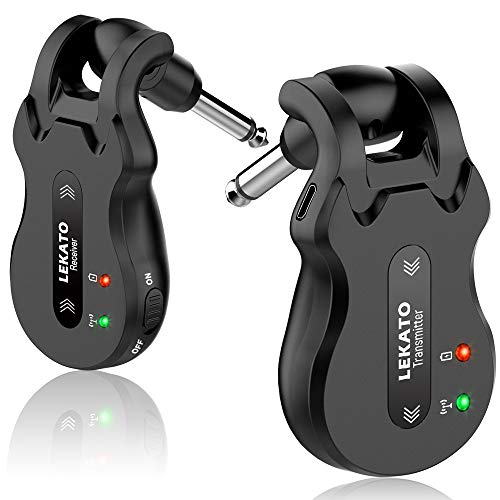
Best for stage and studio players who want high-fidelity audio with minimal latency. The 5.8GHz system emphasizes 24-bit/48kHz audio and claims clearer sound reproduction with reduced interference compared to older formats. It uses a true diversity design and emphasizes a wide frequency response. A potential limitation is battery life per charge, which is shorter than some multi-charge cases for extended singing or instrument usage during long events.
Getaria 5.8GHz Four-Channel System (GWS-26-Type C)

Best for guitarists who perform with multiple instruments or need a robust four-channel setup. The Getaria system advertises 5.8GHz operation with stated 24-bit/48kHz audio and up to 100 feet of range. It highlights a rotatable transmitter and plug head, providing ergonomic advantages for players with tremolo systems or different guitar shapes. A caution is that long-term durability of the rotatable plug should be considered with heavy use on busy stages.
Positive Grid Spark Link Wireless System

Best for players seeking ultra-low latency and broad range with optimized digital transmission. Spark Link offers 2.4G wireless technology with 24-bit/48kHz audio, and latency under 3ms, which helps preserve dynamic touch during fast passages. The system supports a generous 70ft (over 20 meters) range, allowing freedom of movement. A potential limitation is that it uses 2.4G rather than 5.8G in some configurations, which may influence performance in RF-dense environments.
Buying Guide: Key Considerations For Your Wireless Guitar System
- Latency: Lower latency means more natural playing feel. Look for systems under 5–6 ms for live performance and under 3 ms for high-precision playing.
- Frequency Band: 5.8GHz systems generally offer robust performance and less crowding than 2.4GHz, but can vary by location and interference. Some products also support multiple channels to switch away from noisy frequencies.
- Range: Consider your typical stage size. Systems advertising 100 ft or more are ideal for large venues or worship stages; smaller rooms perform well with 30–50 ft ranges.
- Battery Life and Case: A charging case extends playtime for long gigs. Check total hours available per charge and how many full recharges the case provides.
- Multi-Channel/4-Channel Capability: If you’re in a band with multiple wireless instruments, ensure your system supports multiple simultaneous channels without interference.
- Ease of Setup: Plug-and-play systems with clear pairing instructions save time before performances.
- Sound Quality: Look for 24-bit/48kHz audio specs for faithful reproduction of your guitar’s tone; high-resolution audio reduces quantization and noise.
Frequently Asked Questions
- What is the main difference between 5.8GHz and 2.4GHz wireless guitar systems?
– 5.8GHz systems typically offer less interference and more stable connections on crowded stages, while 2.4GHz systems can be more prone to congestion but may work well in quieter RF environments. - Which wireless system is best for long-stage performances?
– Systems advertising long ranges (100 ft or more) with multi-channel support are ideal for longer stages and multi-instrument setups. - Can I use multiple wireless receivers on one stage?
– Yes, several brands support multiple simultaneous connections; ensure you have distinct channels and proper frequency planning to avoid cross-talk. - Is latency the most important factor for a wireless guitar system?
– Latency is crucial for feel and timing, especially for fast riffs and live performances. Aim for latency under 5 ms for most playing styles. - Do charging cases significantly improve battery life?
– Charging cases are helpful for extended gigs, tours, or long practice sessions, giving additional full charges beyond the transmitter’s built-in battery. - Are rotatable plug heads a real benefit?
– Yes, rotatable connectors improve comfort and fit on guitars with various placements of output jacks, especially on guitars with tremolo systems.