
Best Capo for Mountain Dulcimer: Top Picks for Quick Key Changes and Clear Tone
Answering the common question from dulcimer players: what capo best fits a mountain dulcimer neck and preserves tone? This guide highlights five capos that work well with mountain dulcimer strings, offering secure grips, gentle pressure, and reliable quick-change designs. The top choices cover natural wood finishes, versatile clamp mechanisms, and models designed for variety in string spacing. Suitable buyers include beginners seeking easy key changes, intermediate players needing reliable performance on stage, and traveling players who value compact, durable capos.
| Product | Best For | Why It Stands Out |
|---|---|---|
| Roosebeck Capo for Mountain Dulcimer – Walnut | Traditional wood dulcimer players | Specifically designed for mountain dulcimer necks with walnut and lacewood, semi-gloss finish, brass screw for secure hold |
| WINGO Guitar Capo for Acoustic Electric Guitars | Players needing quick changes on various instruments | Quick release, versatile use, strong spring for buzz-free tone |
| Professional Natural Wood Yangqin Capo (JeuRon) | Players using dulcimer-family instruments and transposers | Designed for precise tuning with silicone padding and durable aluminum construction |
| Kyser Quick-Change Capos (KG6BA / KG6RW / KG6SNB) | Guitarists seeking fast one-handed changes | Original quick-change mechanism, lightweight aluminum, professional quality |
Note: The table shows how each selected capo aligns with different playing needs—from instrument-specific designs to versatile, cross-instrument options. For mountain dulcimer players, the strongest fit is the Roosebeck model, with others offering alternatives for players who also perform on different stringed instruments.
Roosebeck Capo for Mountain Dulcimer

Best for traditional mountain dulcimer players who want a headstock-capable solution built for the instrument’s neck profile. The walnut and lacewood combination offers an aesthetically pleasing look with a secure grip. The brass screw provides durable adjustment. Opening dimensions range from 1 1/8 inches to 1 5/8 inches, accommodating common dulcimer necks.
Best for players prioritizing a purpose-built dulcimer capo that maintains string integrity and tone. Choose this if you value a fixed wood construction and a snug fit on your instrument.
Caution: Fit can be sensitive to non-standard neck shapes; ensure your dulcimer neck width falls within the stated opening range.
WINGO Guitar Capo for Acoustic Electric Guitars
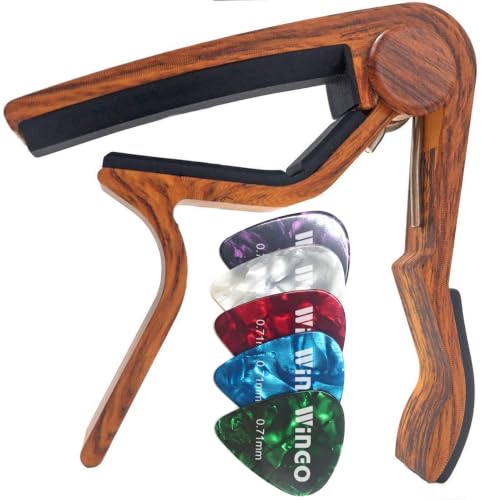
Best for players who want a versatile capo that works across instruments, including steel-string guitars and other fretted instruments. Its quick-release mechanism makes key changes fast during performances and practice sessions. The design aims to provide balanced pressure with a strong spring to reduce buzzing and maintain a clear tone.
Best for players who prioritize quick changes and cross-instrument use. Note that dulcimer players should confirm neck width compatibility since this is primarily marketed for guitars.
Caution: While versatile, it may sit less flush on uniquely curved dulcimer necks compared to a purpose-built dulcimer capo.
Professional Natural Wood Yangqin Capo (JeuRon)

Best for dulcimer-family players exploring a transposer approach with a focus on precise tuning. Engineered specifically for Yangqin, this capo offers balanced pressure across strings to minimize intonation drift during rapid key changes. High-density silicone padding protects strings and bridges from wear.
Better for players who want robust padding and durable aluminum construction for regular performance use. It is a cross-application option if you occasionally work with dulcimer-type instruments.
Caution: This capo is designed for Yangqin and similar family instruments; verify compatibility with your dulcimer model before relying on it as a primary capo.
Kyser Quick-Change Guitar Capo – KG6BA

Best for players who want a one-handed capo change with minimal effort. The Kyser KG6BA uses lightweight aluminum with a steel spring for reliable performance. This is a pro-quality option suited to frequent key changes during performances.
Better for players who perform across multiple genres and instruments. Consider this if you value speed and durability over a model tailored strictly to dulcimer necks.
Caution: Not specifically designed for dulcimer necks; ensure your instrument’s neck width and fret spacing align with this capos’ clamp range.
Kyser Quick-Change Capo – Rosewood KG6RW

Best for players seeking same quick-change technology in a rosewood finish. The KG6RW provides the same solid mechanism and clamp action as other Kyser models, with a warm aesthetic suitable for traditional or stage settings.
Choose this if you want consistent performance across a fleet of stringed instruments while preferring a rosewood aesthetic. Limitation: not instrument-specific for dulcimers; verify neck compatibility for your model.
Kyser Quick-Change Capo – Sunburst KG6SNB

Best for players who want a sunburst finish with the proven quick-change mechanism. This model shares the same robust aluminum build and reliable spring design for fast and stable capo changes on stage or in practice.
Better for guitar-focused players who occasionally use dulcimers. If you mainly play mountain dulcimer, a dulcimer-specific capo can offer a better neck fit.
Buying Guide: Capo Selection For Mountain Dulcimer
- Instrument fit: Mountain dulcimer necks are typically narrow and rounded; look for capos with a narrow opening range and smooth padding to avoid fret buzz or string binding.
- Material and finish: Wood capos provide a warm tone and aesthetic match for traditional dulcimers; metal capos offer durability and quick changes but may affect finish or neck fit.
- Pressure and buzz: Choose capos with even pressure across strings to prevent intonation drift. Padding helps protect strings and bridges from wear.
- Change mechanism: Quick-change designs save time during performances and practice. Test for one-handed operation if you perform live.
- Compatibility: Some capos are instrument-specific (guitars, banjos, dulcimers). If you perform on multiple instruments, a versatile capo can reduce gear needs, but ensure a good fit for the dulcimer.
- Durability and weather: For frequent travel or outdoor gigs, select a cap with corrosion-resistant materials and a secure locking mechanism to prevent loosening.
FAQ
- Q: Do I need a dulcimer-specific capo? A: A capo designed for small, curved necks with padded contact points is ideal, but versatile capos can also work if they fit your dulcimer’s neck width.
- Q: Will a guitar capo damage a dulcimer neck? A: If properly fitted, most capos do not cause damage. Avoid capos that apply excessive pressure or have rough edges on contact points.
- Q: Which material is best for dulcimer tone? A: Wood capos often deliver a warmer, traditional tone; metal capos offer durability and quick changes but may alter brightness slightly.
- Q: How important is padding on a capo? A: Padding protects strings and finishes and helps prevent fret buzz by distributing pressure evenly.
- Q: Can I use the same capo on multiple instruments? A: Yes, if the neck widths align and the clamp provides adequate pressure without binding strings.
- Q: Should I prioritize quick-change or instrument-specific design? A: Quick-change is convenient for live performance, but a dulcimer-specific design may offer a tighter, more reliable fit on the instrument’s neck.