
Best Car Charger Adaptor Plug Solutions for On‑the‑Go Power
Looking for a car charger adaptor plug that keeps devices powered during drives? This guide profiles five top options, highlighting who they’re best for, how they perform, and practical buying tips. Whether you need portable power for travel, work trips, or family road trips, these picks help you compare output, safety features, and USB configurations at a glance. The top picks cover compact inverters for laptops, multiport USB charging, and traditional 12V to 110V power conversion—ideal for different device needs and vehicle setups.
Summary table of selected products:
| Product | Best For | Main Benefit | Limitations |
|---|---|---|---|
| PiSFAU 200W Car Power Inverter | Laptop users and multiple devices | 2 AC outlets + 4 USB ports for versatile charging | Higher power draw; larger form factor |
| 150W Power Inverters for Vehicles | DIYers and light electronics | Solid 150W continuous power with 2 USB ports | Lower wattage than 200W options |
| BESTEK 300W Car Inverter | Heavy device users and camping | High continuous and peak power with dual AC outlets | Bulkier; can draw more vehicle power |
| LISEN Car Charger USB C, 69W | Smartphone and tablet users on the move | Dual ports with PD USB-C and USB-A for faster charging | Smaller total wattage; depends on device charging needs |
| KENHAO 67W 3-Port Car Charger | Multi-device charging on the road | PD and QC fast charging via USB-C and USB-A | Not an inverter; limited to USB charging |
PiSFAU 200W Car Power Inverter

Best for: Road trips that require laptop charging and multiple devices simultaneously. This 200W inverter converts DC 12V to 110V AC with two standard outlets and four USB ports, supporting laptops, tablets, phones, and small holiday lighting or peripherals. The built‑in heat dissipation tech and high‑efficiency circuit design reduce energy waste and minimize noise, making it suitable for long drives or camping scenarios where quiet operation matters.
Why selected: It offers a balanced mix of AC outlets and USB ports in a compact form factor. The presence of two AC outlets allows one to power laptops or a small monitor while the USB ports charge everyday devices. Best for travelers who need flexibility without carrying separate adapters.
Limitations: The 8.5 oz unit is still relatively larger than basic USB car chargers and requires a vehicle 12V outlet capable of handling higher power draws. Do not exceed the inverter’s continuous rating by running multiple high‑wattage devices simultaneously.
150W Power Inverters for Vehicles 12V DC to 110V AC

Best for: Budget‑conscious users who need a reliable inverter for basic electronics and occasional laptop charging. This model provides 150 watts of continuous DC to AC power with a peak of 300 watts, plus two USB ports for mobile devices, making it suitable for small electronics, lights, or tablets on the road.
Why selected: The dual USB charging ports complement the AC outlets, offering a practical mix for everyday driving needs without excessive power consumption. It serves well for short trips or backup power when outlet availability is limited.
Limitations: Not designed for high‑wattage laptops or power‑hungry devices. The power ceiling means plan usage around lighter loads to avoid triggering protection features.
BESTEK 300W Car Inverter

Best for: Users needing higher continuous power for laptops, CPAP machines, or other larger electronics while on the road. The BESTEK inverter provides 300 watts continuous power and 700 watts peak, with two AC outlets and USB ports, making it a robust option for travel and camping.
Why selected: It is a proven option among higher‑capacity inverters with a compact footprint. The addition of two AC outlets expands charging flexibility for multiple devices at once.
Limitations: The unit’s higher output can draw more from the vehicle’s electrical system, so ensure the vehicle’s wiring supports extended high‑load use. It’s bulkier than ultra‑compact options, which may affect space in smaller interiors.
LISEN Car Charger USB C, 69W Dual Port
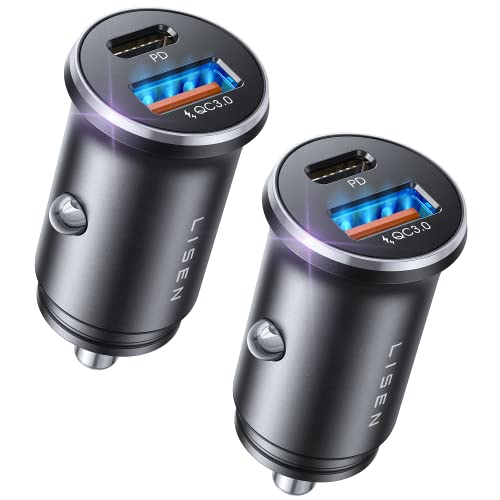
Best for: Smartphone and tablet users seeking fast USB charging without dashboard clutter. This two‑port charger features a PD USB-C port and a USB‑A port, delivering up to 69W total. It balances power with a compact design to minimize heat and tangle.
Why selected: Its emphasis on reducing heat and clutter makes it ideal for drivers who prioritize a clean dash setup and stable charging on the road. The PD port is compatible with many modern devices for efficient charging.
Limitation: Output is distributed between two ports; if multiple power‑hungry devices are connected, charging speed may drop on one port. It’s not an inverter, so it won’t power AC appliances.
KENHAO 67W 3-Port Car Charger

Best for: Multi‑device charging on the go, including newer USB‑C devices and traditional USB‑A gadgets. This USB‑C and USB‑A combo supports fast charging with up to 37W PD on USB‑C and 30W QC on USB‑A.
Why selected: All‑metal housing offers better heat dissipation and durability, which is important for hot vehicle environments. The multiport design helps keep cables organized while charging several devices simultaneously.
Limitation: It is not an inverter; it cannot power laptops or larger AC devices. Ideal when only USB charging is required.
Buying Guide
What power needs should you consider?
Determine the expected load: high‑wattage devices (laptops, CPAP machines) require an inverter with higher continuous power (e.g., 200–300W). For phones and tablets, USB‑C PD or USB‑A charging suffices. Inverters with USB ports add versatility, but know the total continuous power rating to avoid overloading the vehicle’s electrical system.
Inverter vs. USB car chargers: which to choose?
Choose an inverter if you need to power AC devices in the car, such as laptops or small appliances. Choose a USB charger when you only need to charge phones, tablets, or wearables, as they’re lighter, often safer, and less drain on the vehicle battery.
Safety and protection features
Look for models with automatic shutoff on faults, over‑current and over‑voltage protection, and temperature management. Some units include built‑in fuses or smart chips to prevent damage from faults or surges. These features help avoid fuse replacements and protect your devices.
Port configuration and device compatibility
Assess how many devices you plan to charge at once and what types of connections you need (AC outlets, USB‑C PD, USB‑A QC). Dual AC outlets are useful for laptops and larger devices, while PD USB‑C supports fast charging for newer devices.
Size, weight, and installation considerations
12V car outlets vary in size and heat output. If you have limited space, prioritize compact USB chargers. For longer trips with multiple devices, a higher‑output inverter can reduce the number of adapters you need but may take up more space and draw more power.
Device‑specific notes
Laptops, CPAP machines, and dash cams have distinct power needs. Always verify that the inverter’s continuous wattage matches your device’s running wattage, and that peak wattage can handle surge requirements.
Warranty and support considerations
Choose brands with documented support channels and reasonable warranty terms. While this guide avoids speculating on warranties, a policy that covers power components provides added assurance when in transit or camping.
FAQ
- Can I power a laptop with a car inverter? Yes, if the inverter provides sufficient continuous wattage for the laptop and any other connected devices. Check the laptop’s wattage and ensure the inverter’s rating exceeds it.
- Is a USB car charger safer than an inverter? USB car chargers with proper protection are generally safer for charging USB devices and produce less heat. Inverters power AC devices and require attention to heat and power limits.
- Do I need a fuse with car inverters? Many inverters include built‑in protection and fuses. Some setups may require external fuses depending on vehicle wiring and inverter design.
- Will multiple USB ports charge faster? Not always. Some ports share power; if one device requires more power, it may limit how quickly other devices charge. Check per‑port output specs and total power budget.
- What should I avoid when using a car inverter? Avoid running high‑wattage devices that exceed the continuous rating. Also avoid blocking vents or overloading the cigarette lighter socket, which can cause overheating.
- Which option is best for travel with many devices? A higher wattage inverter with multiple outlets plus USB ports provides flexibility for laptops, tablets, and phones, while compact USB chargers are useful for smaller devices and reducing clutter.