
Upgrade your car audio with the right amplifier to match speakers or subwoofers. Below is a quick comparison of selected car amplifiers chosen for multichannel support, bridging options, and power handling to suit different system goals.
| Product | Channels | Key Feature |
|---|---|---|
| Taramps TS 400×4 (Black) | 4 | 400W RMS @2Ω, High-Level Input |
| STINGER MT-1000.5 | 5 | Digital Class D, Compact High Efficiency |
| BOSS R1004 Riot Series | 4 | Class A/B Full Range, High/Low Inputs |
| Pyle PLA2200 | 2 (Bridgeable) | 1400W Bridgeable, MOSFET, Crossover |
| RECOIL DI550.4 | 4 | Class D, 1040W Max, Bridgeable |
Taramps TS 400×4 Black 4-Channel Amplifier

This Taramps TS 400×4 Black is a multichannel, full-range amplifier that delivers 400 watts RMS at 2 ohms. It provides four channels at 100W RMS each or two bridged channels with 200W RMS at 4 ohms. The unit includes RCA inputs, a high-level input with automatic activation, and basic protection circuitry. Its compact Class D design is aimed at efficient power delivery and flexible installation.
STINGER MT-1000.5 5-Channel Class D Amplifier

The STINGER MT-1000.5 is a digital Class D, 5-channel amplifier designed for high efficiency and a compact footprint. Key features include a HexFET/MOSFET topology, high/low-pass filtering options, a remote subwoofer bass knob, and a subsonic filter. This model emphasizes power density and space-saving design for systems that need both front/rear channels and a powered sub output.
BOSS Audio R1004 Riot Series 4-Channel Amp
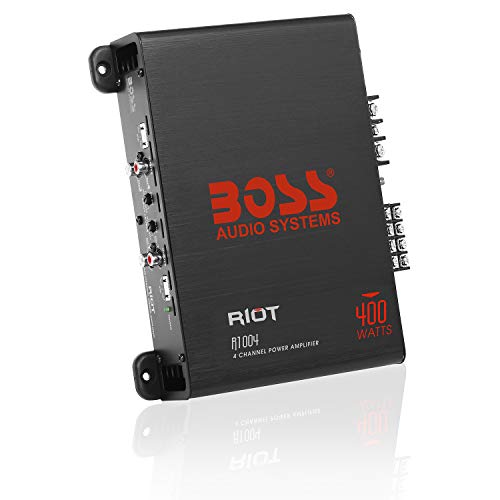
The BOSS R1004 Riot Series is a Class A/B, 4-channel amplifier suitable for full-range speaker setups. It offers high/low level inputs and stable operation from 2 to 8 ohms. Output capability is listed as up to 100W per channel at 2 ohms (max spec) with lower ratings at higher impedances. Its topology focuses on traditional audio character and compatibility with many factory or aftermarket head units.
Pyle PLA2200 Dual Channel Bridgeable Amplifier

The Pyle PLA2200 is a dual-channel, MOSFET-powered amplifier with a bridgeable output and up to 1400W peak bridge capability. It includes switchable bass boost, variable gain, crossover controls, gold-plated RCA ports, and a subsonic filter. The MOSFET pulse-width modulation supply is intended to reduce distortion and support clean output to compact speakers or a bridged subwoofer channel.
RECOIL DI550.4 4-Channel Class D Amplifier

The RECOIL DI550.4 is a Class D 4-channel amp rated for RMS 130W x4 @2Ω and 80W x4 @4Ω, with bridged outputs of 260W x2 @4Ω. It uses a high-speed MOSFET power supply and features adjustable gain, LPF/HPF crossover, and bass EQ. Protection circuits and stable operation across 2–4 ohms make it versatile for speaker and compact subwoofer configurations.
Buying Guide
Choosing the right amplifier for car speakers involves matching electrical and installation requirements with listening goals. Below are key considerations.
Power Matching
RMS vs Peak: Match amplifier RMS power to the speaker’s continuous (RMS) rating to avoid distortion or damage. Avoid relying on peak/maximum numbers alone.
Impedance: Confirm amplifier stability at common impedances (2Ω, 4Ω). Bridging doubles channels into higher power per channel but requires correct impedance to avoid overheating.
Channels And Configuration
2-Channel amps are common for subs or stereo pairs; bridgeable units allow a mono sub channel. 4-channel
5-channel
Class Type And Efficiency
Class D amplifiers offer higher efficiency and smaller size—good for limited space and battery/alternator load. Class A/B
Inputs And Controls
High-Level Inputs enable connection to factory head units without RCA outputs. RCA Inputs
Installation Constraints
Consider amplifier dimensions, mounting location, and required wiring gauge. Higher power amps may require thicker power cables and in-line fusing. Check ventilation and short-circuit protection features to ensure durability in confined vehicle spaces.
Protection And Reliability
Look for built-in protections such as thermal, short-circuit, and over-current safeguards. MOSFET power supplies and quality components often improve reliability and reduce noise or thumps at turn-on.
Sound Goals And Speaker Compatibility
Match amp power and crossover features to speaker sensitivity and speaker type (coaxial, component, midrange, or subwoofer). For clean mid/high reproduction, avoid overpowering small speakers; for subwoofers, prioritize stable low-frequency output and dedicated sub controls.
Comparison Perspectives
- Efficiency & Space: Class D models (STINGER, RECOIL, Taramps Class D models) suit tight installs and lower alternator load.
- Traditional Sound Character: Class A/B (BOSS, DS18 where applicable) may offer different tonal preferences for certain systems.
- Power-Hungry Sub Systems: Bridgeable dual-channel or high-RMS multi-channel amps (Pyle PLA2200, Taramps TS 1200×4 variants) are oriented to driving subs or multiple high-power speakers.
- Factory Integration: Units with high-level input and automatic turn-on (Taramps TS series) simplify installs with OEM head units lacking RCAs.