
Choosing the right wiring kit is essential for a clean, safe car subwoofer installation. Below is a concise comparison of top wiring kits selected for reliability, gauge options, and included components to support subwoofers and amplifiers.
| Product | Gauge / Type | Key Components |
|---|---|---|
| TOPSTRONGGEAR 4ga Amp Kit | 4 AWG (CCA) | Power/Ground, OFC RCA, speaker & remote wire, fuse holder |
| BOSS KIT2 8 Gauge | 8 AWG | Power/ground, fuse holder, speaker, turn-on, terminals |
| DS18 AK4 4 Gauge Kit | 4 AWG (CCA) | ANL fuse holder, shielded RCA, connectors, wire loom |
| Welugnal 0 Gauge Kit | 0 AWG | 0 AWG power/ground, ANL fuse, remote wire, high strand count |
| Muzata 10 Gauge Kit | 10 AWG (OFC) | Power/ground, RCA, remote, fuse holder, terminals |
TOPSTRONGGEAR 4ga Amp Kit – 4 Gauge AWG Amplifier Wiring Kit
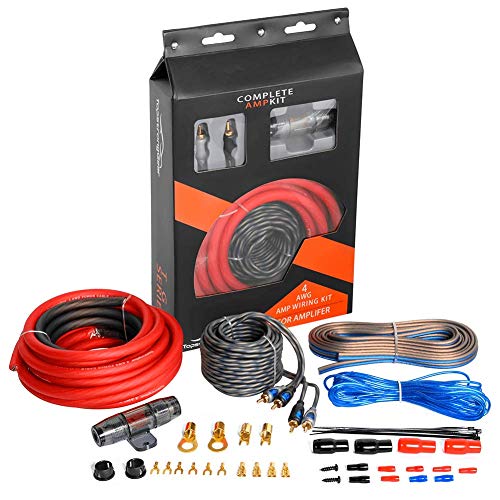
This kit Provides 17 ft 4 AWG power and 3 ft 4 AWG ground CCA cables designed for flexible routing in tight spaces. It includes an OFC RCA cable for lower noise signal transfer and 18 ft speaker and remote wires to connect amp, sub, and head unit. The package is aimed at single-amp installs and supplies a fuse holder for inline protection.
- Best For: Users needing a full 4 AWG kit with OFC RCA for improved signal integrity.
- Notable Feature: Ultra-flex CCA conductors simplify routing.
BOSS Audio Systems KIT2 8 Gauge Complete Car Amplifier Wiring Kit
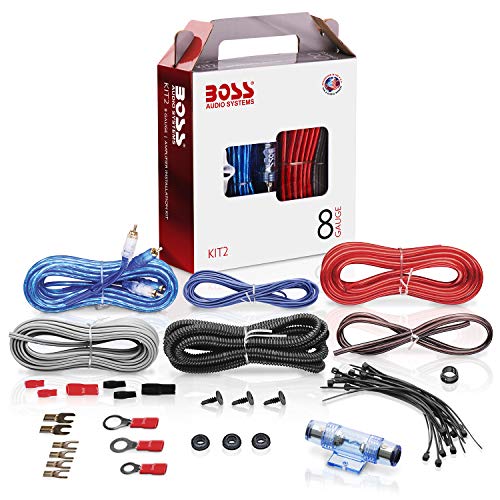
The BOSS KIT2 is a complete 8-gauge solution for moderate-power subwoofer systems. It contains a 20 ft power cable, fuse holder, 16/18 gauge remote and speaker wires, and terminals for secure connections. The kit also includes grommets and wire ties to assist with installation and chassis pass-through protection.
- Best For: Mid-power systems where 8 AWG is sufficient and easy installation is desired.
- Notable Feature: Includes grommets and versatile accessories for cleaner installs.
DS18 AK4 Complete 4 Gauge CCA Amplifier Installation Wiring Kit

The DS18 AK4 kit targets single-amplifier installs rated up to roughly 1200W and contains 4 gauge power and ground cables, an ANL fuse holder with an 80A fuse, shielded RCA interconnects, and all necessary terminals, ties, and loom. The shielded twisted pair RCA helps reduce RF and electrical interference for cleaner audio.
- Best For: One-amp systems needing ANL protection and shielded RCA for noise control.
- Notable Feature: Full accessory set simplifies a neat installation.
0 Gauge Car Amp Audio Wiring Kit – Welugnal 3000W Car Amplifier

This Welugnal kit provides heavy-duty 0 AWG power and ground cables with a high strand count for maximum flexibility and current capacity. It includes an ANL fuse holder and a 100A ANL fuse, remote turn-on wire, and other installation essentials designed for high-power systems up to multi-kilowatt setups.
- Best For: High-power or multi-amp systems where minimal voltage drop is critical.
- Notable Feature: Very high strand count and thick conductor diameter for long runs and heavy loads.
Muzata 10 Gauge Amp Wiring Kit Amplifier Installation
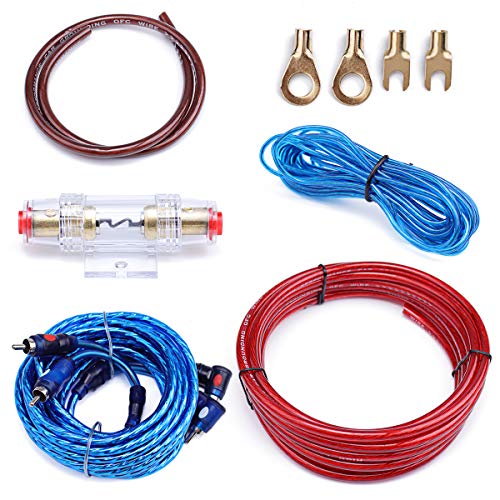
Muzata’s kit uses 10 AWG OFC conductors and emphasizes high-quality oxygen-free copper for improved conductivity. The kit includes RCA interconnects, a fuse holder, connecting terminals, and remote wire. It’s a compact option for lower-power subwoofers or OEM upgrades where copper conductors are preferred over CCA.
- Best For: Installers prioritizing OFC copper wiring for lower resistance at moderate power levels.
- Notable Feature: 100% OFC conductors in a smaller gauge kit.
Buying Guide: How To Choose The Right Subwoofer Wiring Kit
Selecting the proper kit depends on amplifier power, vehicle wiring length, and installation complexity. Below are critical considerations to compare kits effectively.
1. Determine Required Wire Gauge
Match wire gauge to amplifier RMS power and run length. Thicker gauge (lower AWG number) reduces voltage drop. Typical guidance:
- 0–1 AWG: Very high-power systems or long runs.
- 2–4 AWG: Most single-amp subwoofer systems up to ~1500–2000W depending on run length.
- 8–10 AWG: Moderate or factory-level upgrades.
2. CCA Vs. OFC Conductors
CCA (Copper Clad Aluminum) offers cost savings and lighter weight but higher resistance than pure copper. OFC (Oxygen-Free Copper) provides better conductivity and lower heat at higher currents. Choose OFC for efficiency in tight tolerance builds; CCA is acceptable for budget or shorter runs.
3. Fuse Type And Protection
ANL/AGU fuse holders are common for high-current kits; inline blade holders are used on smaller kits. Ensure fuse rating matches amplifier manufacturer recommendations and that the kit includes a compatible holder for neat mounting.
4. RCA And Remote Wiring
Shielded RCAs reduce noise from alternator whine and EMI. A high-quality remote turn-on wire and properly shielded RCA pair help maintain signal integrity, especially with longer cable runs.
5. Installation Accessories
Look for grommets, ring terminals, heat-shrink, wire loom, and zip ties. These items protect cables at firewall pass-throughs, secure grounds, and keep the install clean and safe.
6. Run Length And Voltage Drop
Longer cable runs increase voltage drop; choose larger gauge to compensate. Measure the path from battery to amplifier and increase gauge if runs exceed typical lengths or if using high current gear.
7. Grounding Best Practices
Use the shortest possible ground lead and attach to a clean, paint-free metal surface on the vehicle chassis. For high-power builds, consider grounding blocks or dedicated chassis points to minimize ground loop noise.
8. Multiple Comparison Perspectives
- Performance: 0–1 AWG and 4 AWG kits support highest power and lowest voltage drop.
- Cost vs. Efficiency: CCA kits are cheaper but less efficient; OFC kits cost more with better conductivity.
- Noise Control: Shielded RCAs and twisted-pair interconnects reduce interference.
- Installation Ease: Kits with grommets, terminals, and detailed accessories simplify clean installs.
Use the amplifier manufacturer’s recommended fuse and wiring specs as the primary reference. Match kit gauge, conductor type, and included accessories to your vehicle layout and desired power handling for a safe and effective subwoofer installation.