
Best Cassette Player Recorder With Microphone for Easy Audio Capture
Answer: A cassette player recorder with a microphone is best for preserving old tapes, conducting on-the-go interviews, and classroom or hobby use. This guide highlights five top options and who they’re best for, so you can choose a model that fits your needs and budget. Think students, educators, podcast hobbyists, and retro enthusiasts who want simple one-touch recording and reliable playback.
Buyer considerations at a glance: durability, built-in mic versus external mic support, one-touch recording, playback options (headphone, AUX), power options, and ease of use. Below is a quick reference table to compare the five selected models.
| Product | Best For | Why It Stands Out |
|---|---|---|
| PROSCAN Cassette Player & Recorder | Casual listeners and beginners | One-touch recording; external mic jack; built-in free-standing mic |
| Jensen Cassette Player/Recorder | Students and on-the-go recording | 1-touch recording; built-in condenser mic; external mic jack; auxiliary input |
| Mersoco Cassette Player/Recorder / USB Converter | Voice capture to digital | Cassette/USB mode; records to USB; REM port for external remote |
| Coby Cassette Tape Player & Voice Recorder | Classroom and meetings | Standing mic; built-in speaker; aux input for devices |
| QFX Portable Shoebox Cassette Player Recorder | Tech-savvy users seeking connectivity | USB to cassette recording; USB/Line-in/Out; Bluetooth playback |
PROSCAN Cassette Player & Recorder With Microphone

Key features include a one-touch recording button and both a free-standing microphone plus an external microphone jack with automatic level control for clear recordings. Best for entry-level users who want straightforward playback and simple capture for interviews or note-taking. Caution: external recorders can require manual level adjustments in noisy environments.
Jensen Cassette Player/Recorder

Includes 1-touch recording, fast forward/rewind, headphone jack, and volume control. Built-in condenser microphone and external mic jack broaden your recording options. Best for students and travelers who need a reliable device with multiple input options and compact design. Limitation: may lack advanced digital features seen in higher-end models.
Cassette Player Recorder/Tape Converter / USB

This device adds USB conversion, allowing tapes to be stored as WAV/MP3 on a USB drive. It supports cassette and USB modes, plus an REM port for external control. Best for classrooms or hobbyists who want to digitize collections. Caution: USB drive compatibility can vary by format and file type.
Coby Cassette Tape Player & Voice Recorder
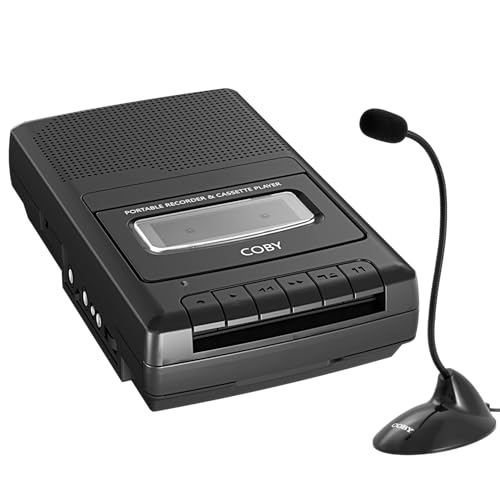
Offers a standing microphone for hands-free recording, built-in speaker, headphone jack, and aux input for external devices. Best for classrooms or meeting notes where participants need hands-free operation. Limitation: built-in sound quality may be modest for critical audio work.
QFX Portable Shoebox Cassette Player Recorder

Dual recording options let you capture from USB to cassette or from cassette to USB. Bluetooth playback plus line-in/out and external mic support adds flexibility. Best for digital enthusiasts who want versatile connectivity. Caution: Bluetooth audio may introduce occasional latency in live recording scenarios.
TOMASHI Portable Cassette Player

Compact design with built-in speaker and microphone; supports playback or recording with optional headphone use. Best for travel and language learning on the go. Limitation: smaller size can limit control precision for advanced users.
KLIM K9 Cassette Player With Earphones

Includes built-in speaker, microphone, and earphones; automatic stop to protect tapes. Best for learners and voice memos who want a simple, all-in-one device. Caution: some users may prefer separate mics for higher-fidelity recordings.
Buying Guide
What features should you prioritize?
- Recording options: Choose between a built-in mic, external mic jack, and one-touch recording for quick sessions.
- Playback and output: Look for headphone jacks, AUX inputs, and built-in speakers to suit private or shared listening.
- Power and portability: Consider battery options or AC power, and the device’s size for travel or classroom use.
- Digital conversion: If you want to preserve tapes digitally, pick models with USB/USB-C or USB-to-tape conversion capabilities.
- Durability and ease of use: Simple controls and sturdy build help in busy environments like classrooms or fieldwork.
Multiple Perspectives
For archival projects, a model with a reliable external mic and easy USB transfer can simplify digitization. For language learners, a compact player with a built-in mic and auto-stop helps manage study sessions. Teachers might prioritize a model with a standing mic and easy plug-and-play connectivity to share audio with the class. Budget-conscious buyers should weigh whether built-in features meet needs or if an affordable model with essential inputs suffices.
FAQ
- What is the main purpose of a cassette player with a microphone?
To record audio directly onto tapes or convert tapes to digital formats, often with a mic to capture voice or interviews.
- Should I choose USB-capable models?
Yes if you want to digitize or archive tapes easily; USB or USB-to-tape features simplify saving files.
- Is a built-in microphone enough for clear recordings?
For basic notes and interviews, a built-in mic is often sufficient, but external mics improve fidelity in noisy environments.
- Are Bluetooth-enabled players necessary?
Not essential for tape playback, but helpful if you want wireless audio streaming or simpler file transfers on some models.
- What about automatic stop functions?
Automatic stop helps prevent tape wear and makes playback easier, especially for beginners.