
Best Cheap 4 Channel Amplifier Options for Car Audio on a Budget
Looking for an affordable 4-channel amplifier that still delivers solid power and clear sound? This guide highlights five budget-friendly options, explains who each model suits best, and shows how to choose based on features like power, input types, and protection. Whether you’re upgrading a factory radio or building a compact system, these amplifiers balance cost and performance for everyday listening and medium-grade setups.
Buyer’s quick pick table: each model’s niche use
| Product | Best For | Why It Stands Out |
|---|---|---|
| Taramp’s TS 400×4 400W | Budget multi-channel installs | Compact 4-channel power with solid efficiency; suitable for small car builds |
| Romicta 4 Channel | Home theater and car/karaoke setups | 4-channel with Bluetooth, multiple inputs, strong Hi-Fi potential |
| RECOIL DI550.4 | Versatile multi-room or multi-speaker cars | High/low controls and 1040W max for flexible tuning |
| Taramp’s TS 1200 Watt 4-Channel | Higher demand systems | Higher RMS power per channel, factory radio ready |
| SounDigital (400W 4 Channels) | Compact, reliable four-channel amp | Simple 4-channel solution with balanced power |
Note: All models listed aim to balance cost and performance. Each product is best paired with proper installation practices and compatible speakers to maximize benefits and avoid potential issues.
Taramp’s TS 400×4 400W RMS Car Amplifier
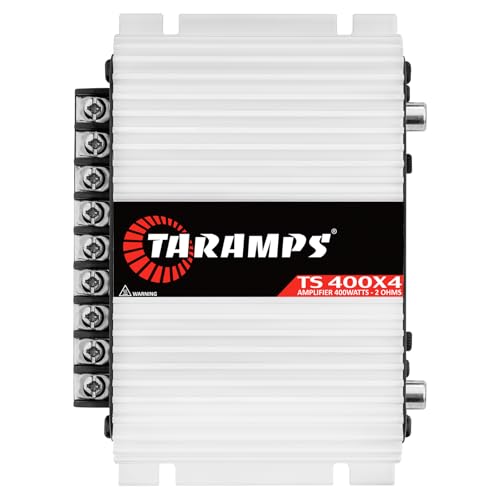
The Taramp’s TS 400×4 is a compact, 4-channel multichannel amplifier designed for small to mid-size car audio systems. It offers 400 watts RMS total output across four channels and supports two bridged channels for added flexibility. Best for budget-conscious installers who want reliable daily listening power in a compact form factor.
Best for: budget-driven builds needing solid multi-speaker control without excessive size. It is most suitable for users who plan a straightforward four-speaker setup or a two-channel bridge for higher headroom on a sub-division of the system.
Why selected: It provides a clean 4-channel platform suitable for standard door speakers or component sets while keeping costs reasonable. The inclusion of bridging capability helps in expanding the system later if desired.
Caution: Professional installation is strongly recommended to ensure proper setup, safety, and optimal performance. Improper installation may result in damage, injury, or voided warranty.
Romicta 4 Channel Bluetooth 5.0 Amplifier

Romicta’s 4-channel Bluetooth amplifier delivers 4x50W RMS, with up to 1200W peak power. It includes Bluetooth 5.0 connectivity, USB/SD/FM, and a microphone input, making it versatile for home theater, car audio, or karaoke use. Its compact footprint suits smaller spaces while still driving four passive speakers.
Best for: users seeking a single, compact amplifier that handles home entertainment and basic car audio, with Bluetooth and USB/SD inputs for flexible media playback.
Why selected: The combination of four channels, multiple input options, and a Hi-Fi emphasis through a low THD spec supports clear listening across rooms or vehicles.
Caution: Ensure the Bluetooth range and input sensitivity meet your setup needs, and confirm compatibility with your other audio sources.
RECOIL DI550.4 Full-Range Class-D 4-Channel

The RECOIL DI550.4 is a Class-D 4-channel amplifier offering 1040W max power with 130W RMS x 4 at 2 ohms and 80W x 4 at 4 ohms. It includes 4-way protection circuitry and adjustable gain, LPF, HPF, and bass EQ, making it a versatile option for various car audio configurations.
Best for: buyers who want flexible tuning and robust protection features in a cost-effective package for four speakers or a multichannel setup.
Why selected: The broad protection suite and adjustable crossover controls enable safer operation at higher volumes while preserving sound quality across channels.
Caution: Verify wiring and speaker impedance compatibility to avoid undervaluing resistance or overloading the amp.
Taramp’s TS 1200 Watt 4-Channel Amp

The TS 1200 Watt model provides 4 x 300W RMS at 2 ohms or 2 x 600W bridged at 4 ohms. It supports high-level inputs with automatic turn-on and RCA inputs for flexible integration with OEM radios. This model is designed for higher-demand car audio systems needing more power per channel.
Best for: enthusiasts building a louder system who want more headroom per channel and straightforward factory radio compatibility.
Why selected: Its higher RMS capability suits larger components or multiple speakers, while still remaining accessible for budget-conscious builds.
Caution: Higher power requires careful installation and proper cooling to avoid thermal issues during prolonged use.
ORION CEA400.4D Cobalt Elite 4-Channel

ORION’s CEA400.4D delivers up to 400W RMS across four channels with 2-ohm and 4-ohm configurations. It includes built-in crossover control with adjustable high-pass and low-pass filters, enabling precise frequency distribution for coaxial or component systems.
Best for: drivers who want a compact, efficient four-channel amp with flexible crossover control for a balanced front-stage or full-range setup.
Why selected: The integrated crossover controls help tailor sound without needing extra external processors, which is cost-efficient for budget builds.
Caution: The horsepower is modest relative to some higher-end models; plan speaker matching accordingly to avoid underutilization.
SounDigital Amplifier (400W 4 Channels)
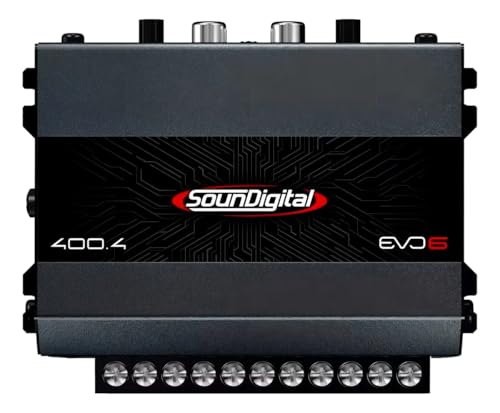
SounDigital offers a compact 400W total power across four channels, described as a versatile four-channel solution for car audio. The model is designed to provide clean amplification with straightforward setup for common four-speaker systems.
Best for: buyers seeking a simple, reliable four-channel option with a focus on compactness and ease of use for everyday listening systems.
Why selected: The straightforward four-channel configuration is ideal for clean, balanced upgrades where space is at a premium.
Caution: Availability and model specifics can vary; verify exact channel power and impedance handling before purchase.
Buying Guide: Key Purchase Considerations
What to consider when choosing a cheap 4-channel amplifier:
- Power and impedance: Match RMS power per channel to your speaker impedance (2 ohms or 4 ohms) for safe operation and adequate volume.
- Inputs and compatibility: Look for RCA inputs or high-level inputs with OEM compatibility if you plan to connect to factory radios.
- Crossovers and filtering: Built-in high-pass and low-pass filters simplify tuning and reduce speaker strain.
- Protection features: Short-circuit, thermal, and overcurrent protections help protect speakers and electronics in budget builds.
- Size and installation: Consider the physical footprint and mounting options, especially for compact or tucked-away installations.
- Upgrade path: If you expect to expand the system, ensure the amp offers bridgable channels or higher-power options.
Practical setup tips: plan speaker layout first, wire gauges appropriately for the current, and use proper fusing and grounding. A professional installation is advisable when higher power or complex routing is involved to ensure safe operation and optimal performance.
FAQ
Q: Are cheaper 4-channel amps reliable for daily driving?
A: Yes, many budget models are designed for everyday use, but reliability improves with proper installation, ventilation, and appropriate speaker matching.
Q: Can I use a 4-channel amp with a factory radio?
A: Some units offer high-level inputs or OEM integration options; verify compatibility with your vehicle’s stereo system and harness.
Q: Is it better to buy a higher-wass model than multiple smaller amps?
A: A single higher-wattage 4-channel amp can be simpler and more efficient for a four-speaker setup, reducing wiring complexity.
Q: Do I need a subwoofer amplifier separate from a 4-channel amp?
A: If you have a dedicated sub, you may use a separate mono amp for the sub and reserve the 4-channel amp for the front and rear speakers. Some 4-channel amps can bridge to drive a sub in a pinch.
Q: What is better for tuning—analog controls or digital DSP?
A: Built-in analog crossovers are common on budget amps; DSP-enabled models offer more precise, software-driven tweaks but often at a higher price.