
Best Cheap Car Code Readers for Quick Diagnostics
Looking for an affordable car code reader that delivers reliable diagnostics? This guide highlights practical, budget-friendly OBD2 scanners ideal for DIYers, commuters, and car owners who want quick insights without visiting a shop. Each pick targets common tasks like reading and clearing codes, viewing live data, and checking I/M readiness. The top five are chosen for broad compatibility, ease of use, and clear data presentation across multiple vehicle types.
Summary table of selected products:
- MOTOPOWER MP69033: Best overall value for broad compatibility and real-time data on a 2.8″ display.
- ANCEL AD310: Best compact option with fast, reliable code reading and clear results.
- VDIAGTOOL VD10: Best DIY-friendly tool with built-in DTC definitions and stable performance.
- LeeKooLuu OBD2 Scanner Ease Setup: Best plug-and-play for beginners seeking straightforward diagnostics.
- FOXWELL NT301: Best for quick CEL checks and reliable live data with professional-grade features.
MOTOPOWER MP69033 Car OBD2 Scanner

The MOTOPOWER MP69033 combines multiple functions with broad protocol support. It reads and erases codes, displays real-time data, checks I/M readiness, and provides vehicle information and data flow. It is best for users who need a feature-rich tool in a compact, no-frills package. Limitations include a smaller display, which may require more scrolling to read longer data sets, and reliance on the vehicle’s power via the OBDII port.
- Best for: Budget-conscious owners who want extensive OBDII capabilities on a wide range of cars.
- Why selected: Strong multi-function set and broad protocol coverage (9 protocols) make it versatile for many 1996+ vehicles.
- Caution: The 2.8″ LCD display may require frequent screen navigation for complex data sets.
ANCEL AD310 Classic Enhanced Universal OBD II Scanner
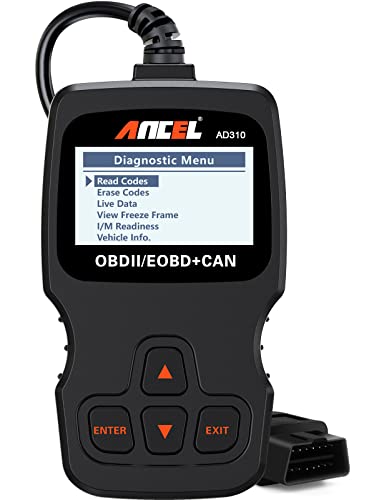
The ANCEL AD310 emphasizes simplicity and reliability, with clear readouts of diagnostic trouble codes, live data, and freeze frame information. Its compact design and sturdy 2.5-foot cable support everyday use in a garage or driveway. It operates directly from the vehicle’s OBDII port without extra power sources. A suitable choice for beginners and casual users who want fast results without extra features that complicate operation.
- Best for: Beginners and casual users needing straightforward DTC reading and clearing.
- Why selected: Strong balance of performance, portability, and a proven track record in the market.
- Caution: May lack some advanced live data parameters found in higher-end models.
VDIAGTOOL VD10 OBD2 Scanner
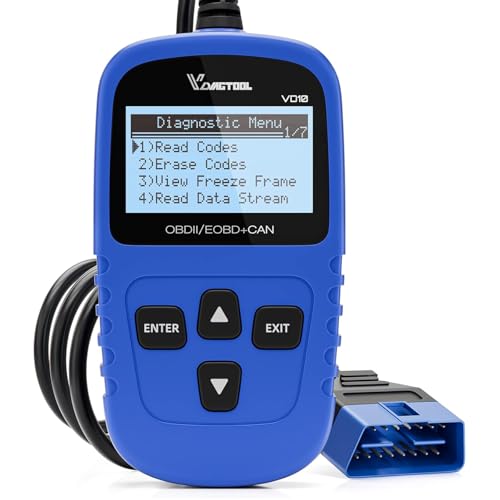
The VD10 is presented as a DIY-friendly tool with quick code reading, clearing, and a built-in DTC library that covers more than 3000 codes. It supports reading live data and I/M readiness, making it practical for ongoing maintenance and troubleshooting. It’s well-suited for car owners who want clear definitions on the screen without online lookups or additional apps. A potential limitation is that some codes may need cross-referencing for full interpretation.
- Best for: DIYers who value instant DTC definitions on-device and ease of use.
- Why selected: Built-in code database reduces dependence on external resources during diagnoses.
- Caution: Some advanced OEM-specific codes may require supplementary reference material.
LeeKooLuu OBD2 Scanner Ease Setup
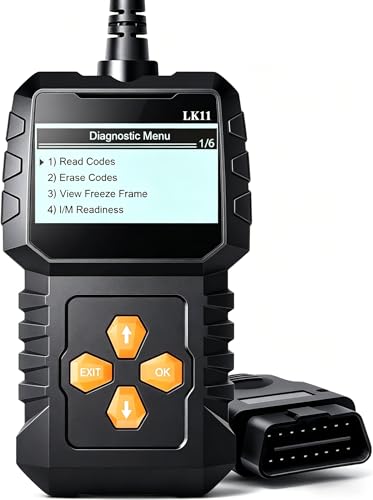
The LeeKooLuu Ease Setup emphasizes plug-and-play practicality. It provides quick engine fault code retrieval, clearing capabilities, live data, and freeze frame analysis. Its user-friendly design caters to DIYers and those who want immediate diagnostics without prior experience. A note: its feature scope is focused on essential checks rather than extensive professional diagnostics.
- Best for: Beginners and casual users seeking a straightforward, no-fuss diagnostic tool.
- Why selected: True plug-and-play design with essential features for quick checks.
- Caution: May not include some advanced data streams found in premium models.
FOXWELL NT301 OBD2 Scanner

The FOXWELL NT301 is widely regarded for its diagnostic reliability and speed. It reads and clears engine fault codes quickly and features I/M readiness, live data, and a dedicated LCD display with clear indicators. It suits users who want a tool that balances professional-grade capabilities with ease-of-use for home diagnostics. A potential limitation is that some users may find it heavier or slightly more complex than ultra-budget options.
- Best for: DIYers and car owners who need fast, dependable diagnostics and I/M readiness checks.
- Why selected: Known for quick results and reliable data presentation in a compact form.
- Caution: Slightly higher price point and a few advanced functions beyond basic readers.
Buying Guide
What should you consider when choosing a cheap car code reader?
- Compatibility: Ensure support for OBDII and your vehicle’s make, model, and year. Most 1996+ US, EU, and Asian cars use OBDII/CAN protocols.
- Ease of use: Look for plug-and-play design, clear screens, and intuitive menus. Beginners benefit from built-in code definitions and simple clearing options.
- Data depth: Live data, freeze frame, I/M readiness, and DTC lookups vary by model. If you want quick checks, prioritize models with clear fault definitions on-device.
- Display and power: A readable screen (LCD or color TFT) and power derived from the vehicle are practical, especially for on-the-spot diagnostics.
- Portability and build: Compact form, sturdy cables, and durable casing help in everyday use and travel scenarios.
FAQ
- Do cheap code readers work on all cars?
Most work on OBDII-compliant vehicles (1996+ in the US, EU, and many other regions). Check compatibility with your specific year and model for any exceptions. - Can a budget scanner clear codes permanently?
Most budget readers can clear codes after repair, but some will reset only temporarily. Look for devices that explicitly state they clear codes and reset MIL/I/M readiness. - Is a larger screen better?
A larger display improves readability, especially for complex data. However, screen size is not the only factor; data clarity and ease of navigation matter too. - Do these tools require a battery?
Most plug-and-play readers draw power directly from the OBDII port and do not require separate batteries or chargers. - Are professional-grade scanners necessary?
For everyday maintenance and basic diagnostics, budget readers are sufficient. Professional tools offer deeper diagnostics and advanced functions for shop use. - What makes a reader “best” for me?
Best depends on your needs: breadth of data, ease of use, device size, and how often you diagnose vehicles across different models.