
Best Cheap Preamp for Turntable: Clear, Budget-Friendly Phono Preamps
If you’re looking to upgrade vinyl listening without breaking the bank, a budget-friendly phono preamp is a smart choice. These compact devices convert a turntable’s phono signal to line level, allowing connection to modern receivers and powered speakers. The top picks here suit different needs: beginners seeking easy setup, vinyl enthusiasts prioritizing noise reduction, and users who want compact, travel-friendly options. Below are five affordable phono preamps that balance price with practical features for American buyers.
Quick buyer snapshot table:
| Product | Best For | Key Benefit | Notes |
|---|---|---|---|
| Pyle PP999 | Budget setup near source | Low noise, simple RCA I/O | Compact and affordable |
| cotsoco Phono Preamp | RCA and TRS versatility | Stable low-noise output | Includes 12V DC adapter |
| Fosi Box X2 | Warm, tube-like sound | 3 gain modes, tube-like warmth | Grounding post included |
| Jancane Phono Preamp | Reliable, simple setup | RCA input, RCA/TRS outputs | Includes 12V adapter |
| Pyle PP444 / PP777 variants | Ultra-compact options | Small footprint, steady performance | Multiple PP models |
Pyle Phono Turntable Preamp PP999
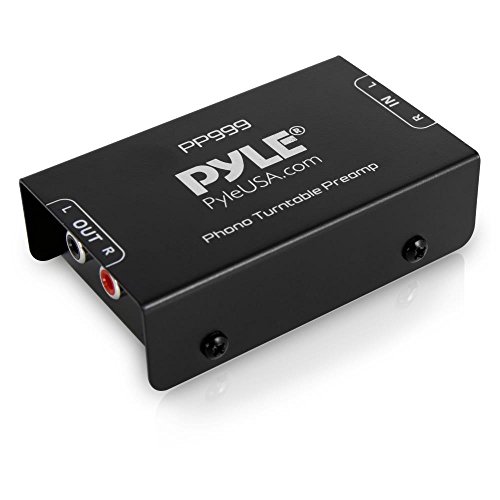
The Pyle PP999 converts phono signals to line level and supports magnetic pickups with an input sensitivity of 3 mV at 50K ohms. It emphasizes low-noise operation with audio-grade amplifiers and provides a 2V peak-to-peak output at 10K ohms. Best for budget setups where the preamp is placed close to the source to minimize noise. Choose this if you want a simple, plug-and-play option for basic vinyl playback.
Who it’s best for: casual listeners and dorm-room setups needing a compact, no-fruss preamp. Why selected: it delivers essential phono-to-line conversion without extra features that add cost. Caution: ensure your turntable does not already include a built-in preamp to avoid double amplification.
cotsoco Phono Turntable Preamp

This preamp offers RCA input and RCA/TRS outputs with a robust, low-noise output at 2V max (P-P) into 10K ohms. It includes a 12V DC adapter and stresses compatibility with turntables that lack a built-in preamp. Best for vinyl enthusiasts who want straightforward RCA wiring and a compact form factor.
Who it’s best for: users seeking a compact, reliable phono preamp with clear RCA/TRS connectivity. Why selected: the built-in considerations and adapter support simplify setup for typical home stereo systems. Caution: check that your turntable output isn’t already amplified or you could hear excess noise.
Fosi Audio Box X2 Phono Preamp

The Box X2 uses a tube-inspired design to deliver a warmer sound while maintaining a 3.5mm AUX input in addition to standard RCA outputs. It offers three selectable gain modes (39, 42, 45 dB) for better matching with different cartridges. Best for listeners who want a richer, more rounded vinyl presentation and flexible gain control.
Who it’s best for: those who enjoy a vintage-like warmth without a technical learning curve. Why selected: the gain options help tailor the output to varying tone preferences. Caution: the tube-like character is a design choice rather than a true tube amplifier; the warmth may not appeal to purists.
Jancane Phono Turntable Preamp

The Jancane model converts phono signals to line level with an input sensitivity of 3mV at 50K ohms, and it provides RCA inputs with RCA/TRS outputs. It emphasizes low-noise operation and includes a 12V DC adapter for easy powering. Best for entry-level users who want a compact, straightforward setup without extra frills.
Who it’s best for: beginners and budget-conscious buyers who want dependable performance. Why selected: it offers essential conversion with minimal setup. Caution: ensure your turntable’s output stage is compatible and does not require a built-in preamp, to avoid hum or noise.
Jancane Phono Preamp With 12V Adapter

Similar to other Jancane entries, this model converts phono to line level with 3 mV input sensitivity at 50K ohms and delivers a 2V peak-to-peak output into 10K ohms. It features RCA inputs and RCA/TRS outputs, and includes a 12V adapter. Best for those who want a compact, reliable preamp with solid low-noise performance.
Who it’s best for: cost-conscious vinyl fans who want predictable, no-nonsense performance. Why selected: compact size and reliable operation. Caution: avoid placing near strong interference sources to minimize potential noise pickup.
Pyle Ultra Compact Phono Preamp PP444
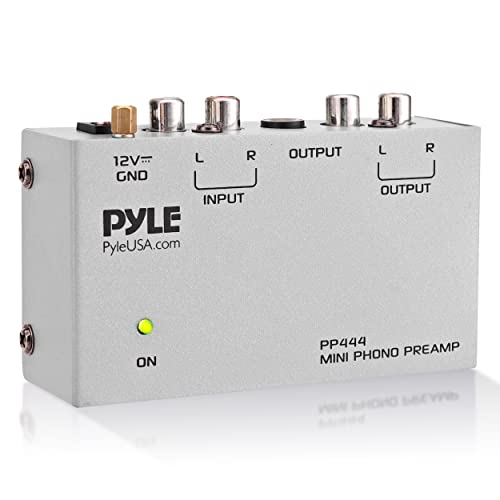
Designed as an ultra-compact option, the PP444 uses RCA input and output to provide line-level conversion for turntables. It’s best for minimal desk space or travel needs. The data indicates it remains a straightforward solution for standard vinyl playback without advanced features. Best for: travelers and students who need a small, simple preamp.
Who it’s best for: users prioritizing footprint over extra controls. Why selected: smallest form factor among the reviewed models. Caution: very compact units may lack some shielding, so position away from electrical devices to reduce noise.
Pyle Mini Phono Turntable Preamp PP777

The PP777 mirrors Pyle’s mini phono preamp line, converting phono signals to line level with a 3 mV input sensitivity at 50K ohms. It emphasizes low-noise operation and a compact footprint. Best for budget buyers who want a familiar Pyle interface in a smaller package.
Who it’s best for: compact-space listeners and students. Why selected: consistent Pyle build at a lower profile. Caution: verify compatibility with your turntable’s output stage to avoid excess gain or distortion.
Buying Guide: Key Considerations For Choosing A Cheap Phono Preamp
- What is your setup? Determine if your turntable lacks a built-in preamp. If it does, any budget phono preamp will help, but if it already has one, you’ll need a line-level preamp only for certain configurations.
- Gain options and noise: Look for adjustable gain or stable low-noise operation. Higher gain helps with low-output cartridges, but may increase noise if the design isn’t well-shielded.
- Input/output format: Ensure RCA inputs and outputs match your current cables or consider TRS compatibility if your system supports it.
- Power considerations: Most models use a 12V DC adapter. Confirm included power supply and ensure it fits your setup near the equipment rack.
- Form factor and placement: If desk space is limited, opt for ultra-compact models. For best noise reduction, place the preamp close to the turntable without interference sources.
- Compatibility with cartridges: Magnetic (MM) cartridges are common; verify input sensitivity and impedance to avoid mismatch.
- Durability and wiring quality: While budget models differ, look for stable connections and solid, shielded housing to minimize hum.
Frequently Asked Questions
- Do I need a phono preamp if my receiver has a built-in phono stage? Answer: If your receiver already has a dedicated phono input, you typically do not need an external preamp. An external unit is useful when your receiver lacks a phono stage or you want to customize gain and noise characteristics.
- What is “MM” in phono preamps? Answer: MM stands for moving magnet. Most budget preamps are designed for MM cartridges, and you should verify compatibility with your cartridge type.
- Will a cheap preamp improve my vinyl sound dramatically? Answer: It depends. A budget preamp improves the signal from a non-phono device, reduces noise, and provides proper RIAA equalization, but the improvement is modest compared to upgrading the cartridge or turntable itself.
- How close should the preamp be to the turntable? Answer: Place it near the source to minimize noise pickup; a short, clean run of cables helps preserve signal quality.
- Are there risks using a tube-inspired preamp for cheap setups? Answer: Tube-inspired designs can add warmth; however, it is not the same as a true tube amplifier. If you prefer a clinical, neutral sound, choose a solid-state option.
- What should I do if I hear hum after connecting a preamp? Answer: Check grounding connections, ensure no mixing of parallel grounds, and verify that the turntable is not connected to a powered device too close to the preamp.