Best Class D Speaker Amplifier for Home and Car Audio
Class D amplifiers deliver efficient, compact power for home, desktop, car, and DIY audio projects. Below is a concise summary of five selected Class D amplifiers that suit passive speakers, bookshelf systems, car installs, and small DIY builds. Use the table to compare at a glance.
| Product | Type / Use | Chip / Key Feature |
|---|---|---|
| Fosi Audio BT20A | Home Desktop / Bluetooth | Mini Class D, 100W x2 |
| Fosi Audio BT20A Pro | Home Desktop / Bluetooth, Upgradable Op-Amps | TPA3255, 300W x2, Bluetooth 5.0 |
| Fosi Audio V1.0G | Home / Bookshelf / Hi‑Fi Desktop | TPA3116D2, 50W x2 |
| BLAUPUNKT AMP1904D | Car Audio 4‑Channel | Class D, 4-channel, high max power |
| AIYIMA A07 | Hi‑Fi Desktop / Home Theater | TPA3255, 300W+ capability, NE5532 op‑amp |
Fosi Audio BT20A Bluetooth Stereo Amplifier
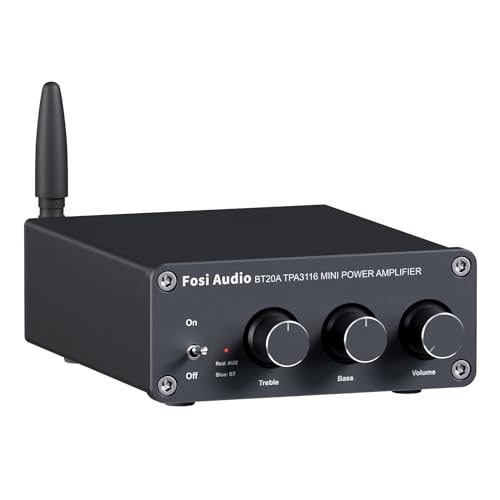
The Fosi Audio BT20A is an entry-level mini Class D amplifier built for simple home and small-venue setups. It features a compact form factor, Bluetooth input, and manual bass/treble controls for basic tonal adjustment. The unit claims a peak capability up to 100W x 2 and is intended for indoor/outdoor, garage, or bookshelf speaker use. Installation is straightforward with a single power switch, making it suitable for users who want a low-footprint amp for passive speakers without complex configuration. The amp emphasizes ease of use and functional control rather than extensive connectivity.
Fosi Audio BT20A Pro Bluetooth 5.0 Amplifier
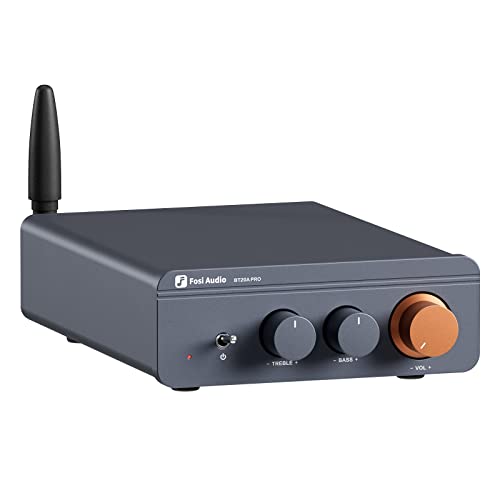
The BT20A Pro upgrades to a TPA3255 Class D chip with a claimed 300W x 2 capability and Bluetooth 5.0 connectivity. Notable features include a low idle power draw (<2.5W), high SNR (≥108dB), and very low THD (≤0.005%). The Pro model supports replaceable op-amps for tonal customization (compatible with several op-amp types listed by the manufacturer). Bluetooth pairing memory and a removal/reset procedure are included. This amp is targeted at users seeking higher power, improved efficiency, and some degree of component-level upgradeability in a compact package.
Fosi Audio V1.0G 2 Channel Class D Mini Amplifier

The V1.0G uses the TI TPA3116D2 chip and offers 50W x 2, making it suitable for bookshelf speakers and modest home audio setups. It supports 12–24V supply voltages, includes built-in speaker protection circuitry, and is designed to be quiet when idle. The solid aluminum chassis and advanced switching design aim to minimize audible noise and interference. This amp is practical for readers wanting a balance between efficiency, protection, and clean output for smaller passive speakers or a compact stereo rig.
BLAUPUNKT AMP1904D Universal Car Speaker Amplifier Class D

The Blaupunkt AMP1904D is a 4-channel Class D car amplifier designed for automotive audio systems. It lists high maximum power and channel RMS outputs depending on load: for example, RMS figures at 2 and 4 ohms are provided to guide compatibility with car speaker loads. Frequency response is broad, and claimed SNR is high (≥96dB). This amp targets car audio installations requiring multi-channel drives and compact high-power amplification with automotive-oriented inputs and protections.
AIYIMA A07 Premium TPA3255 Power Amplifier

The AIYIMA A07 is a compact Hi‑Fi Class D amplifier built around the TPA3255 and featuring a dual op-amp (NE5532). It emphasizes low distortion, low noise, and cool operation. The design supports driving 2–8 ohm bookshelf speakers and offers RCA and 3.5mm pre-out options for integration with active devices or subwoofers. The A07 is positioned for users seeking high-fidelity desktop or small home theater power in a mini amp form that supports easy setup and integration.
Buying Guide: Choosing The Right Class D Speaker Amplifier
Picking a Class D amplifier depends on use case, speaker specs, connectivity needs, and installation constraints. Below are key considerations to evaluate.
Power And Speaker Matching
RMS vs Peak: Focus on continuous (RMS) power ratings and speaker sensitivity. Match amp RMS power to speaker nominal power and impedance (2, 4, or 8 ohms) to avoid underpowering or risking damage.
Impedance Compatibility: Confirm amplifier stability at your speaker’s impedance. Some amps specify RMS at 2Ω and 4Ω—choose based on speaker wiring and final load.
Sound Quality And Chipset
Class D chipsets (TPA3116, TPA3255, TPA3118, etc.) have distinct characteristics. Higher-end chips (TPA3255) often yield lower THD and higher SNR. Op-amps and feedback designs influence tonal accuracy and noise floor.
Connectivity And Features
Inputs: Bluetooth is useful for wireless sources; RCA and 3.5mm are essential for wired connections. Pre-outs allow adding an active subwoofer or powered speakers.
Tonal Controls: Bass and treble knobs provide quick EQ shaping. Replaceable op-amps in some units enable deeper tonal customization for DIY enthusiasts.
Form Factor And Power Supply
Consider size for rack, desktop, or car use. Many mini Class D amps require external DC adapters; car amps need vehicle power wiring and fusing. Check power supply voltage range and included adapters.
Efficiency, Heat, And Idle Draw
Class D amps are efficient and run cooler than Class AB, but high output still produces heat—allow for ventilation. Low idle power draw is beneficial for always-on systems or battery-powered setups.
Protection And Reliability
Look for built-in protections: short-circuit, overload, thermal protection, and speaker-protection circuits. Metal chassis and quality capacitors contribute to durability.
Use Case Perspectives
- Home / Bookshelf: Choose amps optimized for audio fidelity and low noise (TPA3116/TPA3255 options).
- Desktop / Nearfield: Mini amps with pre-outs and low noise are ideal; Bluetooth adds convenience.
- Car Install: Select dedicated car amplifiers with proper RMS channel ratings, 12V compatibility, and automotive protection.
- DIY / Hobby: Small boards (PAM8403) or amps with replaceable op-amps suit experimentation and custom tuning.
Final Tip: Verify speaker impedance, confirm required inputs and outputs, and prioritize amps with clear RMS ratings and protection features for safe, reliable operation.