
Best Open Hole and Closed Hole Flute Guide for Beginners and Students
Answer: Open-hole and closed-hole flutes offer distinct playing feels and tonal control. This guide highlights five representative models to help buyers choose whether open or closed holes best suits beginners, students, or advancing players. The top picks balance playability, durability, and value for the typical American student or hobbyist.
The following buyer-friendly table summarizes five recommended flutes, showing key traits to compare quickly:
| Product | Hole Type | Key Count | Best For |
|---|---|---|---|
| POGOLAB Open Hole C Flute | Open/Closed Hole | 16 | Younger beginners and transitioning players |
| RTGHYTY Professional 16 Closed Hole | Closed Hole | 16 | Accurate pitch and a clean, stable tone |
| Cecilio Open Hole C Flute | Open Hole | 17 | Advancing flutists seeking precise control |
| ZOCWJK 16-Hole Open/Closed Dual-Purpose | Open/Closed Hole | 16 | Versatile for learners and performers |
| Mendini by Cecilio Open/Closed Hole Kit | Open/Closed Hole | Open/Closed | Beginner-friendly bundle with accessories |
POGOLAB Open Hole C Flute, 16 Keys

Best for: Young beginners or players transitioning from open to closed-holes. The offset G key supports a natural hand position, which can reduce fatigue during long practice sessions.
Why selected: This flute combines 16 keys with an open/closed-hole design and a sausage of features—stainless memory springs, reliable pads, and an undercut beveled embouchure hole that aids sound production. The included accessories (carrying bag, strap, gloves, adjustment screwdriver, and cleaning kit) add value for new players.
Caution: The dual-hole setup requires familiarity; beginners may need a brief adjustment period to switch between holes smoothly.
RTGHYTY Professional 16 Closed Hole
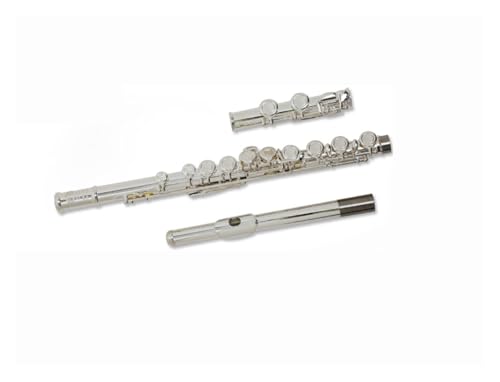
Best for: Players who want stable intonation and a polished look for performances or formal practice.
Why selected: This instrument uses professional white copper tube body and keys with silver-plated finishing for durability and a clean touch. It supports multiple pitch tests and calibration, aiming for consistent pitch and timbre across playing ranges.
Caution: Open-hole alternatives may offer more nuanced finger technique for certain advanced pieces; this model emphasizes closed-hole stability.
Cecilio Open Hole C Flute – 17 Keys

Best for: School bands or students seeking a reliable open-hole instrument with a robust kit.
Why selected: Features a 17-key setup with B-foot joint, offset G key, and split E key for improved tone control. Includes a complete accessory kit (stand, case, grease, screwdriver, cleaning cloth/rod, gloves), making it a strong value for classrooms and practice.
Caution: Open-hole setups may feel different for beginners transitioning from closed-hole flutes; some players adapt with guided practice.
ZOCWJK 16-Hole Open/Closed Dual-Purpose

Best for: Learners who want flexibility in flute technique and tone control.
Why selected: This model combines an open/closed-hole design with a comfortable, row-like E-key layout and a focus on a brighter, richer tone. The E-key split helps with treble playing and tremolo passages, offering a more versatile practice tool.
Caution: The dual-hole design adds complexity; it’s best for players who want to explore both hole concepts rather than absolute simplicity for brand-new beginners.
ZOCWJK 17-Hole Open/Closed Hole Dual-Purpose

Best for: Students who want a wide range of notes with dual-hole capability for nuanced performance.
Why selected: Emphasizes durability and a rich, penetrating tone through a square mouthpiece design and quality sheep casing pads. Dual-use hole design supports a broad repertoire and technique development.
Caution: Slightly heavier key action may require more hand strength; practice to adapt to the heavier feel.
RTGHYTY Professional 16 Closed Hole plus

Best for: Advanced beginners seeking a professional-grade closed-hole instrument with a refined finish.
Why selected: Combines professional white copper tube body with a polished silver-plated surface for a stylish, comfortable feel. The design supports precise pitch tests and smooth intervals for practicing complex passages.
Caution: If your goal is to learn paired-hole technique, this model emphasizes closed-hole stability and may require adaptation for open-hole repertoire.
Buying Guide: How To Choose The Right Open Hole Or Closed Hole Flute
- Hole Type And Play Style: Open-hole flutes often require more precise fingering but allow nuanced pitch control and a larger range of tone colors. Closed-hole flutes provide consistent articulation and easier finger mechanics for beginners or players who want a straightforward experience.
- Key Count And Foot Joint: Most student flutes range from 16 to 17 keys with a B-foot or C-foot joint. A B-foot joint extends the lower range, which can be useful for bass notes in simple pieces; a C-foot is standard for many beginner books.
- Material And Pads: Copper-nickel alloys and silver-plated finishes affect durability and tone. Double bladder pads help reduce air leakage and improve resonance, which matters for beginners learning air support.
- Ease Of Maintenance: Look for included cleaning kits, screwdrivers, pads, and a sturdy case. Open-hole models may benefit from guided practice to avoid squeaks or pitch inconsistencies as fingers learn new positions.
- Accessories And Price Value: Bundles with stands, gloves, cleaning supplies, and cases add value for school programs or home practice. Higher-end models emphasize smoother action and more precise intonation, which can influence long-term learning outcomes.
- Age And Hand Size: Offset G keys and ergonomic key layouts fit younger players or those with smaller hands. If comfort is a primary concern, test a model with an offset G and carefully evaluate the key reach.
Practical Quick-Check Questions
- Is the student transitioning from a beginner flute to a more advanced repertoire?
- Does the learner prefer a tactile, finger-positioning challenge (open hole) or a more straightforward fingering (closed hole)?
- Will the flute be used primarily for school band, solo practice, or ensemble performance?
- How important is bundle content (case, cleaning kit, stand, gloves) for the purchase?
- Is future flexibility important—open/closed hole capability in one instrument?
- What is the learner’s hand size and comfort with offset G keys?
FAQ
- What is the main benefit of an open-hole flute? It offers more tonal control and a broader range of expression through finger technique, but it can be harder for beginners to manage.
- What is the main benefit of a closed-hole flute? It provides easier articulation and more consistent response, which can be advantageous for beginners and school settings.
- Are dual-purpose flutes truly versatile? Yes, they allow players to explore both hole types, aiding technique development; however, they may require more adjustment as the player learns.
- Do accessories affect playability? Yes. Cases, cleaning kits, and pads influence maintenance, longevity, and sound quality, especially for beginners.
- Is it better to buy a kit or just the flute? For beginners and schools, a kit saves time and adds practice value. For experienced players, selecting a core quality instrument may be more important than extras.
- How should I decide which model to buy? Consider the learner’s age, preferred hole type, and whether a bundle fits your classroom or home practice needs.