
Best Seitz Concerto No. 3 in G Minor: A Practical Guide for Students and Players
The Best Seitz Concerto No. 3 in G Minor in Seitz is a staple for advancing violinists and students seeking classical study material. This article highlights five relevant editions and performances, explaining who each is best for and why. It helps teachers, students, and collectors compare options for study, repertoire development, and performance readiness. Read on to discover editions suited to student practice, implementation in lessons, and performance preparation.
| Edition | Best For | Why It Stands Out |
|---|---|---|
| Seitz: Student Concerto No. 3 in G Minor, Op. 12 | Intermediate students | Editor Sassmannshaus provides a clear piano reduction with practical notation for study and practice. |
| Concerto No. 3 in G, K.216: Score and Parts | Ensemble and solo study with full score | Reliable source for scholars needing the orchestral structure and parts in one place. |
| Max Bruch – Concerto in G Minor for Violin and Piano OP26 | Advanced players seeking musical maturity | Provides a comparable G minor concertos with editorial insights and piano reduction. |
| Concerto No. 1 in A Minor – Jean Baptiste Accolay | Beginner to early intermediate repertoire | Classic Schirmer Library edition with compact page count for practice sessions. |
| Rachmaninoff Concerto No. 2 in C Minor, Op. 18 (Piano Duet) | Advanced collaborative repertoire | Duet edition supports ensemble playing and collaborative technique building. |
Seitz: Student Concerto No. 3 in G Minor, Op. 12

Editor: Sassmannshaus, Kurt. Piano reduction included. Language: English, German. Best for intermediate students needing a reliable piano reduction to accompany practice and recital preparation. This edition emphasizes accessible editorial guidance and practical layout for study. A good choice for teachers integrating standard Seitz repertoire into lessons. Caution: some learners may outgrow the simplified arrangement as skills advance.
Concerto No. 3 in G, K.216: Score and Parts

Brand: G. Schirmer, Inc. This edition provides the full score and parts, useful for teachers and performers who want to study the orchestral structure and practice with an authoritative source. Best for: late intermediate to advanced students and teachers who require fidelity to the original layout. Limitation: not a student-friendly simplified edition; may require additional practice pacing for beginners.
Max Bruch – Concerto in G Minor for Violin and Piano OP26

Brand: G. Schirmer, Inc. This edition centers on the violin-and-piano reduction with editorial markings, offering a mature repertoire option that complements the Seitz concerto. Best for advanced players seeking broader G minor repertoire with refined editorial insights. Caution: not a direct Seitz No. 3 edition; use as a companion or alternative program piece when expanding G minor concert repertoire.
Concerto No. 1 in A Minor – Jean Baptiste Accolay
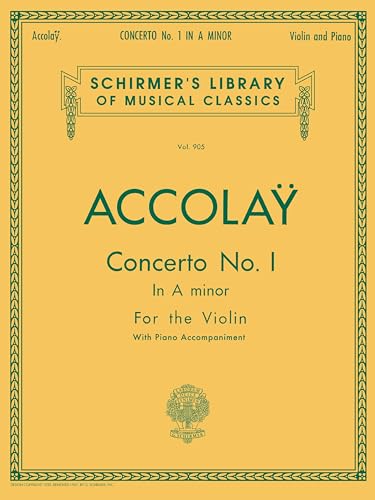
Brand: G. Schirmer, Inc. This Schirmer Library edition is compact and student-friendly, with accessible page counts and a practical piano accompaniment arrangement. Best for: beginners to early intermediate players building recital-ready technique in a graded sequence. Caution: limited complexity compared to mature concertos, so use as a stepping stone to greater repertoire.
Rachmaninoff Concerto No. 2 in C Minor (Piano Duet)

Brand: G. Schirmer, Inc. This duet edition provides a collaborative approach to mastering complex passages and ensemble timing. Best for advanced players seeking a two-piano or four-hand experience that reinforces counting and expression. Caution: high technical demand; not suitable for early milestones without progressive training.
Buying Guide
- What edition fits my skill level? Start with Seitz Student editions for early-intermediate players, progress to full-score editions for orchestral study, and consider concertos with piano reductions for practice flexibility.
- Do I need a piano reduction? Piano reductions support practice without an orchestra. They are ideal for home study and teacher-guided sessions.
- Is the edition suitable for a recital program? Choose concise, well-edited versions with clear articulation markings and reliable layout for performance interpretation.
- Should I prioritize a full score vs. solo violin with accompaniment? Full scores aid sectional study, while solo-with-piano editions emphasize technique and musicality in a practical format.
- What about editorial notes? Editorial markings can guide phrasing and bowing, but avoid overreliance; consult a teacher for personalized interpretation.
FAQ
- Which edition is best for a student starting Seitz Concerto No. 3 in G Minor? The Seitz: Student Concerto No. 3 in G Minor, Op. 12 edition is designed for intermediate students and includes a piano reduction for practice.
- Do I need the full score and parts? If you want to study orchestration and conductor cues, the Score and Parts edition is valuable. For practice, a solo with accompaniment edition may suffice.
- Is a piano reduction sufficient for recital preparation? Yes for practice and rehearsal; for a formal recital, consider a performance edition or orchestral reduction with professional suggestions.
- Can these editions be used for ensemble practice? Yes, especially editions including full score and parts or duet arrangements, which support collaborative progress.
- Are there limitations to beginner players? Some editions are advanced or edited for mature technique; beginners should start with simplified or student editions and gradually advance.
- Where can I find reliable edition sources? Reputable publishers include Bärenreiter and G. Schirmer; verify edition and editor notes to ensure fidelity to the original work.