
Best Ways to Convert Old Stereo to Wireless for Modern Listening
Answering the question “how can I convert an old stereo to wireless?” with reliable, easy-to-use adapters. This guide highlights five top Bluetooth receivers that work well with RCA, AUX, optical, and coax connections. Ideal buyers include nostalgic listeners preserving vintage gear, small-space setups, and users who want seamless wireless streaming without replacing existing speakers. The following table previews each option, followed by in-depth product details to help you pick the right receiver for your setup.
| Product | Best For | Key Benefit |
|---|---|---|
| KAIY Bluetooth Receiver for Home Stereo | Most versatile, 3.5mm/RCA outputs | Fast NFC pairing and wide compatibility |
| KAIY Bluetooth 5.4 Receiver for Home Stereo | Low-latency, robust 5.4 tech | Optical/RCA/3.5mm outputs with USB drive support |
| 1Mii B06T3 Bluetooth 6.0 Receiver | Long range, hands-on control | Rotary volume knob and 98 ft range |
| QwickZen Bluetooth Receiver for Home Stereo | All-in-one 3-in-1 outputs | Optical/Coaxial/3.5mm plus easy control |
| UGREEN Bluetooth 6.0 Receiver | Hi-Res audio with LDAC | Dual pairing and LDAC for high fidelity |
KAIY Bluetooth Receiver for Home Stereo

Features focus on seamless wireless streaming to a stereo, from RCA and 3.5mm jacks. This device can function as a Bluetooth adapter for old receivers or as a general Bluetooth audio receiver for any wired system. It supports fast NFC quick connect for instant pairing. Best for: listeners who want quick setup and broad compatibility with classic gear. Limitation: NFC pairing may require proximity and compatibility with NFC-enabled devices.
KAIY Bluetooth 5.4 Receiver for Home Stereo

Highlights include Optical/RCA/3.5mm outputs with USB flash drive support for direct music playback. Bluetooth 5.4 provides faster pairing and stronger signals with up to 33 feet range. Best for: users who want a flexible connection schema and the option to play from a USB drive. Limitation: Some setups may require manual input switching when using multiple output types.
1Mii B06T3 Bluetooth 6.0 Receiver
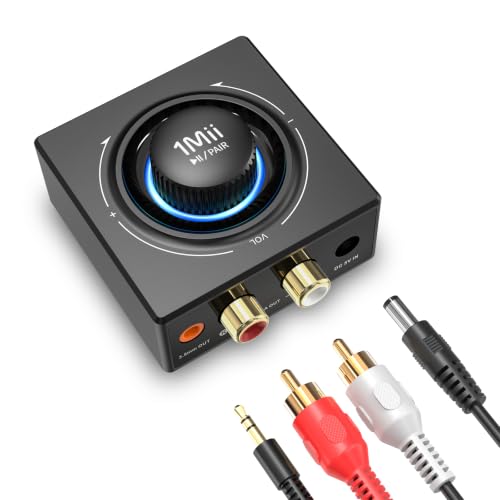
Key benefits are a hands-on rotary volume control and long-range wireless streaming up to 98 feet. Bluetooth 6.0 delivers stable connections and high-quality audio for large rooms. Best for: users who prioritize tactile control and extended range. Limitation: Some devices may experience minor pairing delays during initial setup with older gear.
QwickZen Bluetooth Receiver for Home Stereo

Offers 3-in-1 outputs (RCA/AUX/Optical) with easy volume control and a one-button play/pause. It’s designed to revive legacy audio systems by providing wireless streaming without changing hardware. Best for: those with mixed legacy devices who want straightforward operation. Limitation: LDAC or aptX support is not specified, which may affect higher-resolution expectations on some devices.
UGREEN Bluetooth 6.0 Receiver with LDAC

This model emphasizes high-fidelity listening with LDAC decoding up to 24bit/96kHz and Hi-Res Audio Gold Label certification. It supports dual pairing for two phones and benefits from the latest Bluetooth 6.0 for stability. Best for: audiophiles seeking best possible wireless sound from old stereo systems. Limitation: LDAC compatibility depends on source devices supporting LDAC.
Buying Guide
What output types do I need?
Look for receivers offering RCA, 3.5mm AUX, and, if possible, optical or coaxial outputs. This ensures compatibility with a wide range of speakers, amps, and soundbars. If you use a television or projector with your stereo, optical or coax outputs may be especially helpful.
Is range and latency important?
For living rooms, a 30–50 ft range is typically sufficient. If you plan to move around a large space, consider models with longer range (up to 98 ft). Latency matters for video; devices with low-latency profiles help keep audio synced with TV or movies.
Do I need high-resolution sound?
If you value fidelity, choose a receiver with LDAC or similar high-definition codecs. Ensure your source device also supports the codec for the best results. For casual listening, standard Bluetooth streaming is usually adequate.
What about ease of use?
NFC quick pairing, a simple one-button control, or a rotary volume knob can simplify daily use. Plug-and-play solutions reduce setup steps and driver requirements, making them ideal for non-technical users.
Compatibility considerations
Verify compatibility with your existing gear, especially if you have a vintage receiver or multi-component system. Some adapters are specifically designed for RCA only, while others support Optical and Coax. Consider future-proofing with a model that supports multiple outputs and dual-device pairing if needed.
Maintenance and updates
Choose devices from brands with active updates or documented firmware options. This helps ensure continued compatibility with newer phones and streaming apps, reducing the chance you’ll need to replace the unit soon.
FAQ
- Q: Can I connect Bluetooth to a very old stereo that only has RCA outputs?
A: Yes. Use a Bluetooth receiver that provides RCA outputs and pair it with your phone or tablet. - Q: Will there be any audio delay when watching videos?
A: Some delay is possible; choose devices advertised with low-latency or aptX/LDAC support to minimize it. - Q: Do I need to replace my speakers to go wireless?
A: Not necessarily. A Bluetooth receiver can adapt your current speakers to wireless sound without replacing them. - Q: Is dual-device pairing useful?
A: It can be convenient for sharing music with a friend or family member without re-pairing. - Q: How important is LDAC for home stereo use?
A: LDAC improves high-resolution audio when your source and amplifier support it, but it’s not required for basic streaming. - Q: Do NFC-enabled receivers require special phones?
A: Most modern Android devices support NFC; iPhones generally do not use NFC for audio pairing.