
Best Crossover for PA System: Find the Right Audio Split for Clean, Powerful Sound
Looking for the right PA crossover to deliver clean, powerful sound across your venue? This guide highlights five top crossovers that align with common PA needs—including live sound, DJ setups, and venue installations. Each pick focuses on precise frequency separation, easy integration with subs, and solid control over phase and filters. Best for: live sound engineers needing flexible 2/3/4-way operation; DJs handling subwoofers; and venue owners seeking reliable rack-ready units.
Summary table of selected products:
| Product | Best For | Key Benefit | Format |
|---|---|---|---|
| MIZISNR Professional 2/3/4-Way Crossover | Live sound & DJ setups | Multiple modes with clear LED indicators | Rack-mountable 2/3/4-way |
| MUSYSIC MU-CO4W | Venue installs & DJs | Flexible 2/3/4-way, strong bass management | Active crossover |
| RQG Professional 2/3-Way Stereo & 4-Way Mono | Studio to PA mains | Independent band controls, balanced I/O | Active crossover |
| LICAEVEY 234XL | Stage & home audio | 4-way mono or 2/3-way stereo with rugged build | 4-way/2/3-way switchable |
| ART CX310 | Compact setups | Simple 2-way/3-way operation | 1U rack-mountable |
MIZISNR Professional Crossover With Multiple Modes

This crossover offers two-way, three-way, and four-way modes with a clear front-panel LED matrix showing the active setting. Best for live sound engineers who need quick mode shifts for different venues. It handles separate low, mid, and high frequencies per channel, enabling precise routing to woofers, tweeters, and subs. The device includes independent output gain controls and a dedicated low-cut 40 Hz filter. Caution: the device’s complexity may require a short setup time for optimal calibration.
MUSYSIC MU-CO4W Professional Crossover
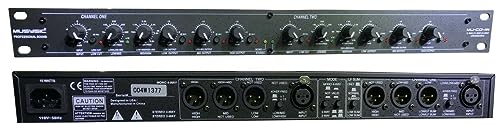
Ideal for venues and DJs needing clean subwoofer integration and flexible band control. The MU-CO4W supports 2/3/4-way operation with a dedicated subwoofer crossover range of 50–250 Hz and a low-pass function for bass management. It also provides precise 70–1000 Hz and 480–7000 Hz band ranges to tailor each driver. Best for: setups requiring tight bass and clean mid/high separation. Limitation: detailed parameter adjustments may require careful listening to optimize per-room response.
Professional 2/3-Way Stereo & 4-Way Mono Crossover

Offers versatile 2/3-way stereo for studio monitors or PA mains and 4-way mono for subwoofer control. Independent gain, phase invert, and 40 Hz low-cut per band enable precise shaping. Best for: systems requiring strong driver control and clean signal paths with balanced XLR I/O to reduce noise over longer runs. Caution: may lack advanced auto-EQ features of some premium models.
LICAEVEY 234XL 4-Way Mono & 2/3 Way Stereo Crossover

234XL focuses on 4-way mono or 2/3-way stereo processing for stage, studio, or home use. It includes balanced XLR inputs and mic-preamp-compatible unbalanced inputs for flexible integration. The rugged, rack-mountable 1U design supports touring and permanent installations. Best for: users who need switchable 4/2/3-way operation with robust build.
ART CX310 Stereo 2-Way/Mono 3-Way Crossover

The ART CX310 provides a compact, 1U solution for 2-way stereo or 3-way mono configurations. It is ideal for smaller spaces or mobile setups requiring simple crossovers with reliable performance. Best for: smaller venues or home studios seeking straightforward routing without extensive tweaking. Caution: limited advanced features compared to larger, feature-rich models.
Buying Guide: Key Considerations For Your Crossover Purchase
- How many output bands do you need? Decide between 2, 3, or 4-way configurations based on your speaker lineup and subwoofers.
- What inputs and outputs are required? Look for balanced XLR I/O for best noise rejection and compatibility with long cable runs.
- Do you need built-in bass management? Subwoofer crossover ranges and low-cut filters help you tightly integrate subs with main speakers.
- Is rack-mounting important? If you tour or install in racks, prefer 1U or 2U units with sturdy enclosures.
- How important is ease of setup? Front-panel LEDs, clear labeling, and simple controls reduce setup time in live environments.
- Compatibility with existing gear? Ensure the crossover can interface with your amps, subs, and speakers without adapters.
Practical tips for choosing
- For venues with multiple zones, a crossover with flexible band routing helps tailor sound per room.
- When accuracy matters, models with independent per-band gain and phase controls offer better alignment with drivers.
- If you need quick in-field adjustments, favor displays and presets that simplify scene changes during performances.
Common questions
- What does a crossover do in a PA system? It splits audio into frequency bands so each speaker handles the range it’s designed for, reducing distortion.
- Should I choose a stereo or mono crossover? Stereo crossovers are better for two-channel mains; mono crossovers are suited for dedicated subwoofers.
- Do I need a digital crossover? Digital crossovers offer more precise control and diagnostics but may cost more than analog options.
- Can a crossover improve overall PA clarity? Yes, by routing frequencies efficiently and reducing speaker stress, you can achieve cleaner, louder sound.
FAQ
- Q: Do crossovers require alignment with amplifiers?
A: Yes, consider phase and gain adjustments to match drivers and minimize cancellations. - Q: Are balanced I/O essential?
A: Balanced connections reduce noise on long cable runs, common in venues. - Q: Can crossovers replace a full active speaker processor?
A: In some setups, crossovers provide essential routing, but full processing may offer extra EQ and protection features. - Q: Is installation difficult for beginners?
A: Basic setups are straightforward; complex tuning benefits from experienced users or reference guides. - Q: Which brands are most reliable for live sound?
A: Reputable brands in the listing provide consistent performance and service support.