
Best Crossovers for Sound Systems: Clear, Studio-Grade Frequency Control
Direct answer: a high-quality crossover helps divide audio into precise frequency bands, letting amplifiers and speakers handle only the ranges they were designed for. This improves clarity, reduces distortion, and yields a cleaner overall mix for PA setups, stages, and home studios. The top picks below span 2/3/4-way options and are suited for live venues, outdoor performances, or fixed installations. Each product is selected for versatility, build quality, and independent band control to support diverse speaker configurations.
| Product | Best For | Key Benefit |
|---|---|---|
| MIZISNR Professional 2/3/4 Way Crossover | Pro PA, live venues | Multi-mode versatility and independent band controls |
| Mono 4 Way Crossover (Yunseity) | Stage monitors, outdoor shows | Strong stage-ready design for mono 4-way routing |
| Yoidesu 234XL Crossover | Outdoor stages, festivals | High-precision stereo distribution with robust build |
| RQG Professional 2/3/4-Way Crossover | Studio to live PA mains | Independent gain, phase, and sub control |
| Timpano TPT-360 | 3-way setups, subwoofer control | Wide crossover point range for front/rear/sub routing |
MIZISNR Professional 2/3/4 Way Crossover

This professional audio crossover supports three operation modes from the back panel: two-way stereo, three-way stereo, and four-way mono. It provides separate output gains, phase reverse switches, and a dedicated 40 Hz high-pass filter for clean low-end control. Best for: live PA mains or stage setups where precise band routing and individual band adjustments are essential. Caution: front-panel indicators help confirm the active mode, but users should verify wiring and speaker compatibility before use in complex systems.
Yunseity Mono 4 Way Crossover

Designed for stage performance and broader sound distribution, this 4-way mono crossover emphasizes stable operation and reliable performance. Best for: outdoor stages or venues requiring a dedicated low, low-mid, high-mid, and high-frequency path with robust build. Choose this if you want strong mono control and straightforward routing. Limitation: product description emphasizes stability—users should confirm input/output compatibility with their specific amplifiers and drivers.
Yoidesu 234XL Crossover

This model advertises advanced technology for premium crossover performance and a versatile design suitable for stage performance. Best for: venues needing reliable stereo distribution and multi-band control for live sound. Better for: applications where a robust, all-around crossover is preferred over single-purpose devices. Limitation: features list is concise; verify band ranges align with your speaker drivers and subwoofers.
Professional 2/3-Way Stereo & 4-Way Mono Crossover (RQG)

Offers versatile 2/3-way stereo and 4-way mono modes with independent controls for each band, plus balanced XLR I/O for clean signal transfer. Best for: studios or live systems where precise frequency distribution and polarity correction are necessary. Caution: while the description highlights XLR I/O, users should confirm connector compatibility with their existing cabling and preamps.
Timpano TPT-360 Three-Way Crossover

The TPT-360 is a full-featured three-way crossover with options for front and rear fade, suitable for both two-way or full three-way systems. Best for: setups that require flexible front/rear monitoring and a wide range of crossover points to tailor subwoofer integration. Caution: ensure compatibility with existing subs and amplification stages to avoid mismatched crossover points.
Taramp’s Crx4 Electronic 4 Way Crossover

Compact, 4-channel crossover with customizable sound adjustments, suitable for car audio and portable setups. Best for: users needing a compact 4-way solution with adjustable tone controls. Limitation: information focuses on car audio; verify suitability for fixed installation or larger stage systems if used in non-automotive contexts.
MUSYSIC MU-CO4W Professional 2/3/4-Way Crossover
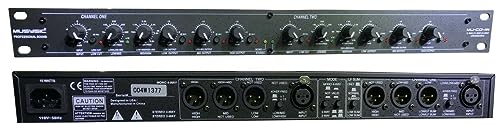
Three-mode operation with 2/3/4-way frequency control, independent gain, phase, and 40 Hz low-cut per band. Best for: versatile systems needing quick transitions between configurations. Better for: applications requiring precise band separation and subwoofer management. Caution: ensure the unit’s input/output specifications align with your preamps and amplifiers for optimal signal integrity.
PRV Audio EX4.6 PRO 4/3 Way Crossover
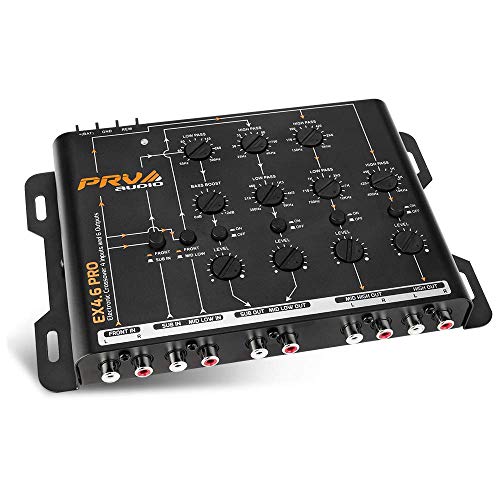
Features 2/3/4 RCA input options and 9 V RMS maximum output with a Bass Boost option up to 12 dB at 45 Hz. Best for: car audio or small studios where flexible input sourcing and bass emphasis are needed. Caution: the description emphasizes car-use features; verify air-flow and mounting suitability for fixed installations or venues beyond automotive environments.
Buying Guide: Key Considerations When Choosing a Crossover
- Configuration needs: Do you need 2-way, 3-way, or 4-way operation to match your speaker cabinet, subwoofers, and amps?
- Band control: Are independent gain, phase, and low-cut features essential for your system to minimize phase issues and optimize bass response?
- Signal path: Will balanced XLR I/O help reduce noise on long runs in live venues or installed systems?
- Flexibility: Do you require mono routing for single-sub setups or stereo routing for dual mains?
- Physical design: Is a rack-mount, compact, or portable form factor preferable for your installation?
- Compatibility: Confirm crossover frequencies with driver ranges and subwoofers to avoid over- or under- excursion.
Frequently Asked Questions
- What is a crossover in an audio system? Answer: A device that splits an audio signal into multiple frequency bands, sending each band to the appropriate speaker or amplifier for clearer sound and less distortion.
- Do I need a crossover if my speakers are full-range? Answer: Not always. If your system uses a separate subwoofer or needs precise tone shaping across multiple cabinets, a crossover can improve control and clarity.
- What is the difference between 2-way, 3-way, and 4-way crossovers? Answer: They designate the number of frequency bands and corresponding outputs; more bands allow finer control over passive or active speaker configurations.
- Are balanced XLR inputs/outputs better for live events? Answer: Yes, XLR connections reduce noise over long cable runs, which is advantageous for outdoor or large-room venues.
- Can a single crossover handle both studio monitors and PA mains? Answer: Some models are versatile enough, but ensure the device supports the required output levels and band ranges for both applications.
- What should I verify before buying a crossover? Answer: Band counts, adjustable crossover points, gain/phase controls per band, input/output types, and compatibility with your drivers and amplifiers.