
Best Daisy Chain Pedal Board Setup for Your Guitars
Answer: A daisy chain pedal board power solution streamlines your rig by powering multiple guitar pedals from a single wall adapter. This guide highlights five reliable daisy-chain options and who benefits most from each. Perfect for players building compact boards, gigging musicians needing clean power, and beginners expanding with new pedals.
Summary at a glance:
| Product | Best For | Key Benefit |
|---|---|---|
| Godtone 1 to 8 Way Daisy Chain Cable | Large pedal boards | Power eight pedals from one source |
| JOYO DC 9V 1.2A 5 Way Daisy Chain | Moderate, versatile boards | Stable 9V with five outlets |
| Donner DPA-1 9V DC 1A | Compact to mid-size rigs | Reliable single-adapter power |
| pigtone 1to5 Way Daisy Chain | Many pedals, tight space | Five outputs with broad voltage compatibility |
| Cheerock 1 to 2 Daisy Chain Cable | Small rigs or starter boards | Simple two-pedal split |
Godtone 1 to 8 Way Daisy Chain Cable Guitar Effect Pedal Power Supply

Best for: Large pedal boards needing power to multiple effects at once. Why selected: This 1-to-8 chain provides eight outputs, enabling a single source to run a full array of pedals, reducing clutter and simplifying setup. The cable uses high-quality copper inner cores and PVC insulation for stable power delivery and longevity. Limitation: The longer daisy-chain does not address pedal-specific current spikes; ensure total draw stays within the adapter’s rating.
JOYO DC 9V 1.2A 5 Way Daisy Chain Cables Power Supply
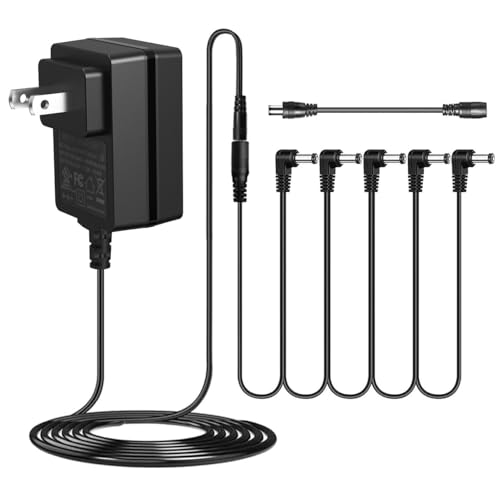
Best for: Portable, mid-sized pedal boards with several effects. Why selected: It includes five daisy-chain cables plus a reverse-polarity option, enabling simultaneous power to five pedals and compatibility with polarity-sensitive pedals. Consideration: Ensure total current draw does not exceed 1.2A to avoid power sag on high- draw pedals.
pigtone 1 to 3 Way Daisy Chain Cable

Best for: Small boards or setups with 2–3 pedals. Why selected: A compact 3-output splitter with a copper core supports stable current and noise isolation, helping keep your signal clean. Limitation: Not ideal for boards needing more than three outlets without an additional power supply.
pigtone 1to5 Way Daisy Chain Cable

Best for: Growing pedalboards with multiple effects. Why selected: Five outputs with voltages 9V/12V/18V compatibility and a robust copper core provides broad flexibility and stable power distribution. Caution: Verify compatible pedals’ voltage requirements to avoid mismatches on multi-volt chains.
Donner DPA-1 9V DC 1A Power Supply
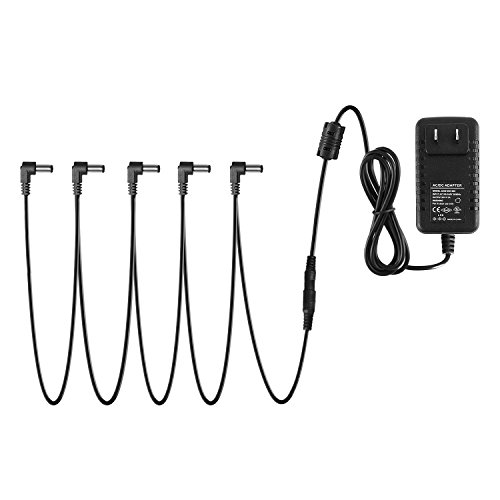
Best for: Keyboard players and guitarists with a small to mid-size pedal setup. Why selected: A compact solution that supports up to five devices with a 5-way daisy chain, offering a straightforward and efficient power setup. Limitation: Output current is limited to 1A; avoid high-current pedals in the same chain.
Buying Guide: Key Considerations for Daisy Chain Pedal Boards
- Power output and total current: Calculate the combined current draw of all pedals. Choose a power supply with a comfortable margin above that total to prevent voltage drop and noise.
- Number of outputs: Match the number of pedals on your board to the supply’s available outlets. If you plan to expand, consider a higher-output or modular solution.
- Voltage and polarity: Most pedals run on 9V DC. Confirm polarity (center-negative is standard) and ensure any multi-voltage cables won’t cause issues with certain pedals.
- Noise and hum: Look for cables with high-quality copper cores and shielding. Noise-free power helps preserve signal integrity across stages.
- Cable quality and length: Longer chains can add resistance. Check cable gauge (usually 18–26 AWG) and the distance between pedals to minimize voltage drop.
- Portability vs. permanence: For gigging musicians, a compact, easily packable power solution is valuable. Studio setups may prioritize maximum output and expandability.
Frequently Asked Questions
- What is a daisy chain pedal power supply used for?
– It powers multiple guitar pedals from a single wall outlet, simplifying cable management and reducing wall adapters on stage. - Is it safe to power many pedals from one supply?
– Yes, as long as the combined current draw stays within the supply’s rating and the voltage is correct for each pedal. - Should I choose an 8-output or 5-output chain?
– Choose based on your pedal count and future plans. Larger boards benefit from 8-output options to minimize adapters and clutter. - Do daisy chain cables affect tone?
– Properly shielded, quality cables minimize noise and voltage drop, helping maintain clean tone across pedals. - Can I mix pedals with different voltage needs on one chain?
– It’s best to match pedals by voltage or use dedicated converters only if the power supply and cables explicitly support mixed voltages. - What is polarity, and why does it matter?
– Polarity describes the electrical orientation of the power plug. If pedals require a specific polarity, using the wrong one can damage pedals or cause malfunction.