
Best DI Box for Acoustic Guitars: Clean, Hum-Free Front-of-House Solutions
Answering the common buyer question: a direct box (DI box) for acoustic guitar helps convert high-impedance, unbalanced signals into a balanced, low-impedance output suitable for PA systems and recording gear. The top picks below are best for performers seeking reliable impedance matching, hum elimination, and easy setup. They’re ideal for live stages, rehearsal spaces, and small studios. The selections emphasize durable construction, clear sound, and practical features such as ground lift and input attenuation.
Summary table of selected products:
- Pyle Premium Direct Injection Audio Box (PDC21) — Best for budget-friendly live gigs with solid hum elimination.
- Radial Pro DI — Best for rugged, tour-ready use with proven transformer design.
- PRORECK DC21 — Best value for balanced/unbalanced conversion and ground isolation.
- Pyle-PRO Premium Direct Injection Audio Box (PDC22) — Best for dual-purpose DI with easy input handling.
- Yovus Passive DI Direct Box — Best for simple, no-frills instrument to XLR output.
Pyle Premium Direct Injection Audio Box PDC21

Features include an inch device connector for keyboards, guitars, and signal processors, along with buzzer and hum cancellation to deliver clean audio. This DI box is designed to connect electric guitars, basses, keyboards, or processors to a PA or recording mixer via XLR outputs. Ground lift helps reduce hum in complex stage layouts.
Best for: Budget-conscious performers who need a straightforward DI solution for guitar or bass on small venues. Why: reliability and simple setup with effective hum reduction. Limitation: may lack some advanced features found on premium models.
Passive DI Direct Box (1/4″ In To XLR Out)

Specification highlights include a passive design with 1/4″ input and through jacks and an XLR output. This model relies on passive circuitry to deliver a robust signal path without external power requirements. Ground interactions are basic, and it is well-suited for straightforward instrument-to-PA connections.
Best for: Musicians seeking a simple, no-fuss DI box for acoustic guitars or other instruments. Why: easy to use with no power needs and dependable XLR output. Caution: lacks active gain control or attenuation features found on other models.
Radial Pro DI Passive Direct Box

Radial Pro DI is a rugged, transformer’s-based direct box designed for demanding environments. It emphasizes a clean, true signal path with a durable I-beam construction. It uses a passive transformer design to deliver high-quality impedance transformation from instrument to stage or studio inputs.
Best for: Touring musicians and venues needing a dependable DI with proven performance. Why: durable build and reliable transformer-based conversion. Caution: may be pricier than basic DI options.
PRORECK DC21 Passive DI Box

PRORECK DC21 provides professional impedance matching with a built-in impedance transformer for precise signal matching between guitars, basses, and mixers or stage amps. It offers balanced/unbalanced bidirectional conversion and a ground isolation feature to eliminate hum and buzz from ground loops.
Best for: Live performances and studio use where balanced and unbalanced paths are needed. Why: dual-output 1/4″ and XLR connections, plus strong isolation. Limitation: as a passive box, gain control must come from the source or mixer.
PYLE-PRO Premium DI Box PDC22
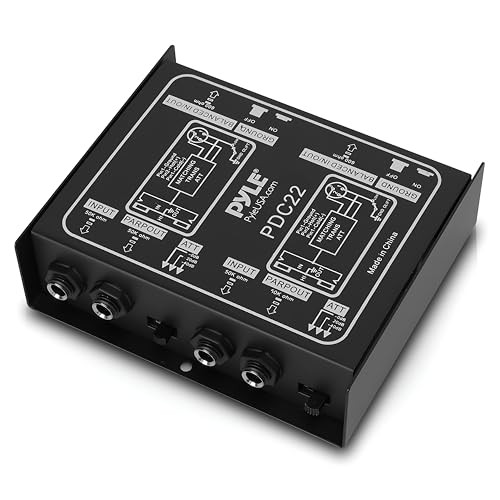
Like the PDC21, this model uses a 1/4″ device connector and provides impedance transformation with hum cancellation capabilities. It supports easy connection of guitars, keyboards, and processors to a PA or recording mixer with a ground lift option to reduce interference on stage.
Best for: Budget-conscious performers needing a compact DI with familiar Pyle design cues. Why: plug-and-play usability and effective hum reduction. Caution: fewer premium features compared to higher-end DI boxes.
Buying Guide
- What is a DI box and why do acoustic guitars need one? A DI box converts high-impedance, unbalanced signals to a balanced, low-impedance signal, improving noise rejection and compatibility with PA systems and recording gear.
- Active vs. passive DI: Passive DI boxes (like many in the list) require no power and rely on transformer-based conversion, which some players prefer for a more natural guitar tone. Active DI boxes add a built-in preamp for additional gain and headroom but require power.
- Key features to consider:
- Impedance matching: Ensures the guitar tone remains intact over long cables.
- Ground lift: Helps eliminate hum from ground loops in complex stage setups.
- Input attenuation: Useful if your guitar’s output is hot or if you’re feeding multiple devices into the DI.
- Outputs: Balanced XLR vs. unbalanced 1/4″ can affect how you patch into venues and studios.
- Constrained space and budget: For smaller venues or home studios, a compact DI with basic hum elimination may suffice. For tours, prioritize rugged construction and transformer-based designs.
- Compatibility considerations: Ensure the DI’s outputs match your mixer or audio interface inputs. Some models offer dual outputs or both XLR and 1/4″ jacks for flexibility.
FAQ
What is a direct box used for with acoustic guitars?
A DI box converts the guitar’s high-impedance, unbalanced signal to a balanced, low-impedance signal suitable for PA systems and recording equipment, reducing noise and preserving tone over longer runs.
Should I choose passive or active DI for acoustic guitar?
Passive DI boxes are simple and robust, ideal for guitar tones with standard output. Active DI boxes provide more gain and headroom, beneficial for passive acoustics or when feeding a loud stage monitor.
Is ground lift important on a DI box?
Yes. Ground lift helps break ground loops, reducing hum and buzz in live setups where multiple devices connect to a single sound system.
Can I use a DI box with keyboards or other instruments?
Yes. DI boxes are versatile and can handle keyboards, basses, and other line-level devices, provided the inputs/outputs match your sound system.
Do DI boxes affect my guitar tone?
Most DI boxes aim to preserve tone, but transformer-based designs and impedance matching can influence perceived warmth and clarity. Choose a model that matches your tone goals and venue needs.