
Best Digital Audio Interface USB for Home Studios
Direct, clear audio is essential for music, podcasting, and voiceover work. This guide highlights five top USB audio interfaces that are well-suited for different creators, from beginners to semi-professionals. Each pick is evaluated for ease of use, input options, and usable features. The top options target solo musicians, podcasters, and multi-role creators who need reliable USB connectivity and solid A/D conversion.
Buyer snapshot: the following table compares the five highlighted products at a glance to help you choose quickly.
| Product | Best For | Key Strength |
|---|---|---|
| Focusrite Scarlett Solo 3rd Gen | Home studios and solo artists | Bright pre-amps and Air mode for clarity |
| M-Audio M-Track Duo | Podcasters and multi-use setups | Versatile inputs with direct monitoring |
| Shure MVX2U Gen 2 | Streamers and on-the-go setups | Auto Level Mode and DSP processing |
| XTUGA Q-12 | Beginner to intermediate PC recording | Low latency and plug-and-play |
| MAONO P2 Hybrid USB | Creators needing hybrid device and mobile use | Wide compatibility with studio-grade specs |
Focusrite Scarlett Solo 3rd Gen USB-C Audio Interface

The Focusrite Scarlett Solo 3rd Gen delivers pro-grade mic pre-amps with Air mode for brightness on vocal and instrument takes. It features two high-headroom instrument inputs and Gain Halos to prevent clipping, making it an ideal choice for solo performers, podcasters, and home studios aiming for polished, studio-like results. Best for: solo singers, guitarists, and voice work who want studio-quality sound without complexity. Limitation: the Solo model has a single mic input, so multi-mic setups require a secondary interface or mixer.
M-AUDIO M-Track Duo USB Audio Interface
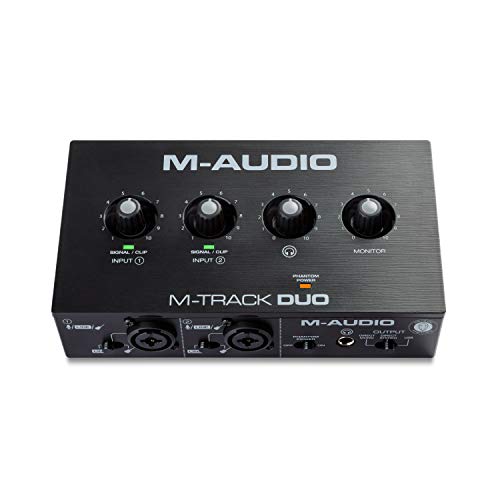
The M-AUDIO M-Track Duo emphasizes versatility for podcasting, recording, and live streaming. It provides two combo XLR/Line/Instrument inputs and 48kHz resolution for clear recordings. It also offers zero-latency monitoring via a USB/Direct switch and dedicated headphone and stereo outputs for flexible monitoring. Best for: podcasters and creators who need flexible input options and straightforward monitoring. Limitation: 48kHz sample rate may be visible as a constraint for high-resolution projects demanding higher fidelity.
Shure MVX2U Gen 2 XLR-to-USB-C Audio Interface

The Shure MVX2U Gen 2 leverages onboard Digital Audio Processing, including Auto Level Mode, Real-Time Denoiser, and a Digital Popper Stopper for consistent zero-latency performance with any XLR microphone. Auto Level Mode adjusts gain in real time and offers selectable tones (Dark, Natural, Bright) for tailored results. Best for: desktop creators and streamers who value automatic gain control and clean processing across devices. Limitation: more advanced DSP features may require some setup for optimal tone choices.
XTUGA USB Audio Interface for PC (Q-12)

The XTUGA Q-12 focuses on reliability for daily PC use with 16-Bit/48kHz resolution, switchable 48V phantom power, and ultra-low latency. It’s plug-and-play and powered directly from the computer, making it a practical option for beginners and mobile setups. Best for: new users and casual creators who want simple, dependable recording. Limitation: 16-bit resolution is lower than professional 24-bit schemes, which may matter for high-fidelity projects.
DigitPro USB 2.0 Audio Capture Card

The DigitPro USB 2.0 Audio Capture Card is a plug-and-play solution for converting analog sources like cassette tapes or vinyl to digital audio. It supports 3.5mm and RCA inputs and works with Windows and Mac across a range of versions. Best for: archivists, hobbyists, and home studios looking to digitize legacy formats. Limitation: not a full-featured multi-input interface; best used for simple capture tasks rather than live monitoring or multi-mic sessions.
MAONO P2 Hybrid USB Audio Interface

The MAONO P2 offers hybrid connectivity with dual USB ports for computer and mobile devices, enabling seamless recording and streaming across Mac, PC, iPhone, Android, and cameras. It supports 24-bit/192kHz audio and studio-grade EIN for quiet recordings, with ASIO support for lower latency monitoring. Best for: creators who need a flexible, cross-device workflow for podcasts, streams, and music. Limitation: more complex feature set may require time to optimize driver settings and routing.
Buying Guide
Key considerations for choosing a USB audio interface
Inputs and outputs: Determine how many mics, instruments, and line-level sources you need. If you record a single vocal with a guitar, a compact interface with one mic input and one instrument input can suffice. For multi-mic setups or future expansion, consider interfaces with two or more combo inputs.
Bit depth and sample rate
Higher bit depth and sample rate translate to better dynamic range and fidelity. Common configurations are 24-bit/96kHz or 24-bit/192kHz. If you plan to edit heavily or work with professional-grade material, prioritize 24-bit/192kHz where possible.
Low latency monitoring
Zero-latency or low-latency monitoring is important for real-time recording. Look for USB/Direct monitoring switches or dedicated DSP features that help minimize delay between performance and playback.
Driver compatibility and ASIO support
ASIO compatibility is essential for professional Windows recording. Many interfaces include ASIO drivers or Windows-friendly equivalents; Mac users typically benefit from native core audio support.
Portability and power
USB bus-powered devices are ideal for mobile setups. If you need more power-hungry pre-amps or multiple inputs, check whether an external power supply is required.
What’s the best pick for different buyers?
- Best all-round for solo performers: Focusrite Scarlett Solo 3rd Gen — bright pre-amps, reliable performance, easy setup.
- Best value with versatile inputs: M-Audio M-Track Duo — two combo inputs, flexible monitoring, solid for podcasts.
- Best for on-the-go streaming: Shure MVX2U Gen 2 — DSP processing and Auto Level Mode for consistent output.
- Best beginner-friendly with plug-and-play: XTUGA Q-12 — simple, reliable, USB-powered with low latency.
- Best for cross-device workflows: MAONO P2 Hybrid USB — dual USB ports, wide device compatibility for mobile and desktop use.
FAQ
Do I need an audio interface if I already have a USB microphone?
Yes. An audio interface improves pre-amp quality and allows instrument inputs, zero-latency monitoring, and better overall audio for recording and mixing.
Is 24-bit/192kHz necessary for home recording?
It’s beneficial for high-fidelity projects, but many home setups perform well at 24-bit/96kHz. Choose higher specs if you plan to edit extensively or work with professional material.
Can I use these interfaces with both Mac and Windows?
Most listed options are compatible with both operating systems, though driver support and ASIO configurations may vary. Check the product pages for specifics.
What is USB bus power?
Bus-powered interfaces draw power from the USB connection, eliminating the need for an external power supply, which is convenient for portable setups.
What is zero-latency monitoring?
Zero-latency monitoring lets you hear inputs without the delay caused by digital processing, important for accurate performance during recording.
Should I buy an interface with DSP features?
DSP features like auto level, denoising, and EQ can simplify workflow and provide consistent output, especially for streaming and live sessions.