
Best Digital Audio Out to AV Converter: Clear, Easy Options for Any Setup
If you’re connecting a digital audio source to an analog AV system, a digital-to-analog converter (DAC) is the right tool. These adapters convert SPDIF/Toslink signals into analog L/R RCA or 3.5mm audio, making TVs, Blu-ray players, game consoles, and media players work with older amplifiers. This guide highlights five reliable options and explains who each is best for, plus practical tips to avoid common issues.
Buyer profile overview:
– Best for simple TV-to-analog setups: short, built-in amplification for reclaiming volume.
– Better for multi-output needs: models that provide both RCA and 3.5mm outputs.
– Choose this if you need high-resolution audio (up to 192 kHz, 24-bit) with minimal distortion.
– Avoid this if you require HDMI output from analog sources, or if your device only supports PCM output without LPCM nuances.
| Product | Best For | Key Output | Note |
|---|---|---|---|
| PROZOR 192KHz Optical to RCA Converter | TVs with Optical but analog amps | RCA | Built-in amplifier; PCM output required |
| PROZOR 192KHz DAC Optical to Analog L/R + 3.5mm | Multi-output audio | RCA & 3.5mm | Set TV to PCM; no optical output in some cases |
| Hdiwousp 192 kHz DAC Optical Coaxial to RCA + 3.5mm | Game consoles and Home Theater | RCA & 3.5mm | Plug-and-play; PCM/LPCM aware |
| DigitConvert DAC 192KHz Optical to RCA + 3.5mm | Vintage AV to modern displays | RCA & 3.5mm | Not reversible to digital |
| DigitConvert RCA to HDMI Converter | Analog to HDMI presentation | HDMI | Not able to output analog from HDMI back to HDMI |
PROZOR 192KHz Optical to RCA Converter

The PROZOR Optical to RCA Converter transforms SPDIF digital audio into analog L/R RCA output. It supports 192 kHz sampling with 24-bit depth and handles common PCM formats. The built-in audio amplifier helps achieve higher RCA volume without external gear. This model is best for buyers with an optical-only source and an analog amplifier that needs a boosted signal.
- Best for: TVs or players with Toslink output and a standard RCA/Amp setup.
- Why selected: Compact, built-in amplification reduces extra components.
- Limitations: Optical output support is hardware-dependent; ensure your device defaults to PCM for best results.
PROZOR 192KHz DAC Optical to Analog L/R RCA + 3.5mm
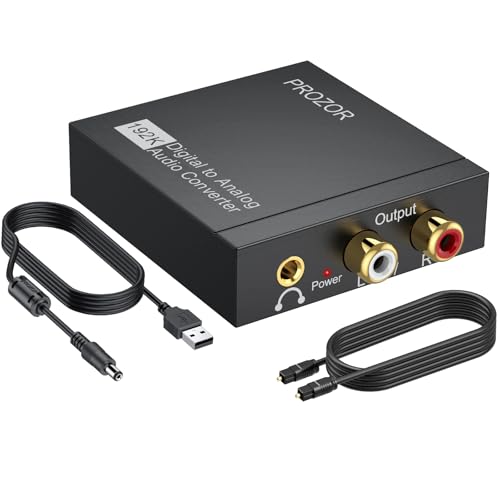
This PROZOR model converts Toslink/SPDIF digital audio into both RCA and 3.5mm analog outputs. It supports up to 192 kHz and 24-bit, making it suitable for refined audio setups that require flexible headphone and speaker connections. It’s ideal for users who want simultaneous RCA and 3.5mm outputs from a single digital source.
- Best for: Multi-output needs from a single digital source.
- Why selected: Simultaneous RCA and 3.5mm outputs simplify wiring.
- Limitations: Ensure your TV or player is set to PCM/LPCM to avoid distortion.
Hdiwousp 192 kHz DAC Digital to Analog Converter

The Hdiwousp converter handles coaxial or Toslink digital PCM/LPCM audio and outputs analog L/R RCA and 3.5mm jack. It’s designed for easy plug-and-play installation with a 192 kHz, 24-bit capability. This model suits gamers and home cinema enthusiasts who want a straightforward, driver-free setup with robust, electromagnetic-noise-free transmission.
- Best for: Quick, reliable PCM/LPCM to multiple analog outputs.
- Why selected: Plug-and-play with included power and optical cable.
- Limitations: Not reversible; it converts digital to analog only.
DigitConvert DAC 192KHz Optical to RCA + 3.5mm

This DigitConvert DAC converts coaxial or Toslink digital PCM signals to analog L/R RCA and 3.5mm outputs, up to 192 kHz/24-bit. It supports stable, synchronized audio without noticeable delay. It’s well-suited for PS4, Blu-ray players, and AV amps that require clean, high-resolution analog output.
- Best for: High-resolution, multi-output analog audio from digital sources.
- Why selected: Strong balance of quality and compatibility for common home theater devices.
- Limitations: Not designed for reverse (analog to digital) conversion.
DigitConvert RCA to HDMI Converter

This device converts analog RCA inputs to HDMI output, effectively upgrading legacy equipment to modern displays. It supports multiple PAL/NTSC formats and provides a straightforward plug-and-play setup. Use this if you need to present legacy analog video on an HDMI-equipped monitor or TV, with audio carried through the HDMI signal.
- Best for: Upgrading legacy AV gear to HDMI displays.
- Why selected: Simple, driver-free operation with broad format support.
- Limitations: Only converts RCA to HDMI; cannot convert HDMI back to analog.
Buying Guide
Key considerations when choosing a digital audio out to AV converter:
- Output options: Do you need just RCA, or both RCA and 3.5mm? Some users also require HDMI or a separate optical output for other devices.
- Sampling rate and bit depth: Look for models that support up to 192 kHz and 24-bit for high-resolution audio. This helps preserve detail on compatible sources.
- Source compatibility: Confirm whether your device uses Toslink (optical) or coaxial SPDIF, and whether the device outputs PCM/LPCM. Some converters require PCM to avoid distortion.
- Built-in amplification: If your amplifier has low output volume, a model with a built-in DAC amplifier can improve louder, cleaner sound without extra equipment.
- Ease of use: Plug-and-play, driver-free operation reduces setup time and compatibility concerns across TVs, Blu-ray players, and game consoles.
- Directionality: Ensure the device only converts digital to analog (not reverse). This is critical for expected performance and compatibility.
- Physical considerations: Box size, power requirements, and included cables can affect installation in tight AV cabinets or wall mounts.
FAQ
- Can I use these converters with a PC sound card? Yes, many will connect to a PC’s optical or coaxial output and route analog audio to speakers or headphones.
- Do these devices support 5.1 surround sound? Some models support PCM/LPCM 2-channel output; for 5.1 decoding, look for upgraded models explicitly advertising 5.1 compatibility.
- Will there be latency when using these converters? Most DACs are designed for audio fidelity with minimal delay, but latency can vary by device and source format.
- Is PCM the only format I should use? PCM/LPCM is typically recommended for stable, distortion-free output; dual-channel configurations are common for stereo setups.
- Do I need drivers to use these converters? No, most are plug-and-play and require no extra drivers.
- Can I use multiple outputs at once (RCA and 3.5mm) from a single source? Some models support simultaneous outputs; check the product specs to confirm.