
Best Digital-to-Analog Coaxial or Optical to RCA Converters for Clear Audio
If you need to convert digital audio signals (coaxial or optical) into analog RCA sound, these adapters are designed to deliver clean, reliable stereo output. This guide highlights five models ideal for home theater, gaming, or HiFi setups. Each option is best for users who want simple, plug-and-play DAC functionality without involving Dolby or 5.1 decoding. The top picks are suitable for TVs, Blu-ray players, game consoles, and stereo receivers that accept RCA or 3.5mm inputs.
| Product | Input | Output | Best For |
|---|---|---|---|
| PROZOR 192Khz Digital to Analog Audio Converter | Coaxial/Toslink Optical | Analog L/R + 3.5mm | General-purpose decoding to stereo |
| XPTSFDU HDMI ARC to RCA Audio Converter | HDMI ARC, Optical, Coaxial | RCA, Optical, Coaxial, 3.5mm | TVs with ARC seeking simple 3-output setup |
| DAC 192KHz Digital to Analog Audio Converter (DigitConvert) | Coaxial/Toslink Optical | Analog L/R + 3.5mm | Clear stereo from digital sources |
| PROZOR 192KHz Digital to Analog Audio Converter | Coaxial/Toslink Optical | Analog L/R + 3.5mm | High-sample-rate audio, PCM/LPCM |
| AUTOUTLET 192kHz DAC Digital to Analog Audio Converter | Optical Toslink | RCA | Professional-grade optical-to-analog conversion |
Note: The first option listed here, while capable, is primarily designed to extract digital audio from RCA sources rather than convert digital to analog. For best results in a digital-to-analog workflow, the other five selections are recommended depending on your input sources and preferred outputs.
PROZOR 192Khz Digital to Analog Audio Converter
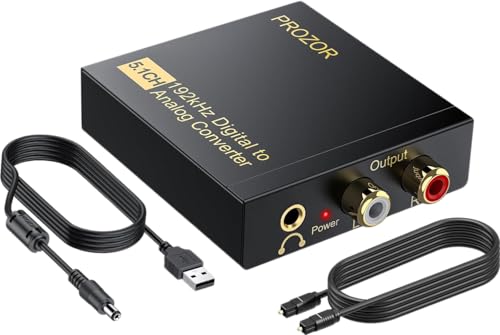
Features: 192Khz DAC, digital optical and coaxial input to analog L/R RCA and 3.5mm output. Covers 5.1CH capable formats and LPCM. Sampling rate up to 192Khz with 24-bit SPDIF input to stereo output. Best for users who need high-resolution PCM audio from modern optical/coax sources and want flexible headphone or speaker connection.
Best for: Keying into stereo systems from Blu-ray players, game consoles, or TVs where PCM/LPCM is the primary format. Choose this if you need strong high-sample-rate performance and a straightforward two-channel path.
Caution: Not designed to decode Dolby Digital or DTS; ensure your source is PCM/LPCM before use.
XPTSFDU HDMI ARC to RCA Audio Converter

Features: 3-in-1 inputs (HDMI ARC, Toslink, Coaxial) with four outputs (RCA, optical, coaxial, 3.5mm). DIP switch lets you select the active input. Supports 32–192 KHz sampling rate and 24-bit SPDIF on left/right channels. Best for: Home theater setups needing ARC compatibility and multiple output options to feed a soundbar, amp, and headphones.
Best for: TV-based audio transfer to legacy RCA-equipped receivers while preserving higher sampling rates. Limitations: HDMI ARC cannot be used alongside other inputs at the same time—select one input via the switch.
DAC 192KHz Digital to Analog Audio Converter (DigitConvert)

Features: Converts coaxial or Toslink digital PCM to analog L/R RCA and 3.5mm simultaneously. Notes: Not a digital-to-analog reverse device. Supports 32KHz to 192KHz sampling rates and 24-bit SPDIF. Best for: People upgrading an older stereo or AV system that lacks digital inputs but accepts analog RCA or 3.5mm.
Best for: Ensuring compatibility with older amplifiers and receivers that need a clean DAC for PCM streams. Caution: It does not process Dolby Digital or 5.1 surround signals.
PROZOR 192KHz Digital to Analog Audio Converter

Features: 192kHz DAC with optical/coaxial inputs to analog L/R and 3.5mm outputs. 2-channel LPCM/PCM support with a note to set the TV to PCM/LPCM. 32–192kHz sampling with 24-bit SPDIF input. Best for: Ensuring a high-fidelity stereo path from digital sources when you don’t need 5.1 support. Choose this if your source is PCM and you want precise reproduction.
Limitation: If your content uses Dolby or DTS, this unit will not pass those formats to analog output without additional decoding.
OREI Digital to Analog Audio Converter

Features: Converts coaxial or optical digital input to analog RCA and 3.5mm outputs. Explicitly notes it will not convert Dolby Digital signals. Supports common sample rates up to 192kHz and 24-bit. Best for: Users with a modern digital source who want a simple, compact converter for PC, TV, or game console audio to a stereo system.
Best for: Quick setup without complex configurations. Limitation: It will not process Dolby Digital or DTS; ensure the source is PCM/LPCM.
Buying Guide: Key Considerations For Selecting A Digital-To-Analog Converter
- Input compatibility: Choose a model that accepts your source signals (optical, coaxial, or HDMI ARC). If you have multiple sources, a 3-in-1 input model (HDMI ARC, optical, coax) can simplify wiring.
- Output needs: Ensure the converter provides the outputs you need (RCA stereo, 3.5mm, or both). Some devices also offer dual outputs for flexibility.
- Sampling rate and bit depth: Higher sampling rates (32kHz–192kHz) and 24-bit depth indicate clearer, more detailed audio. Check compatibility with your source and amplifier.
- Dolby/DTS handling: Most of these units are PCM/LPCM only. If your content uses Dolby Digital or DTS, you’ll need a decoder or a receiver that handles those formats after the DAC stage.
- Remote and ease of use: An IR remote or simple on-device controls can improve everyday use, especially in living rooms or media desks.
- Build and noise considerations: Look for devices with low electromagnetic interference and stable operation to avoid hiss or distortion over time.
- Size and routing: If space is tight, consider compact units and plan cable routing to minimize signal loss and clutter.
Frequently Asked Questions
- What is a digital-to-analog audio converter used for? It converts digital audio signals (coaxial/optical) into analog L/R stereo signals that can feed traditional amplifiers, receivers, or powered speakers.
- Will these converters decode Dolby Digital or DTS? Most listed models are PCM/LPCM only. Check the product notes if you need to pass through surround formats.
- Can I use a DAC with a TV? Yes, if your TV outputs PCM/LPCM and you connect its digital output to the DAC’s input, you can drive a stereo system or headphones.
- Do I need HDMI ARC input on a DAC? Not necessarily. HDMI ARC is convenient for some setups, but optical or coaxial inputs are sufficient for most PCM sources.
- What should I set on my TV or player? For best results, configure the TV’s audio output to PCM/LPCM and ensure it matches the DAC’s input capabilities.
- Are these devices universally compatible with all amplifiers? They are designed for common stereo amplifiers and receivers. If your system expects 5.1 signals or requires decoding, you may need a different solution or an external decoder.