
Best Digital Piano Realistic Touch for Home Players
Answering the buyer’s search for a digital piano with a realistic feel, this guide highlights models that emphasize weighted or semi-weighted keyboards, expressive touch, and clear, piano-like response. Ideal for beginners seeking proper finger strength development or intermediate players needing a portable practice setup, each pick offers solid action, reliable sound, and practical features for daily use. The table below compares the top five options to help you decide quickly.
| Product | Key Action Focus | Best For | Notes |
|---|---|---|---|
| Alesis Recital Digital Piano 88-Key Semi-Weighted | Semi-weighted, adjustable touch | Beginners wanting a feature-rich starter | Built-in speakers; multiple voices |
| Umelody S-190 Semi-Weighted 88 Key | Semi-weighted, touch-sensitive | Practice-first learners seeking affordability | 128 rhythms/voices; USB-MIDI learning |
| Yamaha Piaggero NP15B | 61 touch-sensitive keys | Travel-ready players needing portability | Smart Pianist app for extended control |
| Rhymo 61 Key Keyboard Piano | 61 touch-sensitive keys | Beginner to intermediate on a budget | Large sound library; USB-MIDI |
| Donner OURA DDP-60 88 Key | Semi-weighted with velocity curves | Young players and beginners wanting 128 tones | Minimalist design; 4 velocity curves |
Alesis Recital Digital Piano 88-Key Semi-Weighted

The Alesis Recital centers on a semi-weighted 88-key keyboard with adjustable touch response, making it a versatile option for players building dynamic velocity control. It offers five voices, including acoustic piano and electric piano, along with built-in effects like chorus and reverb. Its two 20W speakers provide room-filling sound, while 1/4″ sustain, headphone, and RCA outputs support practice and external amplification. Best for beginners and early-intermediate players who want a feature-rich learning setup and solid practice tone, with the flexibility to layer or split voices as skills grow. A potential limitation is the absence of fully weighted keys, which may matter to players aiming for grand-piano realism at higher levels.
Umelody Semi-Weighted 88 Key Digital Piano (S-190)

The Umelody S-190 provides a full-size semi-weighted keyboard with touch sensitivity, designed to help beginners develop proper finger control as they transition to acoustic pianos. Dual 5W speakers deliver stereo sound, and the unit includes 128-note polyphony, 80 demo songs, metronome, recording, and playback. This model is best for beginners who want structured practice support, built-in learning aids, and a budget-friendly path to steady skill growth. A limitation is that it uses semi-weighted action, which may not fully mimic a grand piano for advanced players.
Yamaha Piaggero NP15B 61-Key Ultra-Portable

The Yamaha Piaggero NP15B emphasizes portability with 61 touch-sensitive keys and a focus on practical playability. Its Smart Pianist app extends control beyond the instrument’s built-in features, making it a strong choice for players who travel or perform in multiple settings. Best for players who want a lightweight unit that still offers expressive control and a robust app ecosystem. The compact design limits full-range piano feel for those who require a full 88-key keyboard for technique development.
Rhymo 61 Key Keyboard Piano
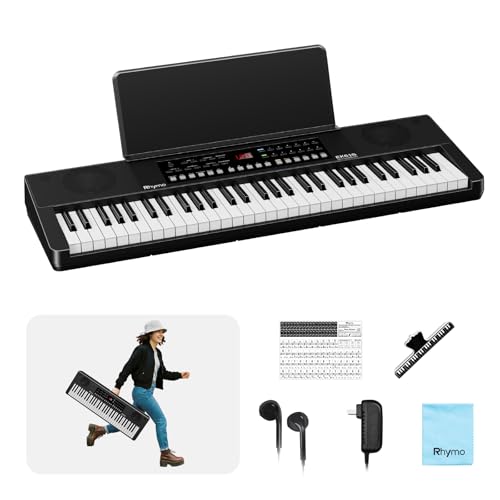
The Rhymo 61 Key Keyboard Piano features 61 touch-sensitive keys with a large built-in sound library (up to 300 sounds) plus layering and splitting capabilities. It includes 300 accompaniment rhythms and 80 demo songs, with USB-MIDI for easy learning connection to devices. Best for beginners and casual players who want a wide sonic palette on a budget. A potential drawback is the smaller 61-key range, which may not suit players working toward full-range piano technique.
Donner OURA DDP-60 88 Key Digital Piano

The Donner OURA DDP-60 delivers an 88-key full-size piano with velocity-sensitive keys and 128 tones across 83 rhythms, plus 47 demo songs and 8 reverb effects. Its minimalist design and four velocity-velocity curves cater to young learners developing touch, with a built-in sustain pedal and a pedal set included. Best for beginners who want a traditional-looking, compact piano feel and a reasonable tonal variety. A limitation is that its action may not fully replicate higher-end weighted keys, which can matter for advanced technique work.
Buying Guide: Key Factors For Realistic Touch Digital Pianos
- Key action: Choose between fully weighted, semi-weighted, or non-weighted graded keys based on your goals. Fully weighted keys mimic a grand piano more closely, while semi-weighted keys offer a balance of feel and affordability.
- Touch sensitivity: Look for keyboards with adjustable touch response to match your playing style and dynamic control.
- Polyphony: Higher polyphony (128 notes or more) helps when layering sounds or playing complex passages without note drop-off.
- Sound variety: A broad voice library (acoustic piano, electric piano, organs, synths) provides creative flexibility for practice and composition.
- Speakers and connectivity: Built-in speakers are convenient for practice; lines out, headphone jacks, and USB-MIDI enable external amplification and learning integration.
- Learning features: Metronomes, recording, playback, demo songs, and app support can enhance daily practice and progress tracking.
- Portability and size: If space or travel is a factor, prioritize compact, lighter models with sufficient keyboard range for practice.
Practical Buying Questions
- Do I need 88 keys or is a 61-key keyboard sufficient for my level?
- Is fully weighted action necessary for my goals, or is semi-weighted acceptable for budget and portability?
- Will I use headphones often, or should I invest in external speakers for room-filling sound?
- How important is app integration (for learning and practice) in my daily routine?
- Do I prefer a portable instrument for travel and performances, or a stable home setup?
Frequently Asked Questions
- What is the difference between weighted and semi-weighted keys? Answer: Weighted keys imitate hammer-action feel; semi-weighted keys offer lighter touch with weighted feel in the upper registers for comfort during long practice sessions.
- Can I use a digital piano for serious piano studies? Answer: Yes, especially models with 88 keys, good touch response, and high polyphony support technique development and repertoire practice.
- Do I need built-in speakers? Answer: Built-in speakers are convenient for practice; external speakers or a keyboard amp can improve stage or room sound.
- Is app control essential for beginners? Answer: Not essential, but helpful for guided lessons, additional features, and easier setup with some models.
- What should I consider for apartment living? Answer: Look for compact 61-key or 88-key models with headphone output and quiet operation; consider lightweight portability options for storage.
- Is USB-MIDI necessary? Answer: USB-MIDI provides easy connection to learning apps and computers for music production and practice integration.