
Best DIN to XLR Cable for Studio and Stage Use
If you need to connect MIDI devices or other DIN audio gear to XLR-based inputs, a DIN to XLR cable is essential. This guide highlights five reliable options and explains who each is best for. The top picks cover studio setups, live rigs, and portable gear, helping you choose based on durability, signal integrity, and ease of use. Buyers will find clear guidance to match their gear and space constraints.
| Product | Best For | Length / Style |
|---|---|---|
| XMSJSIY MIDI 5 Pin DIN to XLR 3 Pin Speaker Instrument Audio Cable | Pro studios and live stages needing reliable locking | 5-pin DIN to 3-pin XLR |
| Seadream MIDI 5 Pin DIN Male to XLR 3 Pin Female Cable | Compact setups and easy routing | 1.64 ft, DIN male to XLR female |
| CNCESS DIN 5-Pin MIDI Female to XLR 3-Pin Male Adapter | Tight spaces and pedalboard-style rigs | 6 in, DIN female to XLR male |
| Seadream MIDI 5 Pin DIN Male to XLR 3 Pin Male Cable | Flexible, general-purpose connections | 1.64 ft, DIN male to XLR male |
| CablesOnline 6ft Dual-XLR to 5-Pin DIN Cable | High compatibility with European stereo setups | 6 ft, dual-XLR to DIN |
XMSJSIY MIDI 5 Pin DIN to XLR 3 Pin Speaker Instrument Audio Cable

Best for professional studios and live performances needing a secure connection. This cable uses a 5-pin DIN MIDI connector on one end and a 3-pin XLR on the other, designed to link MIDI keyboards, electronic pianos, and synthesizers to amplifiers, speakers, and mixers. The locking XLR plug helps prevent accidental disconnections during transit or onstage. The design supports clear, stable signal transfer, which is crucial in high-demand environments.
- Best for: Professional studios, live stages, and home studios with high signal integrity requirements.
- Why selected: Locks securely and reduces the risk of unplugging during a performance.
- Caution: The 5-pin DIN to XLR arrangement may not fit all non-standard MIDI devices; confirm connector types before purchase.
Seadream MIDI 5 Pin DIN Male to XLR 3 Pin Female Cable

Best for compact workstations and travel setups requiring a light, ergonomic design. This cable uses nickel plating on the MIDI end and silver plating on the XLR end, with an ergonomic connector design to reduce fatigue during frequent plug-in tasks. Its shorter length helps keep pedalboards and small desks tidy while maintaining solid signal flow between MIDI devices and XLR-enabled gear.
- Best for: Small studios, portable rigs, and on-the-go musicians.
- Why selected: Ergonomic ends and compact length simplify tight setups.
- Caution: Short length means limited reach; plan your layout accordingly.
CNCESS DIN 5-Pin MIDI Female to XLR 3-Pin Male Adapter
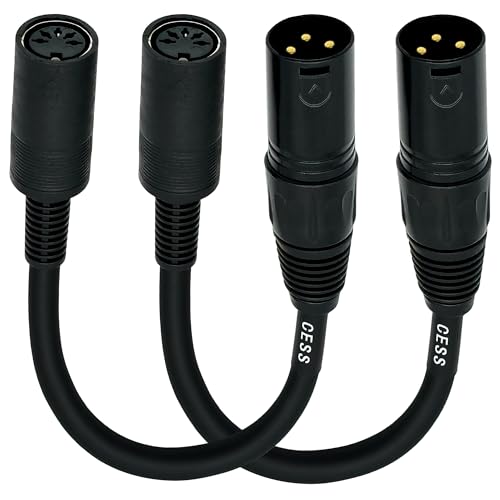
Best for tight spaces and modular rigging. This 6-inch adapter cable provides a compact solution to connect a 5-pin DIN MIDI female port to a 3-pin XLR male input, ideal for linking MIDI outputs to XLR-equipped gear in custom setups. It wires Pin 4 to XLR Pin 2 (Signal+), Pin 5 to XLR Pin 3 (Signal−), and Pin 2 to XLR Pin 1 (Ground) for stable signal transmission.
- Best for: Pedalboards, small studios, and backstage wiring.
- Why selected: Short length minimizes clutter and cable mess.
- Caution: As an adapter, it may not substitute for a full-length cable in long signal runs.
Seadream MIDI 5 Pin DIN Male to XLR 3 Pin Male Cable

Best for flexible connections between MIDI devices and XLR-based inputs where a male-to-male end is required. This cable uses nickel plating on the MIDI end and silver plating on the XLR end, with a flexible black jacket and Velcro management to keep cables organized. It is suitable for general-purpose use in studios and on stage, where easy handling and a reliable connection matter.
- Best for: Flexible setups and instrument racks needing quick connections.
- Why selected: Velcro management helps maintain tidy cables in busy environments.
- Caution: Check compatibility with your specific MIDI interface, as pin configurations can vary in nonstandard gear.
CablesOnline 6ft Dual-XLR to 5-Pin DIN Cable

Best for comprehensive stereo and European-style systems requiring longer reach. This 6-foot cable provides a dual-XLR to DIN connection, accommodating premium stereo setups and devices with DIN 5 or 7 connections. It supports balanced XLR outputs and is positioned as a premium option for longer runs in studios or home theaters.
- Best for: European stereo installations and longer-distance connections.
- Why selected: The longer length helps reduce signal loss over distance in balanced lines.
- Caution: This may be longer than needed for small desks or compact studios; consider shorter cables to reduce clutter.
Buying Guide
Key considerations when choosing a DIN to XLR cable include connector type compatibility, signal integrity, and the physical constraints of your space.
What devices will you connect?
Identify whether you need a DIN MIDI end for keyboards, sequencers, or MIDI interfaces, and an XLR end for mixers, speakers, or audio interfaces. Ensure the end pin configuration matches your equipment to avoid mis-wiring or incompatibility.
Do you need locking connections?
Cables with locking XLR connectors prevent accidental disconnections during performances. If you travel or perform live, locking designs offer extra security over standard friction-fit plugs.
What length is appropriate?
Short cables reduce clutter and signal loss in some scenarios, while longer runs are necessary for larger studios or stage setups. Choose a length that minimizes excess slack without forcing re-routing.
What about durability and flexibility?
Look for corrosion-resistant contact plating (nickel or silver) and a flexible outer jacket. Ergonomic connectors help with repeated plugging while rugged jackets resist wear in busy environments.
Are there any compatibility caveats?
Some devices use specific pin mappings or require ground lift features. Verify the pin assignments (Signal+, Signal−, Ground) and confirm that your devices align with the standard MIDI-to-XLR wiring described in product specs.
Summary of buying considerations
- Best for locking vs. non-locking connections
- Length and portability vs. reach
- Durability features like plating and robust jackets
- Space constraints and rack or pedalboard layout
FAQ
- What is a DIN to XLR cable used for?
Answer: It connects MIDI or other 5-pin DIN devices to XLR inputs for amplification or audio interfacing. - Can I use a DIN to XLR cable for audio only?
Answer: Yes, for devices with compatible DIN outputs that route audio through the XLR path. - Is locking necessary for live performances?
Answer: Locking connectors reduce accidental unplugging during movement and vibration on stage. - Should I buy a short or long DIN to XLR cable?
Answer: Short cables minimize clutter and potential interference; long cables are needed for larger rooms or stages. - Are these cables shielded?
Answer: Many DIN to XLR cables use balanced XLR wiring for noise reduction, but check product specs for shielding details. - Will these cables work with all MIDI hardware?
Answer: They work with standard 5-pin DIN MIDI connectors, but verify compatibility with your specific gear model.