
Best Drum Machine and Sequencer Options for Beat Makers
Find the right drum machine or sequencer for your workflow with compact, versatile instruments that suit live performance, home studio, or DAWless setups. This guide highlights five capable options that balance portability, features, and value. Each pick is explained for who it’s best for and why it stands out. Use the comparison and buying guide to narrow your choice based on sequencing depth, sonic range, and workflow preferences.
| Product | Key Strength | Best For |
|---|---|---|
| Korg Volca Sample 2 | 8-voice polyphony, 16-step sequencer, pattern chain | Beat-makers who want portable sampling and advanced sequencing |
| Akai MPC Sample Portable | Standalone MPC workflow, built-in display, 16 pads | Beginners to pros seeking a complete stand-alone sampling solution |
| Korg Volca Beats | Electribe-style 16-step sequencer, analog-style drum voices | Pocket-friendly analog-style drum programming |
| Korg Volca Drum | 6-part DSP drum engine, 16-step sequencer | Wide variety of drum textures in a compact unit |
| Alesis SR-16 | 233 sounds, built-in effects, MIDI compatibility | Songwriters and live performers needing classic drum tones |
Korg Volca Sample 2 Digital Sample Sequencer Drum Machine
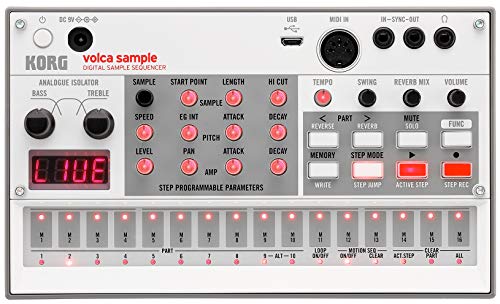
The Korg Volca Sample 2 is a compact, sample-based drum machine with 8-voice polyphony and a 16-step sequencer that supports pattern chaining and start delay. It doubles the memory of earlier Volca models, allowing more samples and longer recordings. This makes it a strong choice for performers and beat-makers who value hands-on control and flexible sequencing in a portable format.
Best for: Musicians who want quick, tactile sample-based beats with expandable memory. Choose this if you value pattern chaining and start delays for live sequencing. A limitation: limited built-in effects may require external processing for certain textures.
Akai Professional MPC Sample Portable Sampler

The Akai MPC Sample Portable combines a compact sampler, sequencer, and effects processor with standalone operation. It supports recording, editing, and playback anywhere, thanks to battery power, a built-in speaker, and microSD storage. It uses 16 responsive MPC pads and a 2.4″ color display to facilitate fast sampling and beatmaking without a computer.
Best for: New and experienced beat-makers seeking a complete standalone MPC experience. It’s also suitable for DAWless setups and on-the-go music creation. Limitation: may have a learning curve for those unfamiliar with MPC workflows.
Korg Volca Beats Analog Rhythm Machine

The Volca Beats offers an Electribe-style 16-step sequencer and eight memory patches for storing patterns. Its built-in speaker makes it ideal for quick idea-jamming and on-the-go sessions. The device provides a straightforward workflow with classic analog-inspired sounds and compact portability.
Best for: Portable drum programming with a quick, easy-to-learn interface. Better for: performers who want immediate, groove-ready beats without a computer. Caution: fewer modern effects options than some digital peers.
Korg Volca Drum Digital Percussion Synthesizer

The Volca Drum combines a digital percussion engine with six-part DSP and a 16-step sequencer. It covers a broad palette of drum textures and allows you to sculpt percussion with dedicated parameters. This unit is ideal for producers who want a wide sonic range from a compact instrument.
Best for: Detailed percussion design in a small footprint. Choose this if you need a broad sonic palette and flexible pattern building. Limitation: digital engine may lack the warmth of pure analog drums for some genres.
Behringer RD-78 Classic Analog Drum Machine

The Behringer RD-78 provides 15 authentic drum sounds and 34 rhythm presets, plus a 16-step sequencer for programming. It’s designed for versatile production and live performance, delivering classic drum tones in a convenient package.
Best for: Those who want a budget-friendly analog-like drum machine with a broad library of presets. Better for: quick songwriting and live gigs. Caution: fewer modern connectivity options than some digital rivals may require external interfaces.
Buying Guide: Key Considerations For Drum Machines And Sequencers
- Workflow and format: Do you prefer standalone hardware or a sampler/DAW-integrated setup? Standalone units offer portability and immediate playability, while hybrid setups suit studio workflows.
- Sequencer depth: Consider the number of steps, pattern chaining, and parameter locks. A longer sequencer with advanced chaining is beneficial for complex beats and live transitions.
- Sound engine: Analog, digital, or hybrid voices impact tone. Analog-style machines provide warmth; digital engines offer a wider range of sounds and precise control.
- Polyphony and voices: Higher polyphony supports more simultaneous sounds, which matters for full drum kits and layered patterns.
- Memory and storage: More memory allows longer samples and larger sample libraries, which is important for sampling-focused machines like the Volca Sample 2.
- Portability and power: Battery-powered units are ideal for busking or on-the-go sessions, while USB or DC power suits studio use.
- Connectivity: MIDI, USB MIDI, audio outs, and line-in options affect integration with other gear and setups.
- Built-in effects: Some models include effects or speakers suitable for practice and live performance. Evaluate whether you need external processing.
- Learning curve: Some devices use unique workflows (MPC-like grids, Elektron-style patterns, or Korg’s Volca workflow). Choose based on your familiarity and preferred style.
FAQ
- What is a sequence-based drum machine?
A device that uses a sequencer to arrange drum sounds across steps to form patterns and songs, often with real-time or step sequencing capabilities. - Should I choose standalone or a sampler-based drum machine?
Standalone units are portable and quick to jam without a computer; sampler-based machines let you load and manipulate your own samples for unique tones. - Are digital drum machines better than analog?
Digital engines offer broader sound libraries and precise control; analog-style machines provide warmth and character associated with classic drums. - What does 16-step sequencing mean?
It means the sequencer runs on 16 discrete steps per pattern, allowing you to place hits and rests to create rhythmic phrases. - Is memory important in a drum machine?
Yes, more memory enables longer samples, more patterns, and more complex sequences without overwriting data. - Can these devices be used with a DAW?
Yes, most offer MIDI or USB MIDI for synchronization and control with a computer or other MIDI gear.