
Best Dual 10-Inch Line Array Systems for Live Sound
Answering the buyer’s intent: these dual 10″ line array systems deliver compact, high-output sound ideal for live venues, churches, schools, and mobile events. This guide highlights five top options, explaining who each is best for and why. Each entry notes best-use scenarios, potential limitations, and what makes it stand out in a stacked system. The summary table below helps compare core specs at a glance.
| Product | Key Benefit | Best For | Note |
|---|---|---|---|
| Sound Town ZETHUS 210BX4 | Four dual 10″ speakers with flying frame | Installers needing stackable, flexible mounting | Full range / bi-amp switchable |
| Sound Town ZETHUS-210BPW-PAIR | Two powered dual 10″ speakers with DSP | Compact paired setups with easy DSP tuning | LCD DSP controls |
| Seismic Audio SALA-210-PKG1 | Four passive 2×10 line arrays | Budget-friendly multi-speaker arrays | Passive, needs external amps |
| Sound Town ZETHUS-Series ZS-210BPW-2PAIRS | Four dual 10″ powered speakers with DSP | Advanced live sound rigging | Integrated DSP presets |
| PRORECK 210BP Array Speaker X4 | Four 10″ two-way powered array elements | Large rooms, portable stacked setups | High power with built-in DSP |
Sound Town ZETHUS 210BX4 Dual 10″ Line Array System
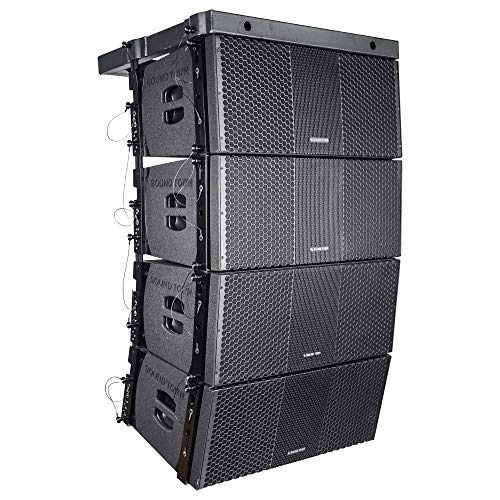
Includes four ZETHUS-210B line array speakers and a ZETHUS-210FF flying frame. Each speaker houses two 10″ woofers and two titanium compression drivers, offering 550W RMS and 2200W peak power. Best for venues that require scalable, high-output coverage from a stacked array. Limitation: setup complexity increases with more flying points.
Sound Town ZETHUS Pair of Dual 10″ PA Speakers

This pair includes two powered dual 10″ speakers with built-in DSP and a single-knob control, plus an all-birch enclosure for durability. Best for mobile rigs or small-to-mid-size venues where quick setup and precise tuning are priorities. Caution: one pair may be insufficient for larger audiences without an additional sub or array extension.
Seismic Audio SALA-210-PKG1 Four Passive 2×10 Line Arrays
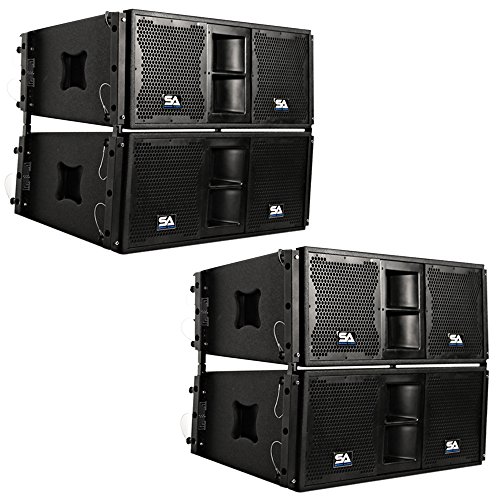
Contains four passive 2×10 line array speakers, designed for flexible configurations with external amplification. Best for users who want a lower upfront cost with separate amps and for events that require stacking multiple passive units. Limitation: relies on external amplification and processing, adding setup steps.
Seismic Audio SALA-210 Passive 2×10 Speaker
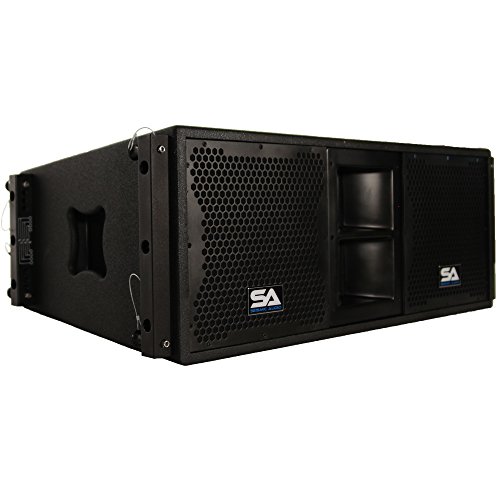
Single passive 2×10 line array speaker. Best for incremental expansion or replacing a single speaker in a system. Caution: as a passive unit, its performance depends on the accompanying amplifier and DSP choices for best results.
PRORECK Dual 10″ Full Range Powered Array Speaker X4

Delivers 5000W P.M.P.O with two 10″ woofers and a 3″ ferrite, offering substantial output for larger venues. Best for users who need very high SPL and a robust, stackable system with easy mounting. Limitation: heavy for portable use and may require careful rigging planning.
Sound Town ZETHUS Series Powered Line Array System

Includes four ZETHUS-210BPW dual 10″ powered loudspeakers with DSP and a robust Baltic birch enclosure. Best for touring setups that demand consistency, DSP tuning options, and reliable power. Caution: integrated DSP presets require some familiarity to optimize for space acoustics.
Buying Guide
What to consider when choosing a dual 10″ line array system:
- Output and coverage: Match speaker power and horn configuration to venue size and seating layout. Higher wattage and careful horizontal coverage improve intelligibility in large rooms.
- Power and amplification: Decide between powered (integrated amps) and passive systems (external amps). Powered units simplify wiring; passive units offer upgrade flexibility.
- Rigging and mounting: Check available flying points, frames, and weight limits. More points allow flexible hangs and stacking, but require proper rigging practices.
- DSP and processing: Built-in DSP helps with EQ, delay, and protection. A simple interface can speed up setup; more advanced DSP benefits complex rooms.
- Durability and enclosure: Birch plywood or plywood-based builds provide stiffness and vibration damping. Consider enclosure weight if portability matters.
- Scalability: For larger venues, assess how easily additional units or subwoofers can be integrated without phase/matching issues.
- Budget vs. requirements: Passive systems with external amps can be cost-efficient but require more components; all-in-one powered systems offer simpler setups at a higher initial cost.
Frequently Asked Questions
- What is a dual 10″ line array speaker best for?
– It provides compact, high-output coverage ideal for medium to large venues, where controlled directivity and clear dialogue are important. - Should I choose a powered or passive system?
– Choose powered for simpler wiring and quick setup; choose passive if you plan to upgrade amps or already own amplification gear. - Is DSP essential in line array systems?
– DSP helps optimize EQ, delay, and protection, especially in rooms with challenging acoustics. It is highly beneficial for professional installs. - Can dual 10″ arrays be stacked for large venues?
– Yes. Stacking or flying multiple units increases coverage and SPL, but requires proper rigging and mechanical safety measures. - What should I pair with passive 2×10 arrays?
– External amplifiers and a suitable processor or mixer help achieve balanced performance and precise tuning. - Do these systems work for live music or speech?
– They are suitable for both, but tuning and coverage should be tailored to the primary use (music vs. speech) to maximize intelligibility.