
Best Dual Amplifier 1000 Watts for Car Audio
Answer: If you want a robust 1000-watt class-AB or class-D dual-channel solution, these five models offer strong output, solid efficiency, and straightforward integration for most car audio systems. They’re best for midsize and full-range setups, for listeners seeking louder, clearer sound with reliable heat management. The list covers a mix of compact monoblock and two-channel bridges to fit different install spaces and power needs.
| Product | Best For | Key Benefit |
|---|---|---|
| CT Sounds CT-1000.1D | Compact mono into a subwoofer or single-channel setup | 1000W RMS at 1Ω, small footprint |
| Pyramid PB717X | Two-channel versatility with bridgeable power | Up to 1000W bridgeable, clear signal paths |
| Pioneer GM-A5702 | High-efficiency two-channel with solid power | 1,000W max, 240W x2 RMS at 2Ω |
| Crunch PX-1000.2 | Two-channel performance with cool operation | 1000W output, quick thermal dispersion |
| Rockville DS10 | Versatile, high-fidelity two-channel with multiple modes | 1000W RMS bridged, built-in crossover |
CT Sounds CT-1000.1D Compact Mono Block

Best for: Vehicles needing a powerful single-channel amp to drive a sub or dedicated speaker with minimal footprint. The CT-1000.1D delivers 1000 watts RMS at 1 ohm and 650 watts at 2 ohms, with a compact chassis that’s easy to install in tight spaces. It’s engineered for efficiency, helping your vehicle’s electrical system perform reliably. Use when space is a primary constraint and you want a strong, tight bass response.
Why selected: It offers high power in a small package, which suits shallow mounting locations and under-seat installs. The included bass knob adds user control over low-end output, improving overall tuning. Caution: At 1Ω loads, wiring and electrical system quality matter for peak performance and stability.
Pyramid PB717X 1000W Two-Channel Mono Bridgeable
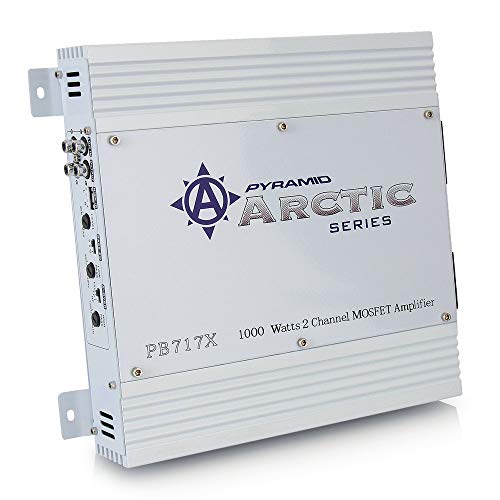
Best for: Systems needing a flexible two-channel amp that can be bridged to reach up to 1000W, with straightforward crossover and input options. The PB717X supports variable gain and a clean signal path, making it a reliable choice for moderate-to-large setups.
Why selected: Its bridgeable design and crossovers make it adaptable for different speaker configurations, helping you tailor bass and overall loudness. Caution: The feature set emphasizes utility over ultra-high efficiency; expect typical heat management with demanding loads.
Pioneer GM-A5702 1000W Max Two-Channel

Best for: Listeners who want a robust two-channel amp with efficient Class AB design that balances power and heat. The GM-A5702 provides up to 1,000W max, with 240W RMS per channel at 2 ohms, and a bridged mode potential for higher subwoofer output.
Why selected: It pairs strong performance with reliable efficiency, suitable for daily driving and weekend shows. Caution: Class AB designs can run warmer than Class D in extreme installs; ensure adequate ventilation in the install location.
Crunch PX-1000.2 2-Channel Car Amplifier

Best for: Those seeking a two-channel amplifier with strong output and efficient operation for mids and highs, plus solid bass control when paired with a suitable sub or full-range setup.
Why selected: The PX-1000.2 uses a Class AB circuit design for reliable amplification and includes a design that helps the unit remain cooler under load. Caution: Power output is dependent on supply stability; ensure your electrical system can sustain peak demands.
Rockville DS10 2-Channel Power Amplifier

Best for: Rig setups requiring versatility—two-channel, stereo or bridged, with a built-in crossover for subwoofers and tops. The DS10 delivers 1000W RMS @ 8Ω bridged (4000W peak), and supports multiple modes for flexible configurations.
Why selected: Its built-in crossover reduces the need for external gear, simplifying installation and tuning. Caution: The device supports different modes; ensure correct wiring and mode selection to avoid misrouting signals.
Buying Guide: Key Considerations For Your 1000W Dual Amplifier Setup
- Power needs and impedance: Match the amp’s RMS power to your speaker/subwoofer load (ohms). Lower impedance demands more current; ensure the electrical system can handle peak draw.
- Channel configuration: Choose mono or two-channel depending on whether you’re driving a sub only (mono) or full-range speakers (stereo/bridged two-channel).
- Efficiency vs. heat: Class D designs offer high efficiency and compact form factors, ideal for compact installs. Class AB tends to be more forgiving in some high-frequency paths but generates more heat.
- Fit and installation: Check mounting depth, screw hole spacing, and wiring access. A compact mono block can fit under seats or in tight car compartments, while two-channel amps require more space.
- Crossover and filtering: Built-in crossovers simplify tuning for subwoofers and full-range speakers. Look for adjustable LPF/HPF settings and subsonic filters to protect drivers.
- Wiring and safety: Use appropriate fuse ratings near the battery, high-quality power and ground wires, and proper gauge for the amplifier’s current demands.
FAQs
- What does 1000W RMS mean for car amps? — RMS is the continuous power output the amplifier can sustain under typical conditions. It indicates reliable, steady performance for speakers.
- Should I choose a mono or two-channel amp for a single sub? — A mono amp is generally best for subs, delivering focused, high-output power. A bridged two-channel can also work if you already plan to power two drivers.
- Can these amps be used with high-impedance speakers? — Yes, but actual power will depend on the impedance load. Always verify the amp’s rated impedance range.
- Is Class D always better for car audio? — Class D is typically more efficient and compact, making it suitable for tight spaces. However, some listeners prefer Class AB for certain sonic textures in mid/high ranges.
- What installation challenges should I expect? — Space constraints, heat management, and wiring routing are common; plan mounts, airflow, and cable runs before mounting.
- Do I need external crossovers? — Many of these models include built-in crossovers, which can reduce clutter. If you need more precise control, external crossovers can complement the setup.