
Best Earbuds With Sound Amplifier for Clear Hearing
The best earbuds with sound amplification help seniors and daily listeners hear conversations, TV dialogue, and surrounding sounds more clearly. This guide highlights five top options, explaining who each is best for, why it stands out, and any limitations to consider before buying. Ideal buyers include seniors needing easier TV listening, readers who want pocket amps for conversations, and users seeking compact, travel-friendly hearing support.
| Product | Brand | Best For | Notes |
|---|---|---|---|
| SuperEar SE5000 | SuperEar | TV watching and daily conversations | Includes headphones and accessories; tactile volume control |
| Joanbro Personal Sound Amplifier | Joanbro | Group settings and long conversations | Multiple mic options; up to 108 dB gain |
| IROGER Rechargeable Hearing Amplifier | IROGER | Hands-free control on the go | Auto Gain Control; long battery life |
| Williams Sound PockeTalker Ultra DUO | Williams AV | TV listening and outdoor use | Includes headset; removable microphone |
| ZEINLAM Rechargeable Hearing Amplifier | ZEINLAM | Compact, all-day use | Charging case; simple one-button control |
SuperEar SE5000 Hearing Amplifier

Best for TV lovers and one-on-one conversations. The SuperEar SE5000 captures ambient sounds for watching TV and everyday activities, with a complete amplification system that includes headphones and accessories. Its tactile volume control allows quick, precise adjustments in familiar environments. This model is ideal for users who need a dedicated home-use setup and value a compact, portable package. Limitation: it does not connect wirelessly to TVs or devices, so proximity to sound sources matters.
Joanbro Personal Sound Amplifier

Best for those who need flexible microphone options for varied listening environments. Joanbro offers 50 dB of acoustic gain with a total up to 108 dB, plus three removable microphones. The detachable extension cables help in noisy settings like group meetings or restaurants or long-distance TV watching. It’s a strong choice for individuals who want adaptable sound capture with selectable mic configurations. Caution: higher gain can amplify unwanted noise in very loud settings, so usage in calm environments can be more comfortable.
IROGER Rechargeable Hearing Amplifier
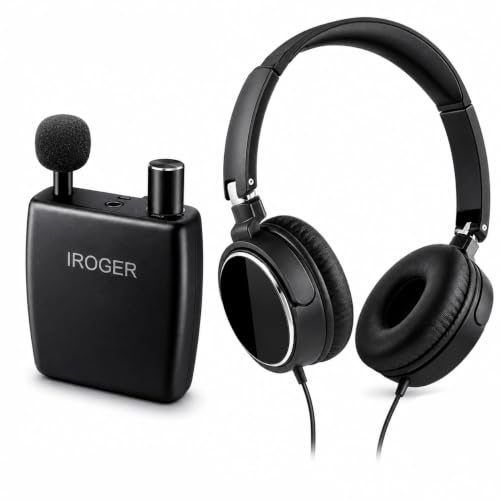
Best for users who want automatic adaptation to surroundings. IROGER uses Auto Gain Control to adjust amplification as environments change, delivering up to 65 dB gain. A single dial controls power and volume, simplifying operation for seniors. Battery life supports long use with a fast recharge cycle. Choose this if you prefer a simple, all-in-one device with minimal setup. Limitation: 65 dB gain may be lower than some high-gain models in very noisy environments.
Williams Sound PockeTalker Ultra DUO

Best for TV listening and mobility. The PockeTalker Ultra DUO includes a TV listening cord, a headset, and an external microphone with an access-friendly design. It offers 20-40 dB acoustic gain and up to 100 hours of battery life, with external volume and tone controls for quick tuning. Choose this when you need a compact, portable solution that supports TV dialogue and group conversations. Limitation: more settings rely on external components, which adds optional accessories to manage.
ZEINLAM Rechargeable Hearing Amplifier

Best for daily all-day use with a compact form. ZEINLAM includes a charging case for portable overnight charging and a simple one-button volume control. It emphasizes noise reduction technology to minimize whistling and background noise, delivering a natural listening experience. Choose this if you want a minimal setup, straightforward operation, and all-day wear with travel-friendly charging. Caution: some users may prefer higher gain in louder environments, where this model’s 45 dB range might be limiting.
Buying Guide
What to consider when choosing earbuds with sound amplification
- Gain and clarity: Look for models offering adjustable gain that suits your typical listening environments, from quiet conversations to TV dialogue.
- Microphone options: Removable or multiple mics can improve understanding in groups or noisy places.
- Battery life and charging: Consider rechargeable options with long life and a portable charging case for travel.
- Comfort and fit: Behind-the-ear and compact in-ear designs vary in comfort for extended wear.
- Connectivity: Some units are standalone amplifiers; others pair with TVs or devices. Wireless connection won’t apply to all models.
- Ease of use: A single-button or tactile controls help minimize confusion for first-time users.
Practical tips for use
- Test gain in a familiar setting to find a comfortable listening level without amplifying background noise excessively.
- Use the provided accessories, like additional microphones or cables, to optimize positioning for conversations or TV watching.
- Store the device in its charging case when not in use to protect delicate components and extend battery life.
FAQ
- What is a sound amplifier vs a hearing aid? Answer: A sound amplifier boosts ambient sound for easier listening in various environments, while a hearing aid is a medical device designed to compensate for hearing loss through more advanced processing and ear-level amplification.
- Do all amplifiers work with TVs? Answer: Many are designed to assist TV listening, but some models do not connect wirelessly to TVs and rely on proximity to the sound source.
- Can amplification cause feedback or whistling? Answer: Some devices include noise reduction and feedback cancellation to minimize whistling, though very high gain in loud environments can still produce feedback in rare cases.
- How long should I wear an amplifier each day? Answer: Start with shorter periods to adapt, then extend wear as comfortable. Battery life can vary by model.
- Is rechargeable better than disposable batteries? Answer: Rechargeable units offer convenient daily use and less ongoing cost, with the caveat of needing periodic charging.
- Can I use these with other hearing devices? Answer: Compatibility varies; read each product’s description to ensure it meets your needs and won’t conflict with other devices.