
Best Emergency Radio Station FM: Top Off-Grid Lifelines for 2026
When power outages or severe weather strike, a reliable emergency radio is essential. The best models provide NOAA alerts, multiple charging options, and clear AM/FM reception. This guide highlights five capable options and explains who they’re best for, so you can pick the right one for your bug-out bag, home kit, or outdoor adventures.
Buyer summary table (quick comparison):
- Mesqool Solar Radio Emergency Hand Crank 12000mAh — All-around solar crank radio with fast charging and clear NOAA reception.
- Mesqool Weather Radios Portable AM FM NOAA Alert with Battery Backup 12000mAh — Similar solar-plus-backup power with weather alerts.
- RunningSnail Hand Crank Radio with LED Flashlight, 2000mAh — Compact, basic power bank and emergency lighting built-in.
- Leaton Hand Crank Emergency Radio, 10000mAh — Large battery, IPX6 splash protection, built-in compass.
- Raynic Emergency Radio, 5000mAh/18500mWh — 6-way charging, NOAA alerts, and multi-band reception including SW.
Mesqool Solar Radio Emergency Hand Crank 12000mAh

Best for campers andprepper kits needing fast off-grid charging and strong reception. This model features NOAA/AM/FM reception with a high-sensitivity signal chip and an extended antenna for clear updates during storms or outages. The 8500mm² solar panel delivers faster charging in low light, making it ideal for remote locations. The hand-crank generates power efficiently, letting you charge the radio or a phone in minutes when other sources fail. A practical choice for bug-out bags and home emergency kits.
- Best for: Off-grid living, camping, disaster readiness.
- Why selected: Combines robust solar charging, reliable reception, and efficient manual charging.
- Limitation: Large panel may be less convenient for ultra-compact packs.
Mesqool Weather Radios Portable AM FM NOAA Alert with Battery Backup 12000mAh
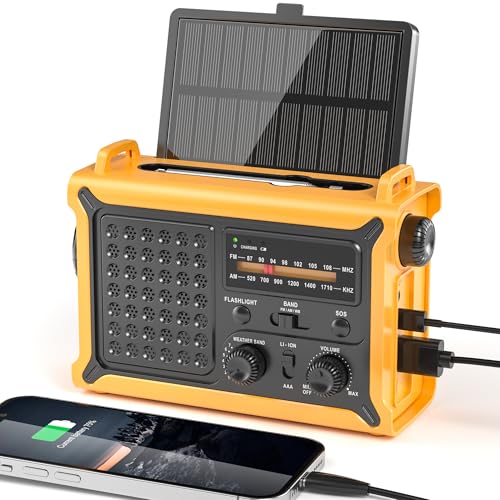
Best for households needing continuous weather alerts and a backup power source. This model mirrors the reception performance of the previous Mesqool device with a larger solar panel for quicker charging and a dependable backup battery. It’s well-suited for home dashboards, apartments, and family preparedness kits that require steady weather updates and extended charging capability during outages.
- Best for: Home safety kits, apartments, and family preparedness.
- Why selected: Strong radio performance plus reliable solar charging and backup power.
- Limitation: Heavier than ultra-compact radios, which may affect portability.
RunningSnail Hand Crank Radio with LED Flashlight, 2000mAh

Best for compact carry and simple emergencies. This model provides AM/FM reception plus a built-in 2000mAh rechargeable battery and a durable LED flashlight. It’s a practical, lightweight option for personal kits, backpacks, or a car emergency stash. The retractable antenna helps reception in remote areas, and the charger is compatible with USB devices for emergency charging.
- Best for: Personal bug-out kits, travel packs, and quick-access power.
- Why selected: Lightweight, easy to use, and includes a practical flashlight and USB charging.
- Limitation: Smaller battery means fewer full device charges between power sources.
Leaton Hand Crank Emergency Radio, NOAA Weather AM/FM, 10000mAh

Best for long outages and outdoor use. The Leaton model packs a massive 10000mAh battery and offers IPX6 splash resistance, making it suitable for camping and adverse weather. It also includes a built-in compass for navigation and a 3-mode flashlight for lighting and SOS signaling. This radio is a solid choice for outdoor enthusiasts and storm-prepared households who need extended power reserves and rugged design.
- Best for: Outdoor enthusiasts, hurricane preparedness, and home outages.
- Why selected: Large battery, rugged build, and extra navigation aid.
- Limitation: Splash protection is not for full immersion or heavy rain scenarios.
PRUNUS NOAA Weather Radio AM FM, AA Battery Radio for Power Outages PRUNUS J161

Best for budget-conscious buyers who want essential NOAA coverage on-the-go. This compact radio runs on two AA batteries and covers 7 NOAA weather bands plus FM/AM. It’s easy to stash in a glove box or emergency kit, and its light footprint makes it ideal for beginners or households building a basic alert system.
- Best for: Starter emergency kits, travel, budget-focused buyers.
- Why selected: Simple, portable, and battery-powered without reliance on solar charging.
- Limitation: Not automatic NOAA alert feature; relies on manual use for alert access.
Portable AM/FM Transistor Radio with Loud Speaker BAIJIALI

Best for home and outdoor use with strong speaker output. This radio covers AM/FM and shortwave bands, thanks to a DSP anti-jamming chip and a telescoping antenna for robust reception. It’s user-friendly with a large tuner and volume control, making it suitable for seniors or anyone who values straightforward operation during emergencies.
- Best for: Home use, seniors, and outdoor trips needing simple operation.
- Why selected: Broad band access and clear speaker output with user-friendly controls.
- Limitation: May not include solar charging or high-capacity battery as core features.
Raynic Emergency Radio, 5000mAh/18500mWh

Best for versatile charging and multi-band reception. The Raynic model features 6-way charging options, including a built-in backup battery, hand crank, solar panel, USB, AC, and AAA batteries. It supports AM/FM/SW/NOAA alerts and includes a flashlight and SOS siren, making it a strong choice for emergency kits that require flexible power solutions and broad broadcast access.
- Best for: Comprehensive emergency power plans and multi-band reception.
- Why selected: Flexible charging, NOAA alerts, and additional safety features.
- Limitation: Higher complexity may be less intuitive for some users.
Buying Guide: Key Purchase Considerations
- Power options: If outages are frequent, prioritize solar charging plus a hand crank and a backup battery. For cars or small kits, a model with USB charging and AA/AAA support can be practical.
- Reception and bands: Look for AM/FM plus NOAA weather bands and, if possible, SW or WB. A larger, well-designed antenna improves signal during storms or in remote areas.
- Alert features: Automatic NOAA alert scanning can provide timely warnings without manual checks. If not available, ensure easy access to local weather information.
- Durability and portability: Consider IP ratings for outdoor use, weight, and form factor. A compass, flashlight, and SOS features add value for outdoor readiness.
- Battery life and charging speed: Higher mAh ratings support longer operation. Solar panels with larger surface areas charge faster; hand cranks should offer smooth operation with minimal effort.
- Ease of use: A simple interface, clearly labeled buttons, and an intuitive tuner are important during emergencies when quick action matters.
FAQ
- What makes an emergency radio essential?
It provides access to weather alerts, news, and critical updates when power and internet are unavailable. - Should I choose solar or battery-powered radios?
Solar reduces the need for replacement batteries, but having AA/AAA backups ensures operation in low light or long outages. - Is NOAA alert automatic on all models?
Not all models offer automatic alert monitoring; verify this feature before buying if it’s a priority. - What is the recommended battery capacity?
Higher mAh numbers mean more stored power; pair with multiple charging options for versatility. - Are multi-band radios better for emergencies?
Yes, broad band reception helps with more stations and updates, especially in areas with limited coverage. - Can these radios charge phones?
Some models include USB charging as a feature; check the output specs to confirm compatibility with your devices.